
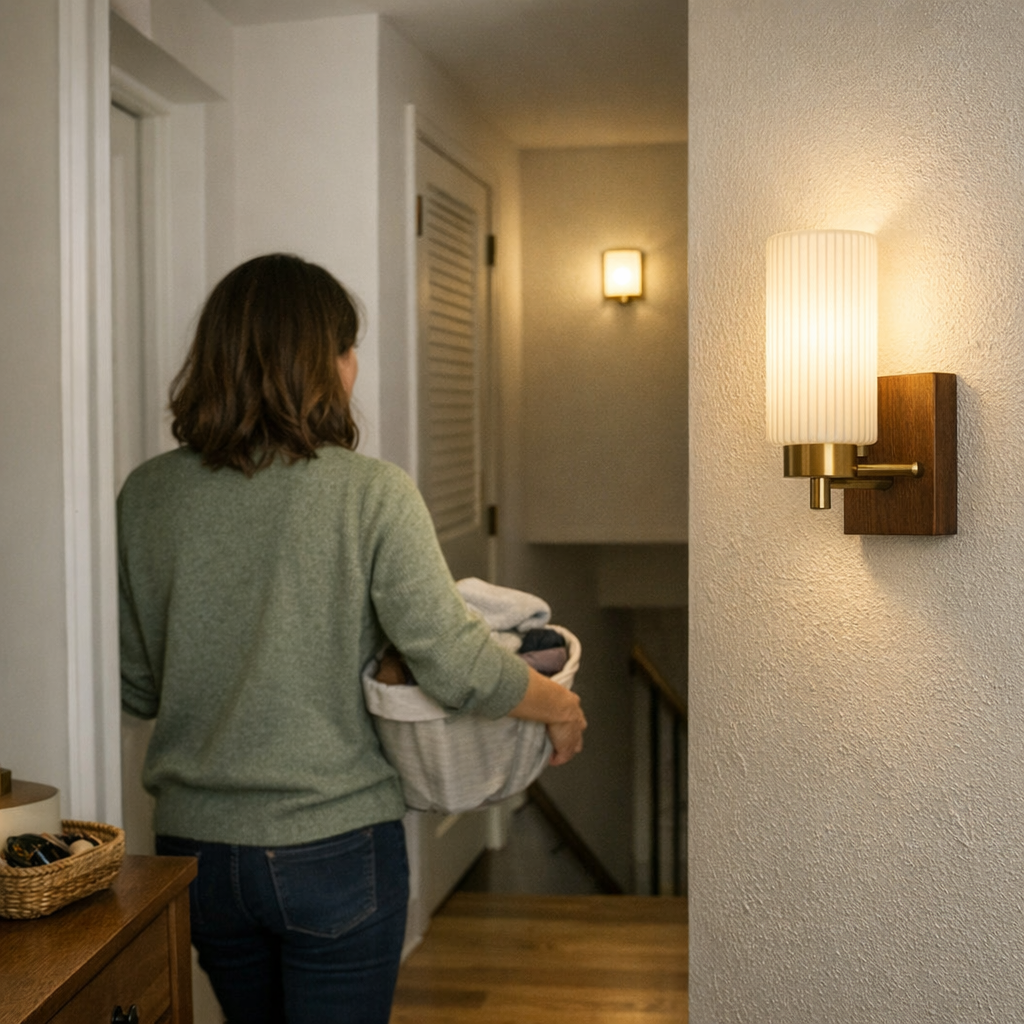
The Single Fixture Trap: Why “Bright Enough” Fails on Day Two
Install one ceiling or wall light and the job looks finished—until real life exposes the shadow zones. The most common complaint isn’t that a room is dark, but that parts of it become unusable just when you need them: staircase landings where the next step disappears, hallway corners where keys drop out of sight, a laundry counter that’s perfectly visible at noon but falls into obscurity every morning or night. The illusion of a “bright enough” space shatters quickly in places meant for movement and tasks. One fixture might light the center, but it leaves edges, thresholds, and critical surfaces in partial shadow—the exact spots you step, reach, or search in every single day.
Where the Light Fails: Centered Fixtures vs. Real Paths
Lighting trouble rarely comes from weak bulbs or dull fixtures. The problem is misdirected spread and placement. A flush mount in the center of a square room might look balanced on paper, but take that setup into a narrow hallway, a stair turn, or a galley work zone, and dark patches start building up. These aren’t just cosmetic gaps. They dictate how confidently you move, whether you stop at doorways to scan the floor, or find yourself squinting into a closet that, hours before, seemed fully illuminated.
Consider the last time you walked a hallway after dark. Did you trust your footing from wall to wall, or did you slow down near the stair turn or search for a light switch before stepping into an uncertain patch? Ceiling fixtures that seem bright overhead often cast long shadows down the wall, putting the most-used thresholds and corners out of reach. The real test comes not when you admire the room from the doorway, but when your routine puts every weak spot under pressure—pausing at a stair turn, missing a dropped shoe near the closet, or tilting an envelope under the only clear spot of light.
Hallways and Stair Turns: Where the Setup Breaks Down
Picture a traditional hallway: one flush-mount ceiling light, looking sleek and “done.” Stand dead center—visibility’s fine. Take a few steps toward the end, head for a closet, or turn a stair corner, and suddenly the floor blurs, profiles dissolve, and there’s a distinct urge to slow down. Kids hesitate at dim landings, adults misjudge a step with a basket in hand, and every turn becomes a pause point—not because the room is dark, but because the light’s spread doesn’t match the way people really move. Awkward hesitations cling to these friction spots, no matter how many lumens you throw at the fix.
Work Surfaces: The Underlit Face and Counter Problem
The single-fixture mindset is especially brutal for tasks: bathroom mirrors with shadowed cheeks, laundry counters where one half gleams and the rest fades after sundown, entry tables that pull you in to squint at paperwork or screens. You start adapting—leaning closer at the mirror, sliding a basket into that one usable patch, or shifting position to dodge the flash of ceiling-glare on tile or steel. Cranking up the wattage only makes the brightest spot harsher, does nothing for lost edges, and amplifies uncomfortable glare on glossy finishes. The divide between what looks bright and what actually works grows wider each day you use the space as intended.
The Repeat Offender: Everyday Friction, Not Just Dimness
Poor lighting isn’t an obvious red flag on installation day. What shows up is the accumulating irritation—each morning you slow down to check the closet floor, each night you fumble at the bottom stair or nudge laundry baskets blindly through a corridor missing just one sliver of light. Not pitch-black, but an undercurrent of frustration: pausing, double-checking, missing handles, or stepping more tentatively than necessary. Over time, these small breakdowns harden into routine. What once seemed “done” now interrupts every task that counts.
Why More Bulbs Don’t Solve It: Placement and Layering Win
Trying to fix spread gaps with bigger, brighter fixtures almost never works. Stronger bulbs simply spotlight the same central zone, while stubborn shadows hug the edges. The shift comes from layout: add a low-profile wall sconce near a stair bend, or a hardwired light near a closet, and you erase the most persistent dark lines—the exact places feet search and hands fumble. Layering doesn’t mean a flood of extra light. It means filling the empty strips just beyond a main fixture’s reach, smoothing the experience so movement is continuous, not tentative, and surfaces work evenly for every routine. The difference is felt immediately the next time a child rounds a stair corner, or someone crosses a once-dim threshold without missing a step.
The Power of Two: Targeted Correction Beats Power Alone
Long, L-shaped corridors and stair landings are repeat offenders for dark pools. One centered ceiling mount guarantees faded corners and shadow-soaked entryways on repeat. A second source—wall sconce, directional wall light, or soft panel—breaks the monopoly of overhead lighting, pushes gentle illumination horizontally, and targets the trouble spots. This isn’t about overall brightness, but about giving visibility where your feet, hands, and eyes actually go. Coverage becomes a question of path, not just square footage. Every added layer directly attacks the shadow lines that overhead fixtures habitually miss.
Lighting Built for the Real Routine
The best lighting isn’t measured by initial impressions; it’s measured by how little you have to adjust yourself in the third week. If you catch yourself shifting your walk at the hall’s end, angling for better mirror visibility, or bracing at a stair turn, the setup is subtly failing you every day. Recurrent pressure points include:
- Stairway bends where the bottom step isn’t visible until after you’ve hovered a foot
- Hallways with offset thresholds—crossing means stepping from glare to gloom without warning
- Bathroom sinks and vanity mirrors split by uneven lighting so the face is half in shadow, half in glare
- Utility counters lost at the edges, even though the fixture passes the “brightness test” just overhead
None of these problems are solved by style. They’re structural signals you need even, layered light matched to the real movements your routine demands.
Quick Fix: Field-Tested Ways to Reveal Spread Gaps
- Trace your daily route: Stand at every door, corner, or stair you cross each day. Is the floor as visible at the edge as it is at center?
- Layer on a mission: Add a wall sconce or directional wall light at task points or hall turns. Don’t just opt for a brighter ceiling light—fill in the shadow pools where you actually pause, pivot, or reach.
- Test after dark or at dawn: Walk the area at low-light hours. Pay attention to steps, handle visibility, and whether the edge of a counter or basket shows clearly, not simply whether the space “looks” illuminated from a glance.
The Real Benefit: Comfort That Survives Repetition
What fails with “just one fixture” is most obvious on a rushed morning, when awkward pauses, blind corners, or lost surface edges slow you down or double your steps. Lighting that adapts to lived-in movement—layered, low-profile, and positioned for human routines—doesn’t just look finished, it functions fluidly day after day. The mark of a truly usable setup is when you stop noticing lighting at all—because every spot you use is finally, quietly, visible.
For lighting that works beyond the first week, match your layout to movement, not just symmetry. Even, shadow-free light transforms a space from “bright enough, sort of” into a room that actually supports the way you live and work—no extra thought or clumsy workaround required.