
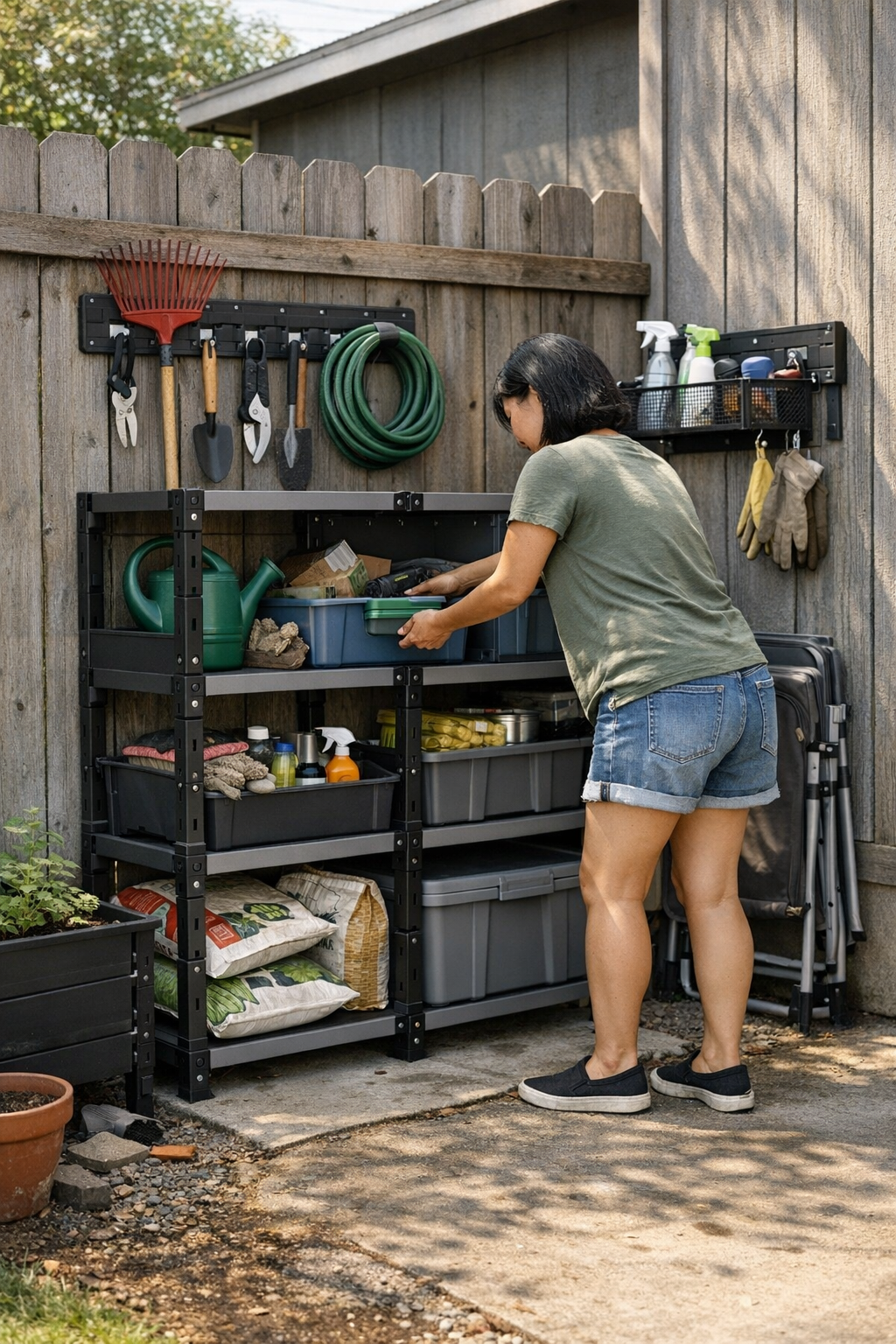
Real outdoor setups start to break down as soon as more than one person tries to use them—especially in tight corners, garage edges, or those slim backyard strips that already feel too crowded. You think you’ve got it organized, then Saturday hits: sports gear, garden tools, folding chairs, all coming and going in random waves. Suddenly, putting one rake away means dragging out half a bin, or worse, stepping sideways because the aisle you cleared last week is jammed with new overflow. Setup friction isn’t just possible—it’s guaranteed.
Where Shared Bins Fall Apart
Take a simple backyard chest or open bin. It’s easy on day one: clear, accessible, a blank slate for everyone’s gear. Then real routines kick in. Someone comes home late and tosses in a bike helmet. Someone else jams a shovel in at an angle, blocking the crate underneath. By midweek, folding chairs teeter right where the walkway narrows, and every return becomes a reshuffle. The “just stick it anywhere” habit takes over instantly.
Shared bins and open shelves do one thing well—they collect. But they don’t guide. Here’s how the cracks start to spread:
- Drop-off is fast, pickup is slow: It’s easy to throw things in, but every retrieval means digging through a layer cake of stuff.
- Walkways shrink: Gear bleeds past the bin, edging into walking space, until your only path is a zigzag around obstacles you didn’t plan for.
- Responsibility vanishes: No one knows who left what, or who should clear the mess—so no one does. Pileup is the default.
What looks like a minor search—just a few seconds to move a soccer ball or a watering can—compounds into routine gridlock. Cleaning up feels thankless, so resets get skipped until the next big block forces an hour-long overhaul.
Overflow Isn’t Just Ugly—It Changes How You Move
The difference between “organized” and “works when busy” hits hardest when the space fills up. That garage-side zone where bikes land after school, or the utility strip behind the house: after a rush of use, the setup reveals exactly where it fails.
- Paths disappear beneath stray bags and gear, forcing you to step over piles or tilt past a rake just to get out the back gate.
- Returning a single broom means first extracting a stack of balls or relocating a heap of chairs—every “quick fix” slows the whole routine.
- Small tools disappear to the bottom, buried beneath “temporary” dumps that linger for weeks.
This isn’t just about neatness. Clogged return paths quietly kill motivation. If it takes effort to stash one thing, odds are you’ll just set it down somewhere visible, repeating the cycle. Over a few weeks, clutter escapes to every corner, until the whole setup feels like a trap.
Why Zone Clarity Changes Everything
The biggest difference isn’t shelf size—it’s assignment. Systems with no clear zones teach everyone to freestyle. Soon, balls migrate to tool piles, and overflow ends up wedged in the deadest corner. What starts as shared space drifts into a mishmash you “work around” instead of use. Only when every main function gets its own lane does the setup start to breathe again.
What the Shift Looks Like
One side-yard tested the default approach last spring: one bulk chest, one open crate, all tight against the fence. For a few weeks, the system held. Then summer routines landed, guests brought their gear, kids dumped toys in waves. Pretty soon, every reset meant untangling a folding table just to get to a spade, or digging for balls through a wedge of chair legs. By July, it was faster to carry yard tools through the house than risk the outdoor pileup.
Things changed only after splitting zones:
- Wall hooks went up for small tools—high, visible, and impossible to bury under other gear.
- Sports balls landed in a single open bin, not mixed with anything else.
- A taped square on the floor now signals exactly where to stack folding chairs—never in the path.
- Big items get their own corner or vertical rack, so walkways stay open and returns fast.
The setup isn’t perfect, but the difference in day-to-day hassle is huge. Overflow doesn’t spill everywhere; it finds the nearest end of its own zone, never blocking the whole route.
Assigned Zones = Faster, Less Annoying Resets
- Parking a shovel takes one motion: grab the hook, hang, done.
- Returning rackets or balls is obvious: their bin is the only logical place, no matter who’s cleaning up.
- Bulkier items have a boundary: chairs fit one place and don’t drift into walkways, so movement never chokes off completely.
The pressure point isn’t perfect alignment—it’s survival. As long as things land in the right zone, the system flows. The bar for “good enough” drops. Echoes of real use—hasty returns, mixed habits, one-off dumps—don’t trigger catastrophe resets. The setup stays functional even when life gets messy.
When Trouble Spots Don’t Become Sinkholes
Sure, odd days still mean finding a missing ball under the hose or bumping a forgotten chair. But now, those moments are speed bumps, not weekend projects. Overflow stops short of infecting every area. The more defined the zones, the more “acceptable mess” stays contained and resets don’t spiral.
Is Your System Actually Working?
- If you layer-shift (move three things to grab one), your zones are leaking.
- If one wall or bin always overflows, your categories are muddled, not just your capacity.
- If corners quietly become junk magnets, your footprint isn’t guiding traffic—it’s inviting clutter.
- If you avoid the area because reset is a chore, your flow is broken—and daily use is paying the price.
Notice who’s constantly “fixing” things and why. A solid setup makes even a sloppy return frictionless. Without that, the mess comes back faster than anyone can keep up.
Practical Tweaks That Stop the Creep
- Dedicate wall space for rapid-grab tools—even a couple hooks make a difference above the pileup zone.
- Give sports and kid gear their own open bin—not to tidy, but to make the next drop and grab smoother under pressure.
- Mark a landing strip for bulk items—use tape, a mat, whatever breaks the habit of dumping chairs in the path.
- Break up known clutter magnets—if a corner always eats abandoned stuff, rearrange its boundaries or split storage load with a second bin.
Most of all, keep routes navigable. Looks don’t count—a tidy layout means nothing if you’re dodging bins or squeezing past gear every normal day. If your setup lets you reset in seconds after a rush, it’s working. If it just looks good on Sunday but collapses by Tuesday, it’s time to rethink how the space is mapped.
The Real Difference: A Setup That Handles You, Not the Other Way Around
No storage system is immune to real life. When routines collide and mess creeps in, assigned zones reveal their value: resets shrink from an hour to a few unthinking motions. You might still see stacks and scatter, but they don’t block movement or demand constant vigilance. The space helps you reset on autopilot—and actually invites repeat use, not avoidance.
Showroom perfection won’t last. But a setup that organizes itself in the middle of real use is far more valuable than one that just sits neat and empty. Test yours. Pay attention to the problems that keep coming back. The solutions aren’t complicated, but the difference between friction and flow is impossible to miss.
Find outdoor storage setups that fit the way your routines actually work at TidyYard.