
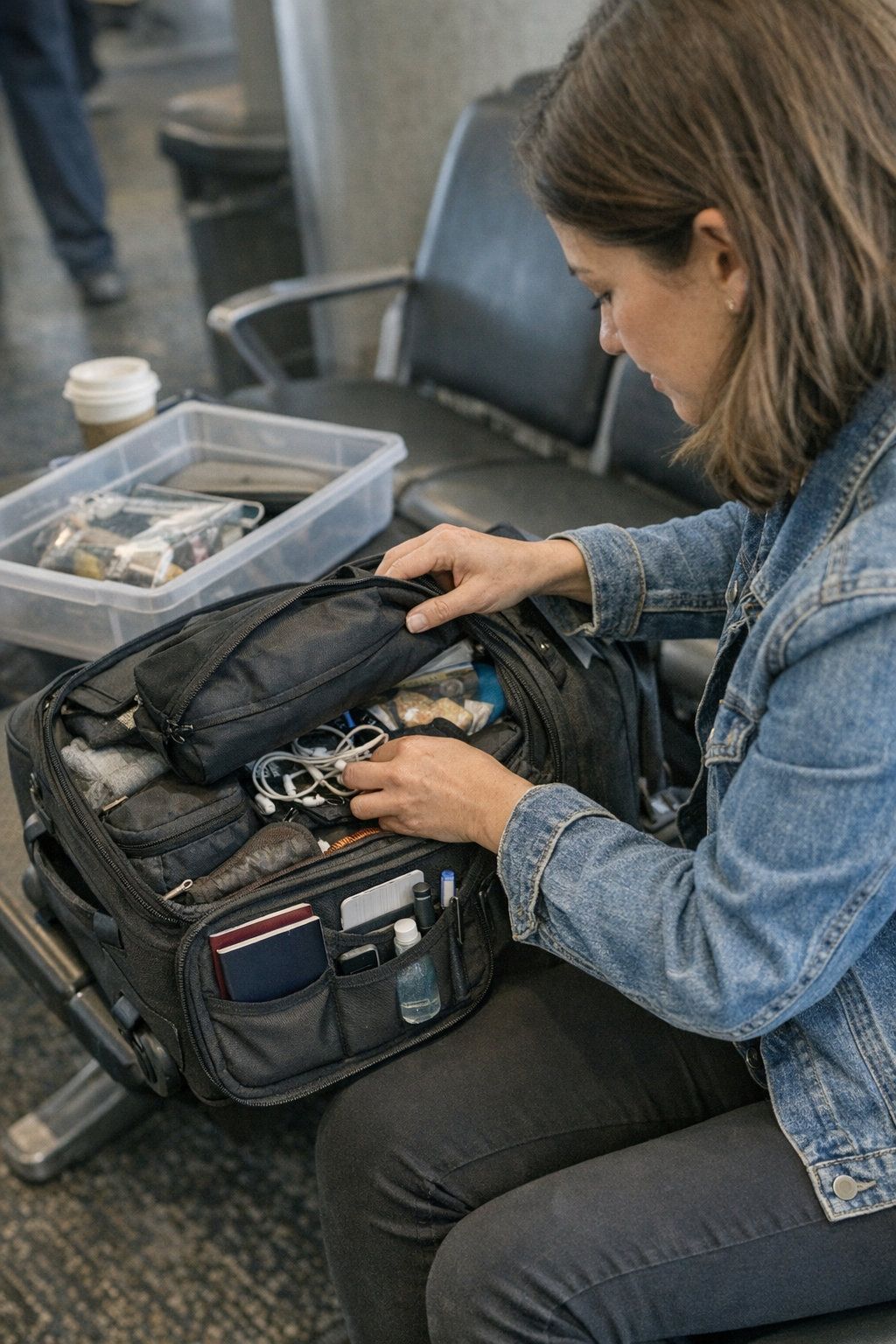
The moment you face your first airport checkpoint, that “perfectly” packed carry-on gets exposed. On your bedroom floor, everything has a slot and zippers shut clean. But real travel isn’t staged—if pulling your passport, headphones, or pen takes unzipping multiple pouches or dismantling a neat stack, your organized setup suddenly feels clumsy. That first retrieval stalls your progress, highlights buried items, and puts your supposed system on display when the line behind you starts inching closer. What looked streamlined at home starts breaking down under repeated airport pressure. The difference isn’t a minor inconvenience—it’s the hidden cost in every slowed-down reach, tray transfer, or seat entry along the way. In the world of CarryOnSupply, that’s the gap between looking prepared and actually staying in control through each leg of the trip.
When Organization Looks Right but Fails in Motion
You feel it immediately: digging past a decoy layer to find your boarding pass, or wrestling loose headphones tangled beneath cords you didn’t mean to shuffle. At home, that zipped-pouch setup pretends to be ready. Once the travel routine starts, though, every repeat grab becomes a reminder—another zipper, another search, another item shifted out of alignment. Each extra step multiplies friction, erasing the sense of readiness you thought you’d built.
Visual order creates the illusion of preparation. Airport reality cares only about quick, clean access. If you hesitate at security or slow the boarding line because an “organized” compartment blocks a document, you’re not supported by your setup—you’re sidetracked by it. The difference between order and flow widens every time you need to repeat the same dig or repack sequence mid-journey.
The Real Cost of Pouch Overlap
Almost every travel slowdown hides in plain sight: pouch overlap, when grab-it-now items hide beneath rarely-touched ones. Your passport slips behind a snack pouch, your device charger blocks sanitizer. One supposed improvement—segmentation—turns routine retrieval into partial unpacking, and the problem multiplies with every use.
At home, this doesn’t show. On the move, especially when you’re squeezed in a security queue or snagged in the boarding shuffle, every buried item means exposing more contents, handling extra pouches, and repacking on the spot. Security trays aren’t a test until you try to grab one thing and end up juggling three. That’s when you realize what seemed efficient is just fragile.
Well-segmented bags often devolve into a repack dance the moment you need something fast. The “system” that felt clever is suddenly slow—and in full view of an impatient crowd or tight aisle.
Interruptions That Break the Flow
Every traveler recognizes these growing pains:
- Security line stall: Your ID is buried, so now you’re shifting stacks just to reach the tray, with pouches slipping loose and the agent waiting.
- Boarding slow-down: Boarding group called, but your pass hides under charging cords, forcing a pause the line notices.
- Seat-entry gridlock: You reach for headphones or hand wipes, but three pouches come out in a lump—and now you’re blocking the aisle for everyone else.
- Overhead-bin panic: A quick grab for gum or sanitizer means unthreading your pouch routine, with loose items to re-sort in a cramped space.
These moments seem minor in isolation, but compounded, they dissolve whatever calm travel rhythm you pictured. A setup that works motionless, on a flat surface, quickly loses its shape and logic in live airport movement.
Why Bags That “Have a Place for Everything” Still Slow You Down
Manufacturer tags claim “a place for everything,” but reality is rougher: transit vibration, bag shifting, and human error disrupt every preset slot. Compartments that photograph tidy turn into unknowns after ten paces through a busy terminal. Cables drift under pouches, documents migrate behind snacks, and “divisions” turn porous after a few bumps. More separation can mean more blind searching, not less interruption.
The misstep isn’t usually about lacking dividers or cubes—it’s about whether each compartment can handle quick grabs under time pressure. Too many sections, or the wrong sequence of slots, means multitasking every reach. If your “organized” bag needs multiple actions for a single document or cable, it’s designed for static order, not active travel.
Direct Access Beats Perfect Packing, Every Time
Airports favor the setups that go direct. The best carry-on system gives all frequent-use items single-step access—no extra zippers or nested pouches in your path. Get real about use patterns:
- Keep passport, boarding pass, and sanitizer each in their own easily-reached pocket—preferably outside or near the main zipper, not buried inside a tech pouch.
- Stash headphones, snacks, or pens in spaces that don’t require unstacking gear or shifting organizers to reach them.
- Background essentials—spare chargers, adapters, backups—live deeper, so daily items never need to compete for access.
This kind of setup often sacrifices a photo-friendly symmetry or an illusion of minimalism. But it keeps travel flow moving, especially when routine actions—tray handoffs, document checks, headphone grabs—become a one-motion habit instead of a pause-and-reset exercise.
Real Fixes That You See in Use
Too many close calls create new habits. Shift all repeat-use items—passport, phone, pen, sanitizer—into their own outer zone and you’ll instantly cut retrieval steps in every scenario:
- Security trays: You reach once, get exactly what you need, and move on—no stack of pouches to restack, no loose item scramble.
- Gate checks: Boarding documents come out cleanly; pocket clutter or pouch confusion doesn’t slow you down.
- Seat entry: Grabbing in-flight gear is a single move, not a disruption that reorders your entire packing structure in the aisle.
- In-transit tweaks: Gum, wipes, or a pen can be reached mid-walk or mid-wait, with nothing dislodged or in need of reordering.
The feeling of improvement isn’t visual—it’s kinetic. Fewer awkward pauses, no accidental pile-up, and an actual reduction of steps at every handoff. The bag flows with your routine, instead of tripping you up every time you move.
Minimize Overlap, Maximize Flow
The practical rule is simple: Set up your bag for action, not for a photo. Give repeat-grab items a single, non-overlapping home. Never let your core documents, quick snacks, or tech essentials share space with bulk pouches or deep storage. Where fast-access crosses with background items, interruption always creeps in—especially under time pressure.
What makes a carry-on workable is rarely the brand or the extra divider—it’s how well you can grab what counts, without dragging other pieces along or unmaking your supposed system. That’s the real advantage of a functional packing structure: you spend less time resetting and more time just moving through the airport, flight, and arrival, with fewer bottlenecks and less fumble.
Your Bag Doesn’t Need to Win at Order—It Needs to Keep You Moving
No setup survives unchanged forever. Airports shift, airline rules update, and your needs keep evolving. But the bags that perform—those you trust on repeat trips—are the ones that let you grab what matters, reset with minimum hassle, and avoid multi-step repacking for every tiny retrieval.
Choosing strong structure over visual perfection means you’ll spend less time stuck, less time embarrassed by your own “system,” and more time simply moving forward—with no one in line behind you knowing what could have gone wrong. That’s the payoff for getting real about how you pack, and why CarryOnSupply’s tools make sense beyond the tidy photo stage.