
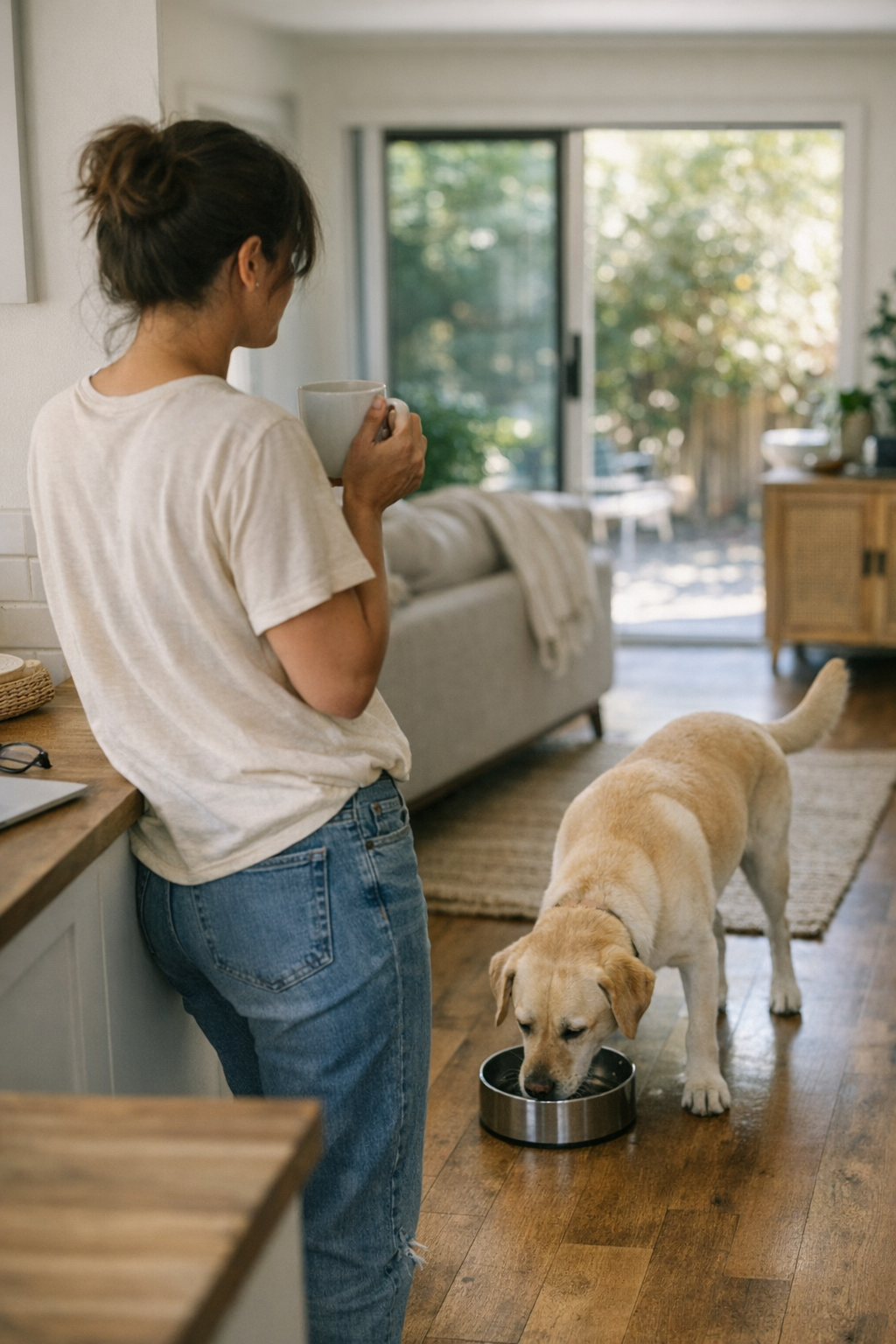
The signal is small, but persistent: your dog’s paws cross the kitchen tile, cut through the hall, then repeat—again and again. No whining, no mess—just an unmistakable pattern that interrupts your routine and theirs. For many owners, this kind of midday pacing has a simple root: a single weak point in the setup that keeps blocking a normal dog-life flow. If you keep seeing your dog trace the same loop at the same time, it’s not random energy. It’s a routine failing to match up with real, everyday needs—a leash wedged under mail, a food bowl sidestepped by a recycling bin, or a towel out of reach at the exact wrong moment. Miss the fix, and both you and your dog pay for it in lost calm, repeated interruptions, and a constant reset that drags down the rest of the day.
The Hidden Message in Midday Pacing
Pacing at predictable hours isn’t mysterious or dramatic. Nearly always, it marks something simple but important missing in your dog’s routine flow. Midday loops are not noise. They’re a direct signal that a friction point has crept into the handoff between dog and home.
Your dog doesn’t resort to outbursts—they hesitate by doors, circle thresholds, and hover without settling. Meanwhile, you’re halfway through an email or moving laundry, catching the moving shape, lap after lap. Each pass slips in under the radar but quietly breaks focus, slicing up what should be a routine stretch of the day. The surface looks organized, but the underlying pattern gets more jagged with each ignored circuit.
Routine Gaps Hide in Plain Sight
Daily home rhythms run on habit—walks, water, feeding, quick resets, then back to work. But midday exposes any setup gap with zero warning. It’s the moment you’re busiest: counters crowded, video calls live, laundry half-sorted. Your dog drifts to the margin until pacing is the only thing you notice.
This isn’t an accident. Most midday pacing starts after a tiny routine slip: the last walk was late, the water bowl is edged behind a chair, or a leash is buried under outerwear. “Tidy” setups can hide these weak points—quick to look neat, slow to actually reach when needed. Bowls in the corner turn out blocked by stools, towels are across the room when paws are muddy. Each one zaps twenty seconds per day, but stacked together they unravel your dog’s flow.
The Familiar Friction of Midday Loops
Common scenarios:
- Leash misplaced or buried: You lunge for a midday let-out, only to dig past bags and coats. Your dog circles, feeling the delay.
- Cleanup supplies not ready: A towel’s in the laundry instead of by the door. Paw prints multiply while you scramble for wipes.
- Food and water access blocked: Bowls slip behind stools, beds, or bins; your dog paces and hesitates, never quite settling back down.
These hiccups aren’t disasters, but routine friction compounds quickly—turning small misses into a louder midday drag. If your dog’s pacing comes back again after toys, treats, or a hurried let-out, it’s the setup waving for attention.
When “Organized” Still Doesn’t Work
It’s tempting to believe that an organized space is a solved routine. But tidy surfaces aren’t proof of a frictionless setup. Problems tend to hide where you only notice them under pressure.
Take the feeding station that looks perfect in the breakfast nook: mat lined up, bowls precise, nothing to trip over. But every midday rush, your dog starts that same restless path. Why? At peak activity, reaching the bowls means weaving around chairs, stepping over resting legs, or dodging laundry piles. Order on paper collapses if access is slow, blocked, or awkward in motion.
This mismatch repeats all over: crates you can’t close without moving a vacuum, wipes stored deep behind a laundry basket, toy bins out of the dog’s line of travel. What looks set is exposed as unworkable with every repeated interrupt.
Repeated Friction—Not Just a One-Off
Most owners end up reshuffling: pushing bowls up front, moving bins, unblocking the walkway, tossing quick chews to stall the routine. But if the same snag keeps coming back, even right after tidying, it’s not occasional mess—it’s a warning from your setup. The routine demands keep nudging against a structure that drags you, and your dog, into a familiar loop of frustration.
What Happens When Pacing Goes Unchecked
Let pacing linger and it becomes built-in: meetings fracture, hallways clog, and true rest becomes a memory instead of a daily feature. Your dog won’t explode or destroy—they’ll just hover, neither fully in one space nor another, never settling. The dog’s calm fragments as the day stretches and small roadblocks never really move out of the way. Ignore it, and you’ll find afternoons become a series of small, confusing jolts that leave both of you more restless and less able to reset.
Signals to Watch For
- Daily pacing at the same hour and spot
- Dog resumes pacing soon after a let-out or quick fix
- Hovering near water or food but not using it
- Blocking thresholds or hallways with nowhere to rest
- Rest is interrupted and replaced by wandering
These aren’t complaints—they’re structural gaps showing up as visible daylight friction between your routine and the home’s real life flow.
How Small Shifts Change the Routine
Most fixes don’t need an overhaul; a single adjustment in setup can reset the whole pattern.
Shifting a major water bowl a few feet away from a traffic pinch-point, for example, can turn frantic laps into a single direct trip, then a return to rest. In real use, the moment access is clear, the dog’s pattern changes—not because the surface got tidier, but because routine resistance disappeared. Sometimes moving towels to a wall hook by the door, rotating the crate so the door isn’t blocked, or setting a toy basket within reach is all it takes to reroute the afternoon loop.
The result is more than convenience. It’s the difference between frantically plugging holes and having a routine that stops demanding constant correction. The flow becomes readable: you catch when pacing really signals thirst, pre-walk energy, or boredom—and you can stop it before the friction builds.
Real-World Observations from Daily Use
- Access wins over order: even well-placed gear is useless if it’s tough to grab under time pressure.
- Visibility matters: if the bowl or bin can’t be seen from the path, the dog keeps circling.
- High-functioning setups sometimes fall apart only during busy transitions, not at rest.
- If you keep moving the same item repeatedly, the underlying structure needs rethinking, not just a fresh tidy.
You don’t need perfection. What you need is lower friction, faster returns to calm, and a space that works as hard as you do at settling the routine.
Making the Pacing Loop Work For You
Don’t battle the pacing—use it to diagnose the weak spot the routine keeps revealing. When the loop starts, ask: what’s missing? Is access blocked, or is a needed item out of practical reach? These are not minor style choices; they’re signals about how your home setup is shaping every afternoon’s flow, for better or worse.
Try a single practical change before the loop becomes baked-in background. Sometimes moving the rest mat, shifting the wipe caddy, or putting a bowl in a high-traffic line makes the friction stop feeling inevitable—and gives both you and your dog a routine that’s easier to repeat, not endure.