
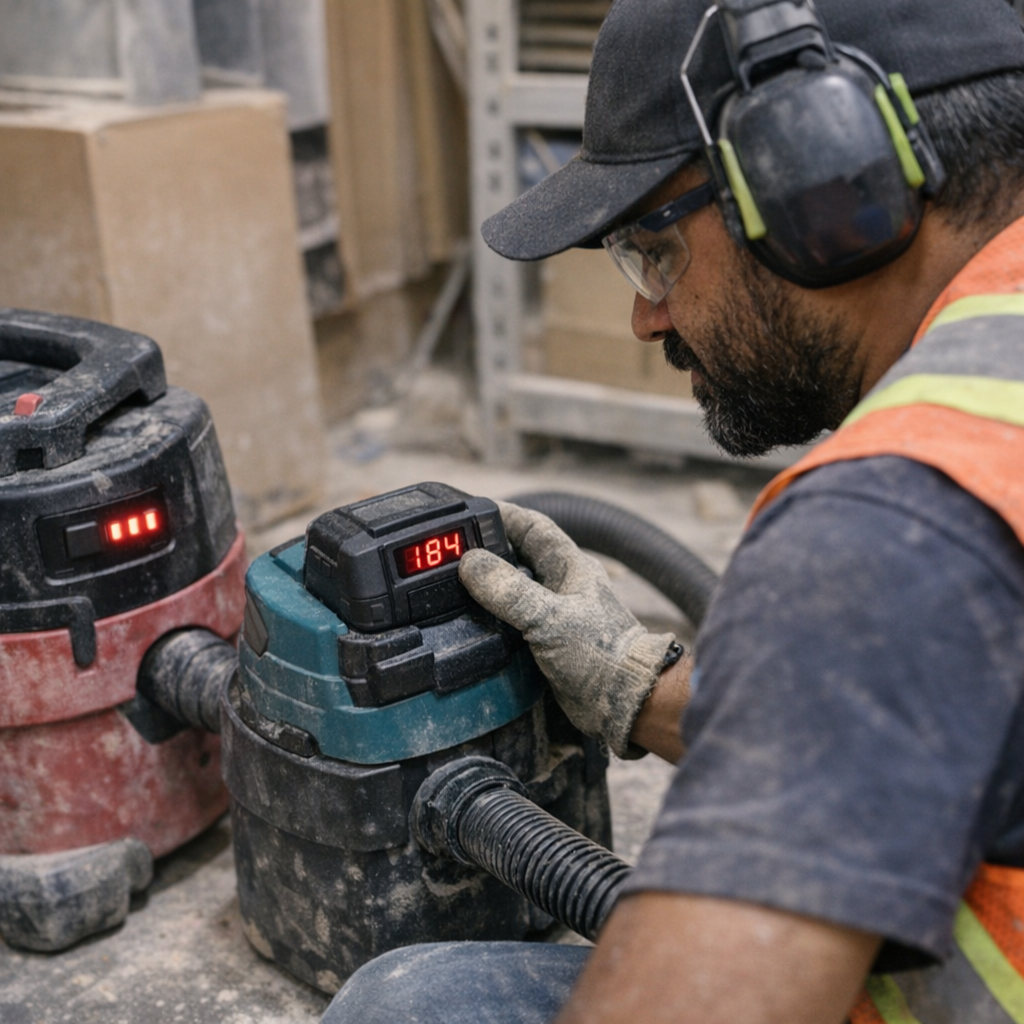
The drop in battery voltage hits before you notice it—but everything after gets harder. The vacuum lags on a long sanding run; dust suddenly hangs around the jobsite. Tools don’t care if it’s just an hour left in the day or there’s a deadline—performance is performance. And if you rely on an air-cleaning power cleaner to keep pace during rough cutting, concrete drilling, or non-stop sanding, you’ve learned fast: what really matters isn’t just the tool’s muscle or badge. It’s how you track—down to the moment—your battery voltage, while the job’s unfolding for real.
Voltage on the Floor: Why Numbers Turn Into Mess
Start the air cleaner and expect strong suction, only to find dust escaping anyway—or the clean hiss replaced by a dull, uneven whine halfway through. Ignore the voltage too long, and what should be a routine sweep turns into a patchy, repeated fight with fine debris. A flashing LED or a vague feeling won’t help you in a corner after cabinet sanding, or after filling a hallway with tile dust. Here, those “good enough” shortcuts mean mess, slowdowns, and more filter swaps when you’re already spent—and the job’s not done.
Let voltage drop just a little too far and you pay with weak airflow, gummed-up filters, and an ugly restart when you should have finished. The worst part? You rarely catch it until it’s too late. Only when daylight angles in or the site light comes up do you spot the real cost: lines of leftover dust in baseboard cracks, or a powder settling across new paint just as you’re packing gear.
The Unseen Slide: What a Voltage Drop Looks Like Mid-Job
Two identical cleaners, two people wrapping up a nasty round of sanding and drilling. Both start out strong. But watch as the hours build: one runs until its “low battery” glows red; the other uses a digital meter showing numbers creeping steadily down. With the LED, you might sense the weak pull just as the tool gives in. With the voltage readout, you spot the drift—airflow fading, motor tone softening—before it gets in your way. The slip is subtle, easy to miss until a haze hangs in the air or cleaning passes start taking longer, each sweep leaving behind a growing trail to re-do later.
Repeat Jobs: Where Stray Dust Stings the Most
If you’ve worked cleanup in a crowded storeroom or after hours at an assembly bench, you know: missed dust doesn’t just vanish, it migrates—on shoes, carts, even settling on finished surfaces you’ll have to touch again. Often, what seems like a clogged filter is really just the tool starved for voltage. Wait too long to check, and yesterday’s work visits you twice—scrambled up with a fresh batch of static-clinging, fine debris.
Late in the Day: The Reality of Chasing Dust with Tired Batteries
The end of a shift, you’re hauling the cleaner back and forth through doorways, under pipe clusters, behind new cabinetry. By the fourth cycle, the vacuum’s tone starts warbling, airflow drops, and you find yourself working harder for less result, feeling suction lifeless against your hand. You keep going, thinking there’s still charge left—until you spot faint, ugly dust trails looping around wire bundles or slipping under shoe molding. Sometimes you only see these after packing up, forced to drag hoses and tools back out for another round.
Out in the open, you might shrug off a little dust—but on finished trim or floors, every missed spot is a time penalty. The built-in gauge? Usually just a lagging signal that you’re already behind.
Precision Upgrade: The Small Change That Fixes the Rhythm
The fix isn’t complicated—a digital voltage meter that reads to the decimal. My own rig shows changes of 0.1V on a 21.6V pack. The practical effect: the instant voltage slides to 18.4V, the swap happens—before the airflow fades, not after. There’s no last-minute stutter, no silent drop in suction that ruins the finish or doubles your dusting. Just a clear cutoff to keep everything consistent and under control.
Over time, this means less stalling out. No guessing if it’s filter or battery. No chasing ghostly dust lines with a broom after hours. It’s less break in your rhythm, less wasted effort, and a cleaner exit with fewer double-backs at the closeout.
Work Smarter: Building Voltage Checks Into Your Workflow
Check voltage every half hour of real run time, or sooner if suction pulls weak or the pitch softens in your ear. Don’t write off a slow pass or new resistance as just a filthy filter. Glance at the digital display and you’ll know: if voltage is low, swap in a fresh pack—simple. Factory LEDs? Rarely bright enough, often unreliable under shoptop glare or with dust slicks covering the lights.
Beyond Suction: The Real Cost of Running Low
Letting voltage dip isn’t just about a little less suction. Motors strain, dragging heat and wear up with every underpowered pass. Filters gum up, dust sneaks past, and maintenance stacks up. Ignore it for weeks and you’ll feel it—in extra tool wear, frequent swapping, and eventually a higher bill for parts and repairs. Small shortcuts ripple out: more wasted motion, more fatigue from going over the same square foot twice, and less time cutting or fastening where you wanted to.
Make It Routine: Voltage as a Hands-On Habit
However you monitor juice—onboard indicator, ear for the tone, or a digital meter clamped to the case—the discipline shapes your day. For sanding runs, concrete work, or any job where airborne dust can sabotage a result, those hard numbers beat hope every time. Pick a conservative swap threshold (18.4V works well for 21.6V batteries), and run with it—you’ll get steadier workflow, fewer filter swaps, and, most of all, less wasted time.
See tools and power equipment tuned for real work at Gumboll.