
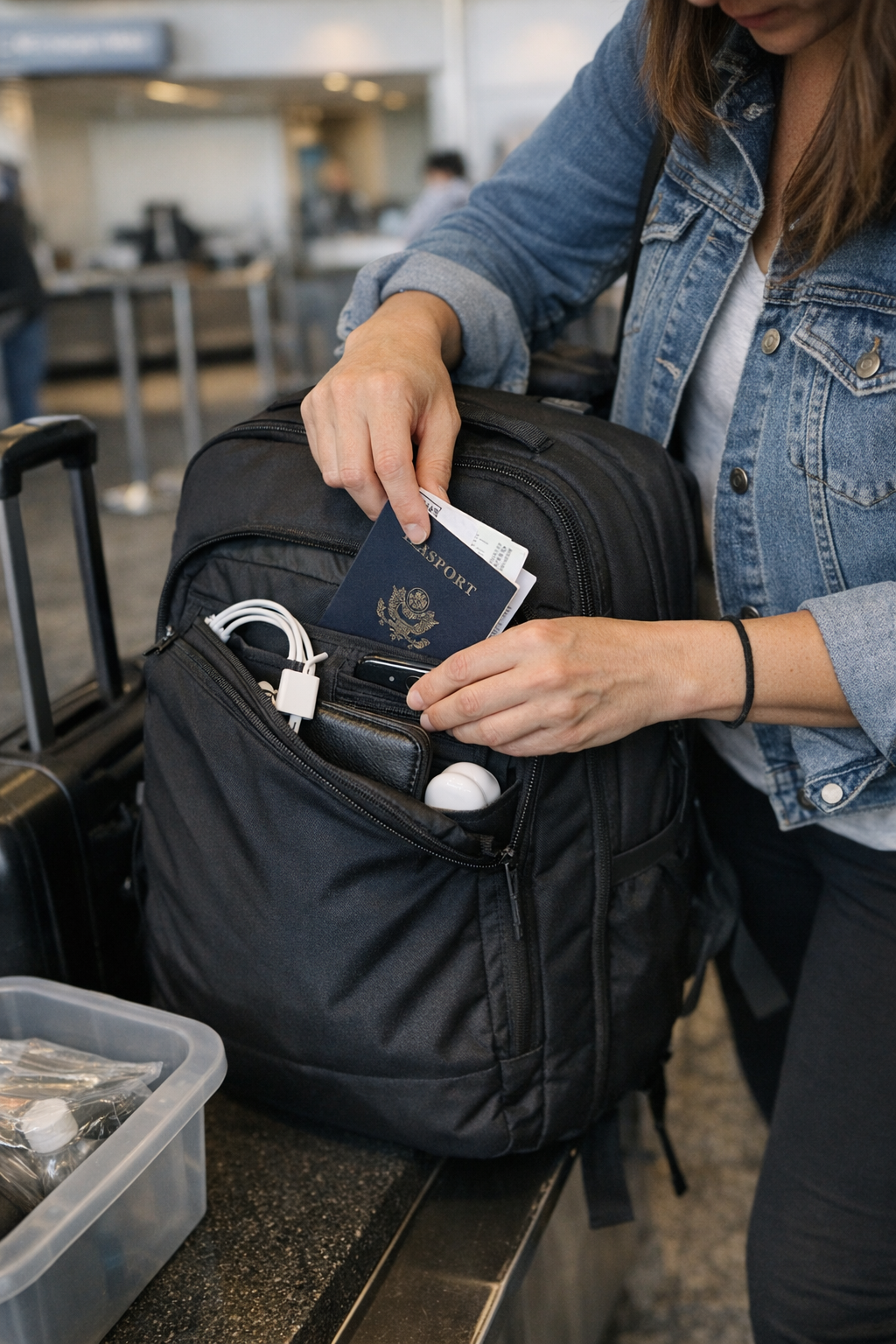
The illusion of a well-packed carry-on usually shatters the third time you’re cut off by a document check or the second time your charger goes missing in a crowded airport. A bag that looks “organized” on your bedroom floor often falls apart during real travel—when friction hits, cosmetic neatness turns useless. The real test is not how your bag looks at home, but how quickly it gives up a passport at a tense security line, or whether a quick tech grab turns into a scramble with organizers and cubes under pressure.
When “Organized” Packing Slows You Down
An “Instagram-ready” carry-on—cubes aligned, pouches color-coded—can fool you into believing you’re ready for anything. Then you hit the first security tray, and the cracks start showing. Suddenly:
- your passport is lodged under two packing cubes and a tangled band of charger cords,
- getting to your headphones requires unzipping the entire main compartment (and restacking half the bag after),
- a charger, visible when you packed, is now wedged under snacks and a toiletry kit, forcing a partial unpack just to keep your phone alive.
With each repetition—security line, boarding call, seat adjustment—these delays pile up. What started as a small annoyance grows into a measured drawback: every round drains a little more momentum, until your “organized” layout feels like a liability you have to manage every step of the trip.
The Cost of Repeated Access in Real Travel
Real travel isn’t an unbroken flow—it’s a repeating pattern of line-jumping, document handovers, squeezing down narrow aisles, reaching for tickets or wipes with one hand while dragging luggage with the other. Every stop-and-grab reveals whether your packing system works under real tension, not just at rest.
If you’re reaching for high-frequency items and your hand keeps heading to the main compartment, you’re setting up a slow-motion mess. Every repeated dig means another round of repacking, misaligned organizers, and items sliding into new corners. At security, visible hesitation draws attention and stress; at the gate, one awkward reach disrupts your pace and everyone else’s. The cost isn’t just in time—it’s visible in the way your setup starts fraying around the edges before you even board.
Why Visual Order Isn’t Enough
Neat columns of pouches or perfectly layered cubes don’t survive flight connections or rapid-fire checks. The real flaw shows up the moment you’re forced to open your bag in motion: if essential items still require shuffling—the “quick grab” becomes a partial repack, every single time. Visual order fools you into thinking you’re set, right up until a checkpoint exposes how buried your essentials are. A functionally packed carry-on exposes its advantage only when your hand finds what you need, first time, with zero reshuffling—or doesn’t.
Function-Based Packing: Setting Up for Movement
Instead of thinking by category—chargers here, toiletries there—structure your carry-on around how, when, and how often you’ll need each thing. Ask which items you’ll need while standing, walking, or answering a document check. Function-based packing means:
- placing passports, boarding passes, tickets, and small tech in dedicated, instantly reachable outer pockets,
- building in single, predictable access points for true quick-grab essentials,
- deliberately separating must-reach gear from everything else that can stay stowed long-term.
No setup is frictionless. Giving outer pockets more responsibility may add visual bulk or cause your perfectly symmetrical layout to sag. But the first time you clear security or respond to a spontaneous gate change without digging… that “imperfection” pays off. Items that matter most stay accessible, while the main compartment is reserved for cargo you won’t need to touch mid-transit.
What This Looks Like in Repeated Use
Put to the test on a two-airport route with an international connection, a function-first setup exposed the difference within minutes. Passport, earbuds, charger, and wallet—all moved to a single unzip-and-reach pocket. Each checkpoint became a one-move task: zip open, hand over, zip closed—no shifting, no accidental dump of cubes, no run-on repacking. The main compartment only opened once, at the hotel hours later. The trade-off—a slightly chunkier outside pocket—became invisible compared to the compounding time and stress saved by the second round of security.
Packing Pitfalls: Where Function-Based Setup Makes a Difference
Packing for visual order falls apart at exactly the worst moments—
- The aisle pause. You halt traffic, balancing your bag, scrambling for a ticket that sits two zippers deep—just as someone needs to squeeze by.
- The tray shuffle. Pulling a charger out from the main compartment triggers a cascade: pouches slide, cubes splay out across a communal security tray, your focus shreds as the line pressures you to hurry.
- Return friction. Once you grab something, it never lands in the exact spot you started with. Two retrievals later, your tightly organized system is a loose stack—and that charger or passport is now buried again, setting you up for the cycle to repeat.
Function-based setups aren’t magic, but they cut the drag immediately. Each “interruption” becomes smaller and less costly. You stop rebuilding your setup on the fly, and minor slowdowns stop turning into major pileups as the trip rolls on.
Is It Worth Re-Structuring Your Carry-On?
If your carry-on feels like a puzzle where every use scrambles the solution, the answer is yes. It’s not about chasing maximum neatness or color-matched bliss. It’s about whether reaching for your passport—on the third, fourth, or fifth try—requires another repack, or just one clean motion. Grouping by type has its visual charm, but the moment you really need speed—a gate change, tight seat row, impatient line—one well-placed outer pocket can save you from dumping your “organized” contents across the aisle.
Every Travel Routine Exposes Your Setup—For Better or Worse
The longer your journey, the more brutally honest your bag becomes. What survived a home test collapses in the noise of airports and real movement. Security delays, lost tickets, endless shuffling after each “just one thing” grab—these recurring frictions invite a tougher question: Does your carry-on work when you need it over and over, not just once?
No packing method is flawless, and no carry-on can escape all repacking. But a function-first setup—designed for repeated, real access in transit—reduces drag, saves time, and lowers in-motion stress across any travel sequence. That, not visual order alone, is what holds up when travel gets real.
See what a function-based carry-on setup feels like at CarryOnSupply.