
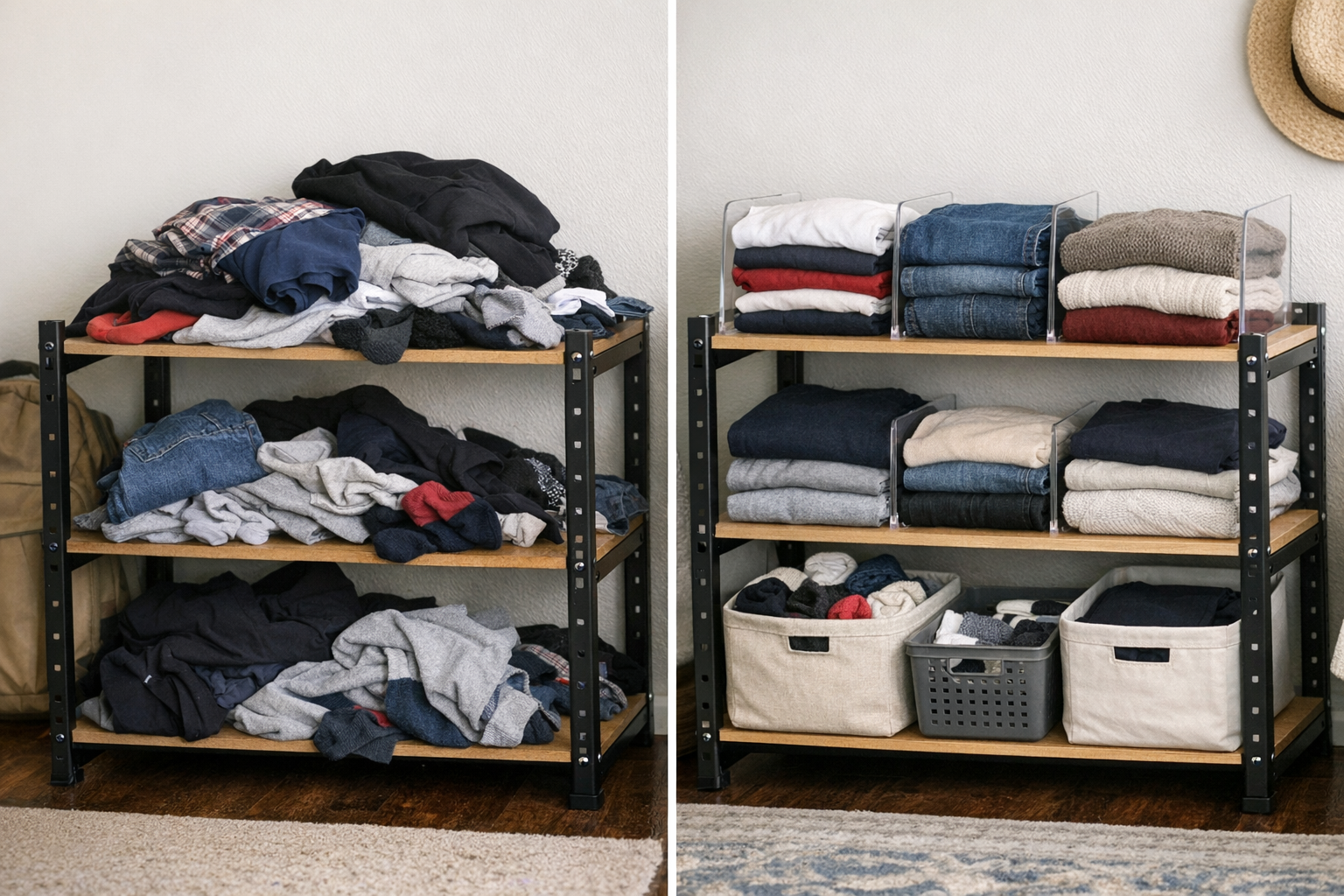
What quietly sabotages a closet isn’t the day you organize it, but the mornings that follow. Shelves look pristine right after move-in or a big sort—crisp piles, everything sorted, optimism high. But real-life friction builds fast. Shirts tumble after one rushed pull. Stacks buckle, socks migrate, shelves blur. Motivation fades long before the system does. Whether your closet keeps its sanity a week later rarely depends on your folding discipline. It’s the structure—open shelves versus divided zones—that determines whether your storage works for you, or quietly demands fixing, every single day.
Where Open Shelving Breaks Down—Fast
At first, open shelves feel like a simple win: easy to load, easy to scan, no small parts. But they fall apart in real usage. Reach for a sweater at the back, and you drag a tangle of shirts forward with it. Bookended by nothing, neat stacks quickly tilt and spread. A pile of folded pants is fine—until you grab one from the middle, and the rest slouch sideways. Socks wander into T-shirt space. Towels blend into spare bedding. Every new item threatens the old order.
There’s no built-in stopping point. One careless return sends an entire section spiraling. Open shelving rewards patience—until the day you’re running late, or simply don’t feel like refolding anything. There’s no penalty for crowding too much in, but the price shows up later as a minor avalanche and a slower start to your morning.
The Real Cost: Resets That Never Last
You fix the stacks once, maybe twice, then lose patience. More effort goes into keeping that “organized” look than actually finding what you need. A shirt slides out, you refold half a pile. Socks you separated days ago now hide at the back. It becomes a tedious reset—one step forward, two small setbacks each time you pull something out or put it away. The result: a closet that looks organized only during resets, and demands constant hands-on maintenance to stay that way.
Sectioned Storage: Invisible Help for Everyday Mess
Real relief starts when every category gets its own guarded space. Shelf dividers, bins, or baskets carve out real boundaries—no more best guesses about where the sweaters end and the jeans begin. Even the simplest divider means grabbing your gym shorts won’t topple your dress shirts. A bin for scarves or belts keeps them from endlessly mixing with gloves or extra socks.
On a day you’re out of energy, you can toss something back into its “lane” and trust the rest of the shelf won’t follow. Slim dividers keep stacks vertical; bins give even the trickiest items a home. The messy realities of daily living—rushed retrievals, quick toss-backs—don’t undo the entire order. Suddenly, staying sorted doesn’t rely on you being meticulous. Your closet quietly does the steadying for you.
In the Wild: Where Structure Saves Time
Think of the utility closet with deep shelves: towels piled next to cleaning supplies, lightbulb boxes perched behind stacks of sheets. Opened up, it looks fine—until two busy weeks go by. You dig for a single rag, and half the towels tumble. You move one bin, and the dryer sheets scatter into the vacuum bag supply. The reset cycle begins again, usually right when you’re already in a rush.
Add sectioned baskets or adjustable dividers, and the problem changes. Towels stay flanked, rarely shifting. Boxes of supplies each get a contained space, no longer knocked or scattered. You can reach behind one spot without disrupting everything up front. Minutes add up, patience returns, and you actually use what you stored—without re-stacking every few days.
Small Upgrades, Real Impact
Upgrading from a bare shelf to a divided system looks like a small move on paper. But the weekly difference is real. One homeowner’s closet went from a wide shelf where shirts and sleepwear merged within days, to tidy, firmed-up sections thanks to a few slender dividers. Reach for pajama pants; the shirts hold position. By Friday, nothing is buried. Visibility stays clear, reach-and-grab is faster, and re-setting the shelf shrinks from a 10-minute job to a simple two-minute fix—sometimes just a single adjustment instead of dozens.
Not everything needs a rigid home, but dedicated zones dramatically lower the “where did that go?” frustration. Anxiety about tossing and returning vanishes. You’re not fighting entropy; you’ve just made it run uphill.
The Creep: How Closets Lose Their Boundaries
The gradual breakdown isn’t always obvious. Maybe your favorite T-shirt migrates, or bin contents blur together until you just give up looking. Suddenly, finding a single item takes a shuffle, a dig, and putting five other things back into place. When a closet lacks prompts—dividers, bins, physical clues—it can’t quietly nudge you. Over time, category walls collapse. Maintained systems stop helping, and everything blends into a daily puzzle of misplaced basics.
It’s not about perfection. Even a subtle upgrade—one more basket, a divider for stacks—restores some order for weeks, not hours. The system does just enough to keep you from giving up and letting clutter take over.
Let Your Storage Reflect How You Live
Organization isn’t one-size-fits-all. Some shelves need big bins for winter gear that rotates out. Others need tight, vertical dividers to keep go-to shirts visible and ready. The trick isn’t buying the fanciest system; it’s what makes routine easier. If you find baskets turn into catchalls by the end of the week, try smaller ones or tweak what goes in. Relentless shirt migration? Insert a divider and reclaim that edge.
The best systems aren’t flawless—they’re responsive. They notice and adapt to your real habits: frequent grabs, rushed mornings, whatever items always seem to shift around. Sometimes, just shifting a bin or adding a single boundary gives your daily routine a reset that sticks.
Everyday Tweaks That Actually Help
1. Give each zone slack—Don’t cram every bin or divided section to the brim. Breathing room makes it possible to add or remove items without the dreaded cascade.
2. Use see-through or pale dividers—You keep a sightline to what’s inside and avoid the “out of sight, out of mind” problem. Items don’t get overlooked (or lost to a bottomless pile).
3. Pay attention to ease—If putting something back takes more than a few seconds, friction will wreck your system. A fix should never slow you down; systems that reset quickly survive real life.
The Quiet Payoff: Less Work, More Clarity
No closet is immune to chaos, but some setups push the battle off your plate. Shelves with built-in boundaries create daily clarity—without demanding you refold or reshuffle after every use. Suddenly, you’re not organizing by hand; the storage itself holds the line. That’s where small upgrades pay back, again and again: with clearer categories, steadier stacks, less time spent searching, and routines that finally feel less like a test of willpower, and more like a system you can trust—even when life gets messy.