
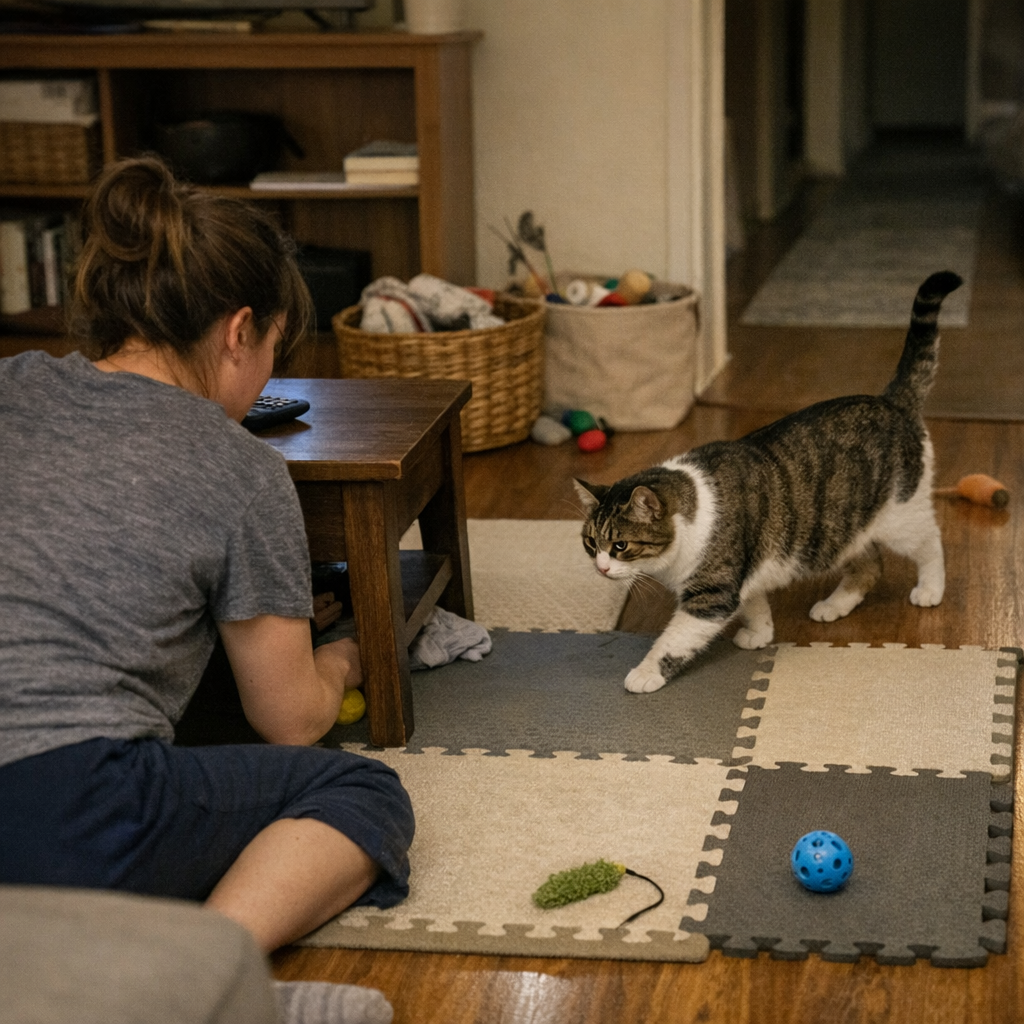
If you live with an indoor cat, you know the friction: at night, the living room looks set—basket in the corner, toys in their spot, mats roughly aligned. But every morning, cleanup feels pointless. Fabric mice reappear under furniture, that mat is crooked again, and balls you thought corralled are scattered in new places. It’s not just about things looking messy—it’s about reset work piling up, tiny resets you didn’t expect to become a daily tax. The difference between “looks fixed” and “actually under control” shows up after a few days, not just one cleaning. Every evening starts more scattered, but the root problem isn’t obvious until you’re hunting for the same toy or straightening the mat mid-coffee, again.
When Evening Play Backfires—On Day Three, Not Day One
The first night, most setups feel fine. You set a post-dinner play window, probably around 8:30 PM, and everything resets easily—cat content, toys gathered, routine feels organized. But by the second or third night, frayed routines show up. The “night surge” repeats just as you want calm. Instead of toys stopping at the play area, you’re now retrieving them from doorways or under furniture corners. Mats drift out into the living space, making even a late walk for water involve an ankle catch or sidestep. Routine tasks—‘just a two-minute pickup’—stretch out when you spot a stray catnip mouse or ball across the hall as you’re turning off lights. The setup that looked practical on night one reveals its limits when you’re repeating the same resets every night, slowing down when you meant to wind down.
The Real Friction Isn’t Mess—It’s Repeating the Same Reset
The giveaway isn’t the level of mess, but the cycle you can’t break. By the third or fourth night, you notice:
- Toys needing to be retrieved from under the TV stand or deep under the couch—sometimes requiring an awkward reach, or a flashlight you didn’t expect to need
- The play mat never quite where it belongs, so every morning includes a lopsided quick-fix—usually while your hands are full or you’re still waking up
- Your bedtime constantly interrupted by “one more” burst of cat energy right as you’re closing the house down
The result? Less enjoyment of the setup you planned, more micro-adjustments and stray cat items slowing your transition from work mode to rest. The room’s visible order fools you—until repeated small chores keep resurfacing, draining energy at the end of every day.
Why Tidy Looks Don’t Equal a Working Routine
The real signal isn’t how it looks after a single cleanup—it’s whether the setup holds up without constant returns. Patterns emerge fast:
- Toys are outside their basket again before sunrise
- You revisit the living room post-bedtime just for a quick retrieval or shuffle
- The play area keeps spreading into shared walking space, taking up more of the floor every day
The problem isn’t clutter—it’s a cycle that keeps breaking your evening flow. If your routine keeps making a lie of your own ‘final’ cleanup, the solution won’t come from one more storage container.
The Real Fix: Adjusting Play Timing, Not Adding Baskets
The reflex is to look for a new storage fix—a bigger basket, new mats, furniture shifts. But most setups collapse not from lack of storage, but from timing that bleeds into your rest period. Shifting play 20–30 minutes earlier resets the home’s energy curve. Cat play winds down earlier, so the last cleanup marries with your active hours instead of encroaching on relaxation, and the resets don’t chase you around late at night.
When owners actually push playtime earlier, these shifts become obvious:
- Cats settle before people wind down—no late-night zoomies just as you dim the lights
- Toys stay closer to their zone, making reset a two-minute job, not a drawn-out hunt
- The last round of organizing happens before tiredness sets in, so you don’t wake up to yesterday’s work
- Mornings start with less interruption—no detour for toy rescue or mat realignment before breakfast
The payoff is direct: you’re not spending the last minutes of your evening relocating things you already put away, and you start your day without the feeling you’re stuck in a clean-reset loop.
How Timing Reduces Not Just Mess, But Cleanup Friction
Picture the routine play zone: basket by the wall, foam mat, an assortment of toys. If play always begins close to your own bedtime, chaos bleeds into late hours. By the time you reach for your water glass or move toward the bedroom, you’re sidestepping balls, picking up toy scraps, or nudging the mat away from the hallway, just to keep a clear path. The “full reset” never happens, because interruption always wins.
Move play up by just half an hour. Cleanup happens as you’re still awake—resetting the area isn’t another tired chore. By the time your routine shifts to winding down, the cat is already in rest mode. The room holds overnight; you aren’t starting every morning with yesterday’s unfinished business.
Spotting If Structure Is Helping or Quietly Adding Work
Perfect order won’t hold, but the pattern should change. When timing fits household flow, you stop chasing the same cleanup battles. A good basket or mat works with the routine—not as another hurdle between you and the first coffee. You notice quickly whether a chosen setup holds for days, or introduces new, sneaky work each night.
Diagnosing Real Weak Points: Watch for Patterns, Not One-Off Messes
Patterns reveal breakdowns, not one-time episodes. Three or more nights in a row of:
- Toys lost to other rooms or under hard-to-reach corners
- Late-night cat surges disrupting your sleep transition
- Cleanup getting pushed later and later into your evening
…signals that the schedule—not just the setup—could be feeding the friction. Recognizing this can spare you the endless double-reset cycle that pulls you out of rest mode.
Small Adjustments That Actually Shift Your Routine
You don’t need a total overhaul, nor more gear, to break the pattern. Instead, try:
- Shift play slightly earlier: Start 10 minutes ahead of usual. If late-night interruption remains, adjust again. Matching play timing with your evening low-energy point reduces stray sprints and scattered cleanup jobs.
- Anchor new timing with the best toy: Set the most-loved item out earlier as a start cue—and stick with finishing before your own wind-down begins.
- Use clear end signals: Blanket down, a favorite treat, or something as simple as a light or sound can mark the end, making it clearer for both you and the cat.
- Tweak item placement, not just item count: If baskets keep drifting, move them slightly closer to natural walkways; if the mat always blocks a path, try the opposite wall. The goal isn’t prettiness, but fewer after-hours corrections.
Each tweak lets structure—placement, timing, and signals—do more of the heavy lifting, reducing how much you have to intervene just to maintain basic order.
When “Looks Fine” Fails: Surface Order vs Real-World Ease
Even after rescheduling, some flaws will still show through. Examples:
- A basket looks organized, but toys keep migrating as soon as you’re not watching
- The mat is aligned with the couch, but ends up inviting launches into shared space—so clutter moves rooms, not just corners
- Cleanup tools are technically “right there,” but awkward to reach at the real moment of need, stretching the process or influencing you to skip a reset
This is why visible order is just a starting point. The setups that last aren’t hidden or spotless; they keep maintenance low, retrieval easy, and interruptions minimal—making repeated routines bearable even when your own energy is stretched thin at the end of the day.
A Stronger Setup Isn’t Perfection—It’s Routine That Stops Dragging You Back
Living with an indoor cat means friction will always find a way in—mats shift, toys wander, timing slips. But when your setup and scheduling work together, the pattern stops demanding the same tired fixes and lets both you and your cat settle faster. The difference isn’t in “looking controlled,” but in needing fewer late-night resets just to keep pace. Small shifts—especially in when you play, not just how you store—break up the repair loop that makes every evening slower. A practical setup is the one that’s easier