
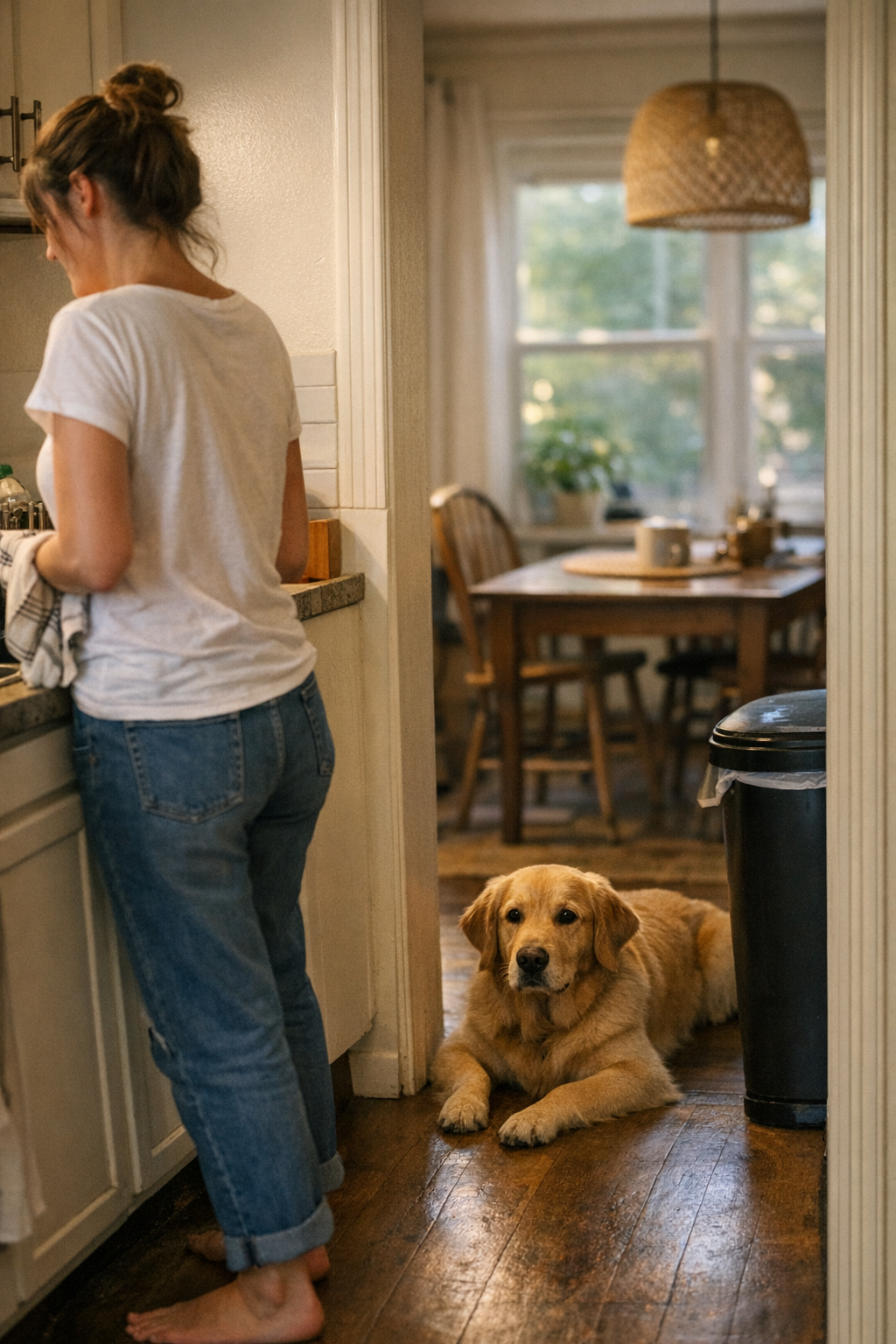
Every dog owner knows the exact spot: that stretch of kitchen floor your dog turns into a roadblock as soon as mealtime ends. Cleanup isn’t just about clearing bowls—suddenly, you’re stepping around a lounging body, dodging a tail, snagging the towel at an awkward angle. The kitchen looks under control, but your pace slows. By the third day of rerouting, delayed chores pile up, and rest slides further into the night. The routine doesn’t blow up—it just quietly drags, one small detour at a time, carving friction into something that should be simple.
When the Smallest Pause Turns Into a Drag on the Whole Night
An ordinary dog routine flows until it unexpectedly doesn’t. The most overlooked squeeze is the “threshold pause”—your dog settling right where you cross after meals. The first night, you dance around them without a thought. By the end of the week, stepping around that body becomes automatic, but so does the irritation: arms full of dishes, you shuffle sideways, or you reach for cleanup supplies and realize your stride is twisted. Passing through becomes an obstacle course you never meant to build.
This isn’t a dramatic standstill. It’s half-second stalls—hesitations as you adjust, sidestep, or reroute to avoid a dog who thinks they’re just being present. Each subtle block extends the distance between “done eating” and “actually finished for the night.” Days stack up. The reset window stretches. What looks like a calm kitchen hides a recurring snag you feel every time you try to get something done without bumping into fur.
Why Dogs Anchor Themselves in the Worst Spot
This isn’t about stubbornness. Dogs position themselves at the threshold because that’s the stage where you’re most active after meals. They’re tuned to your rhythm, waiting: will it be treat time, a hint toward a walk, or just a belly rub? For them, the kitchen doorway is a control tower. For you, it’s a tripwire. Every time your dog camps in that path, the logic is obvious in hindsight—the only route from dinner zone to cleanup or rest now funnels through a waiting, alert dog.
This repetition is what quietly wears you down. Side-stepping isn’t a nuisance for one night. But when the same “move” repeats at every routine pinch-point, what used to flow now stutters. Your habits adapt: maybe you stop carrying two things at once, or you delay wiping the counter because your reach isn’t clean. The routine bends, but never gets truly better. You’re not just moving around a dog—you’re compensating for a weak setup, one awkward crossing at a time.
The Hidden Tax: Adapting Doesn’t Translate to Smoothness
Humans adjust quickly—bend, lean, detour, stretch around the block in the path. But those clever workarounds harden into new habits: always clutching dishes higher, always waiting for the moment when the dog finally shifts. The old “fix” becomes an invisible hassle. It’s rare that anyone admits a problem—bowls get left soaking, crumbs escape underfoot, cleanup lingers one step behind. Meanwhile, the threshold remains staked out by a dog who’s just waiting for your next move, right where every task intersects.
The Smallest Setup Shift That Changes Everything
You don’t need an overhaul. The real difference comes from a move small enough to test in a single evening. Try this:
- Serve your dog dinner away from the busy doorway—shift the bowl one meter to the side, toward a quieter corner.
- As cleanup begins, your dog finishes and settles somewhere with less “traffic,” not out of training, but because the new placement cues them differently.
- No more forced pauses between the sink and the trash, no more clumsy balance acts with a towel or falling bowls. Cleanup flows. You actually walk straight lines again.
This tweak, repeated across the week, rewires routine momentum. It isn’t discipline or retraining—it’s layout logic. The difference is instant and multiplies daily: less stepping around, fewer glances down for a tail or nose, a clear path between each part of cleanup. The bottleneck moves, and suddenly you’re not losing time to invisible dog traffic jams.
“Looks Fine” vs “Works Well”: The Real Test of Kitchen Setup
A visually neat kitchen is a universal goal—bowls lined up, floor wiped, clutter hidden. But underneath a calm surface, function stalls. The test is not whether the area looks tidy, but if it lets you cross from one job to another without negotiating obstacle after obstacle.
Ask yourself: is your setup made for show, or made for motion? The bowl mat might look perfect on Instagram, but if your dog lands right in your path every night, the only thing smooth is the surface appearance. Consider:
- A bowl placement that lures your dog into your cleaning lane every single meal.
- A cozy mat in a walkway that moves from “thoughtful” to “trip hazard” as routines harden.
- Cleanup gear visible but just far enough away that you hesitate, bend, or abandon a task halfway to avoid disturbing the dog.
Any of these signs means you’re living with the gap between “organized” and “workable.” Surface calm can let real bottlenecks quietly persist for months.
Everyday Pattern, Real Impact: Why the Wrong Setup Costs More Over Time
Pretending “it’s just a second” doesn’t change the cost. If you recognize the same sidestep, the same stall at the door, the same hallway backup after feeding, you’re paying for a setup that works against you. Multiply those moves morning and night, across seasons, and the interruption shapes daily comfort for both human and dog. The longer it goes, the more your dog expects you to adapt, and the less momentum you keep for yourself.
Pattern Recognition: When Odd Pauses Become Routine Obstacles
Notice the difference between coincidence and pattern. When “my dog always ends up here” lines up with “I always get blocked now, not just once,” that’s a structure problem, not a personality quirk. If every leash grab, wipe fetch, or bedtime reset comes with a dog in the way, it’s time to rethink: your routine isn’t random, and neither are these micro-frustrations.
Beyond Bowls: Setup Logic Affects Every Routine Transition
This bowl blocking is only one form of the same home-dog bottleneck that repeats everywhere you share space:
- Grabbing the leash and finding a crate wedged beside your usual reach, or towels stored two steps too far while the dog waits by the door.
- Returning with muddy paws, but wipes or towels are placed on the wrong side of the landing—so cleanup delays and muddy tracks begin.
- Toys sliding underfoot into hallways and bedding curling into walking lanes, causing extra resets before you can move through cleanly.
- Rest corners that look cozy but require a full bedding reset each use, because the dog shoves everything into the main crossing lane.
These don’t look dramatic, but they interrupt flow and fill each routine with small, repeating drag. The frustration isn’t a messy room—it’s a room that slows you down no matter how organized it looks.
Setup Change Means Routine Change—Or It’s Not Working
The most effective setups tolerate reality: fatigue, rushes, imperfect returns. A good arrangement isn’t fussy or “styled”—it’s just reliable under strain and supports both sides of the leash without constant reminders.
The proof is always in the aftermath: Cleanup runs faster, you grab towels and wipes without rerouting, the dog settles out of the line of fire, and the shift from chores to downtime comes sooner. Less irritation, less juggling, more real rest at the end of the night.
Good Routines Fix What Never Looked Dramatic, But Always Slowed You Down
No fancy trick is needed—just a new spot for the bowl, a tweak to mat placement, wipes where your hand actually lands. If your routine feels easier by the third night, you’ve probably fixed what setup kept dragging you through. The best dog-life upgrades are invisible in photos, but obvious in use.
Find practical, everyday setups for smoother routines at DogPile.