
Where the Clean Pegboard Wall Works—And Where It Fails
Finishing a fresh pegboard wall in your garage or workshop feels like crossing a threshold. Hooks snap in, hammers line up, and suddenly every tool has its moment in the sun. For one bright afternoon the setup is pristine: wide open sightlines, exactly spaced groupings, nothing buried or lost. It’s not just the satisfaction of order—it’s that flash of hope that maybe, finally, grabbing a tool won’t disrupt your flow. No more basket digging or drawer searches. Just walk up, pick up, get to work.
But then real life moves in. Within days—a rushed repair here, a borrowed tool there—the wall’s perfect logic sags. Each gap shouts at you, clutter creeps in, and grabbing what you need quietly gets slower. The wall promises efficiency, but the moment your hands are full or routines fray, the openness starts to betray the setup.
How Return Friction Creeps In
Pegboards thrive on visibility: everything’s right there, until what’s missing jumps out just as sharply. It’s not an obvious flaw on day one, and it isn’t sabotage—it’s the reality of actual work. A wrench set aside to “put back later” during a midday rush, a neighbor wandering off with your all-purpose pliers, or a late project wrap-up where tools are tossed on the nearest surface instead of reset on their hooks. The instability multiplies with the pace of use.
The next day, you grab for what’s gone, your eye landing on a blank hook. Instead of a smooth sequence, you pause, reverse, and retrace steps across the room—double-checking benches, glancing behind the rolling cart you had to shift just to open up space. Multiply that little stall by a week’s worth of tasks, and the wall’s clean design reveals itself as a brittle system: it only holds up when every reset is flawless, every time. That’s not routine—it’s wishful thinking.
Openness Becomes a Signal for Disorder
Pegboards sell the vision of everything on display, while closed cabinets gently hide your mistakes. At first, the exposure feels empowering—tools are uncrowded, arrangements seem obvious. But the cost is relentless: the second a screwdriver skips its return, the whole row looks crooked. One empty hook halts your eye every pass. Clustered tools—three on a spot meant for one—turn from “at least I put it back” into a silent mark of friction. The wall won’t shut up about it.
Worse, in shared or busy garages, your missing wrench is now everyone’s problem. One person skips a reset, another starts a wild goose chase. You notice two trips across the room for the same item or end up circling back just to double-check that the open gap isn’t hiding a tool wedged behind a cabinet again. The wall is meant to save time, but each little return failure ripples, breaking momentum and dragging everyone into minor, repeating searches.
The Mess of Routine in Motion
Picture a typical rush: you’re up early to fix the garden gate. Drill in hand, you cross to the bench for new bits—and the tool stays on the bench, “just for a second,” while you field a call. By the time you return, the wall shows only its empty outline. You’re hunting behind the rolling chest (had to nudge that aside, again), squinting around the shelf edge, picturing whether you left the tool in another corner.
Busy weeks layer extra chaos. Tools moving between wall hooks, drawers, temporary shelves—each detour adds up. One area turns into a dumping ground for overflow. The top of a rolling cart becomes a tool graveyard. That enticing wall, all lines and logic, now blocks fluid movement. Dead corners never fill in. Reset discipline dissolves: it “looks” organized, but really, you’re working around the setup more than through it. Instead of freeing up the floor and reducing cross-room traffic, the wall becomes another slowdown. What you see matches the ideal; what you feel is more stops, more redundant motion, more awkward maneuvering to reach a basic tool.
Relief in Real Tweaks: Add a Bin, Change the Flow
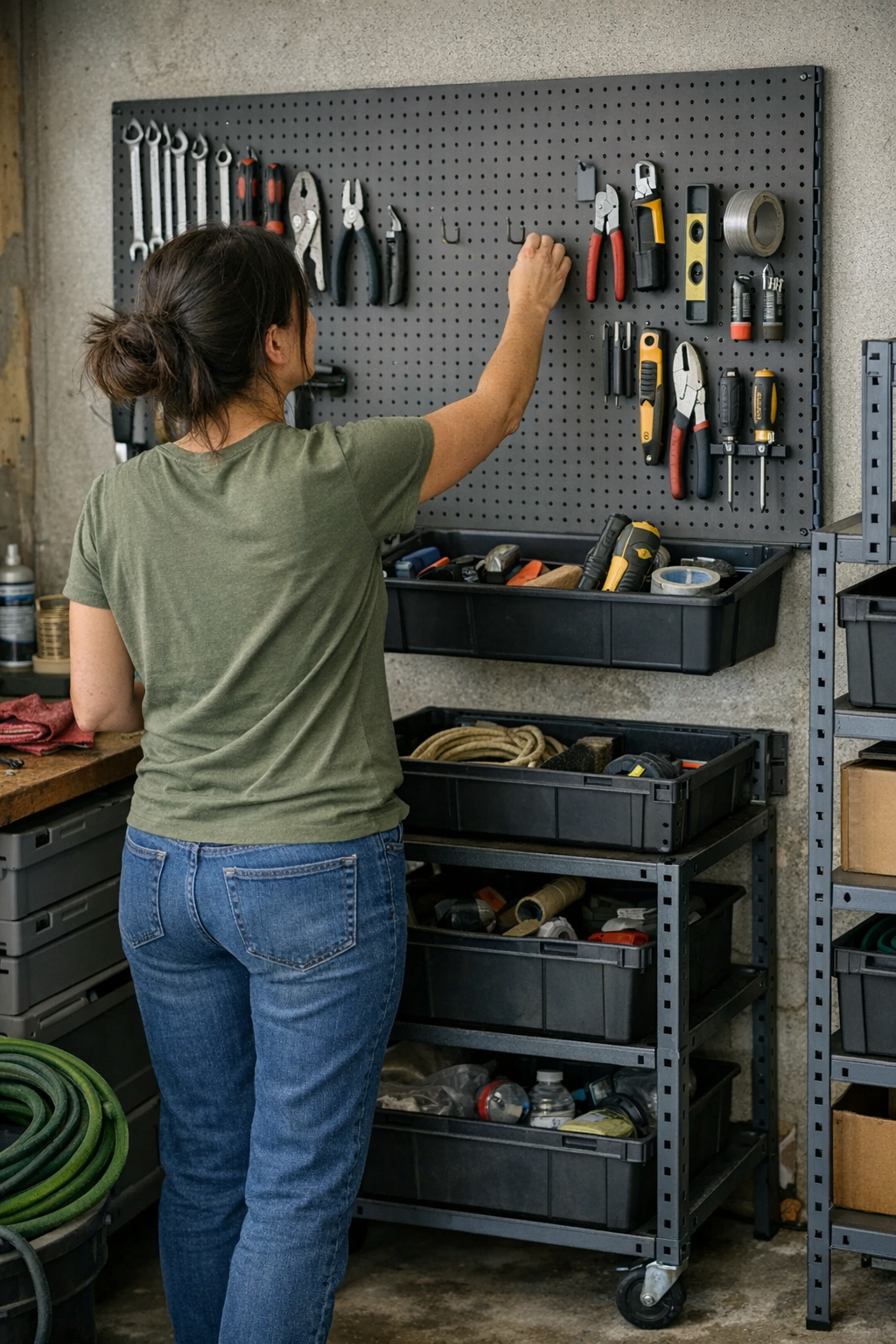
A truly functional pegboard isn’t the one with perfect rows and no clutter—it’s the setup that cushions the blows of actual, imperfect routines. The tweaks that matter most are often small but decisive. Shift your highest-use tools to the most reachable spots—think shoulder height, near the main work zone, never behind something you’ll keep dragging out of the way. Then, add a narrow shelf or shallow bin directly under the board. When you’re mid-project, and resets slip, that space catches overflow instead of letting it sprawl.
This one move changes the texture of everyday use. You’re no longer forced into an all-or-nothing reset. Stray tools can land one step from their hook, buying you time without visual disaster. Floor space stays clear, and you stop tiptoeing through growing clutter islands. Shared garages see fewer finger-pointing debates, because the system now flexes for normal busy overlap. It’s not about giving up on order—it’s about making sure small lapses don’t snowball into major stalls.
Pegboards vs. Cabinets: Real-World Trade-Offs
Don’t fall for storage fantasy. Closed cabinets feel clean—until a bad drawer stacks up a year’s worth of mismatched gear, invisible until you’re forced to dump it all and start over. Pegboards make your system’s strengths and failures public: there’s nowhere for chaos to hide, but every glitch grabs your focus. If your setup helps tools get reset naturally—preferably as the last step of the work, not an extra ordeal—the wall stays clear and the routine stays quick. If not, openness just means more “Hey, what’s missing now?” moments.
The pegboard is not the hero or the villain; it’s the test of whether your storage fits the pressures of your real routine. Does the wall encourage the right returns, or does it break down under a week of actual mess?
Designing for Reset, Not Perfection
A pegboard shouldn’t be a static display. Its worth comes from supporting the random, messy churn of repeated daily projects. That means:
- Cluster your high-touch tools in your true action zone, not across the garage or blocked by a rolling shelf.
- Add catch-all bins or ledges for tools in motion; let them serve as short-term landing pads, not permanent clutter pits.
- Treat open gaps as feedback, not failure—move zones, rethink access, and adjust the wall when patterns keep breaking down.
- Let go of showroom standards. Clarity and speed matter more than the illusion of an untouched wall.
Your setup should survive sloppy resets and hectic weekends—not just look good after a half-day purge. The right adjustments reduce wasted steps and dead corners, letting you grab, return, and keep moving even when life refuses to slow down.
Pegboard walls aren’t a magic fix. But when built with honest reset routines—where an imperfect return doesn’t logjam the flow—they become a lasting asset, not a recurring frustration. Aim for a wall that supports the chaos, not one that’s undone by it.
Explore more practical storage setups and solutions at StackNest.