
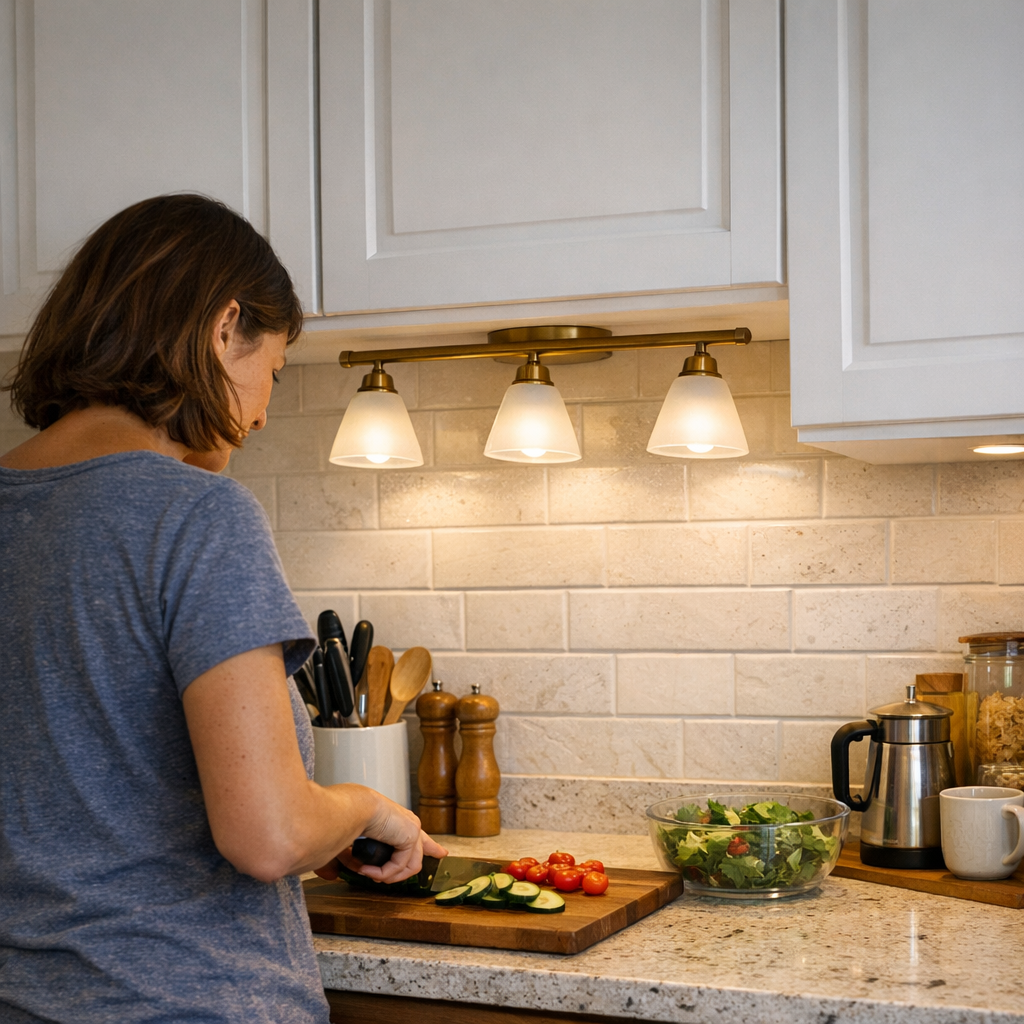
Kitchens that look brightly lit from the doorway often break down under real use. The ceiling fixture switches on, the room floods with a pleasant glow—and then you grab a knife, lean over the counter, and stare into your own shadow. No matter how powerful that ceiling light is, it can’t reach under cabinets or along the backsplash where you prep, wipe, or search for lost tools. The result isn’t just a dim spot; it’s a stubborn, daily gap that works against you every time you move from “seeing the space” to actually using it. In the world of indoor lighting, nowhere does the difference between visual brightness and functional visibility become clearer—or more frustrating—than on the kitchen counter.
Where Ceiling Lights Fall Short—And Why It’s Hard to Ignore
It’s a familiar trap: ceiling lights pour an even blanket of light across the room, but the moment you step up to the counter, crucial zones turn unreliable. The backsplash sits in a permanent dusk. The tight line under upper cabinets never catches a direct beam. Every time you rely on these spaces, you find the same points of friction:
- Knife work stalls: Your hand and tools throw double shadows, obscuring the exact point of the cut.
- Cleaning gets patchy: Spills and crumbs cling to the back edge, invisible during a quick wipe-down.
- Small items vanish: Spoons, scoops, and measuring cups slip into shadow, turning a two-second grab into a blind search.
The consequence is small but constant: squinting, leaning, and shifting position to chase clarity that simply isn’t there. Kitchen work gets slower, less certain, and fractionally more annoying, every single day.
The Problem Hides in Plain Sight
“More light in the room” doesn’t mean “usable light at the counter.” Shadows at the far edge and under the cabinets never clear up, even with a stronger ceiling bulb or whiter paint. The angle is wrong; the cabinets themselves block the path, trapping darkness along the critical work zone.
This creates an everyday trick: the kitchen appears ready and bright, but the very surfaces you use most often—back edge, right under shelves—stay stubbornly shadowed. If you prep at the wall, you push your work forward or put up with uncertainty. Missed spills and off-target cuts aren’t dramatic injuries—they’re quiet, recurring friction that dulls the entire kitchen experience.
Seeing the Real-World Impact During Daily Use
Take one evening routine: ceiling light on, onions out, you reach for the cutting board. The instant your body leans in, a thick shadow swallows the precise spot you need to see. You twist or shift, trying to catch an angle where the light fills the space, but the shadows simply rearrange, now duplicating or splitting under your hand. Even when nothing goes wrong, you’re working at half-clarity.
Same problem during cleanup—a line of gloom at the back edge lets sticky streaks linger past multiple wipes. On busy mornings, the far corner swallows a measuring spoon, costing you time and a rinse. No one tells you why kitchen routines feel clumsier than they should. But it’s the invisible structure of the light—its reach, not its wattage—that keeps tripping you up.
How Under-Cabinet Lighting Quietly Solves the Problem
Under-cabinet fixtures target these blind spots with precision. Continuous, diffused LED strips or slim bar fixtures cast light right where ceiling setups fail: across every inch of the counter’s depth and into the backsplash’s farthest edge. The shift is practical and immediately obvious:
- Every part of the counter—from wall to front—is evenly illuminated without break.
- Double shadows shrink or vanish, restoring detail for chopping and reading recipes.
- Nothing gets lost in darkness; spills, crumbs, and tools stand out instantly.
- Movement becomes automatic—you stop hunting for light, and just get the job done.
This isn’t about transforming your kitchen into a showroom. It’s about removing a subtle, built-in handicap that you stop noticing until it’s gone.
Why Diffused Lighting Beats Spotty Puck Solutions
Trying to patch the problem with puck lights or spot LEDs usually leaves you with worse contrast: some areas blindingly bright, others still in shade. The result—stripes of light and shadow—solves nothing for a long counter or wide prep zone. Only edge-to-edge, uninterrupted strips provide seamless working visibility.
Replace pucks with a single diffused run under your cabinets, and the last stubborn dim spot disappears. You stop leaning or moving awkwardly just to see what your hands are doing—and finally, you clean and prep without working around the light itself.
When Lighting Matches Routine—The Difference You Feel, Not Just See
The goal isn’t just a dazzling kitchen. Reliable under-cabinet light locks in day-to-day ease that you can’t get from ceiling fixtures alone:
- Prep tasks become automatic—no wasted attention on where the light lands.
- Every surface cleans fully, not just the ones you can see at first glance.
- No more searching by feel or shifting breakfast forward for lack of visibility.
- Visual strain drops; the work zone feels finished and trustworthy all the way to the wall.
That difference grows as the months pass. The proof isn’t just in a brighter kitchen, but in how you stop noticing shadows, awkward reaches, and small mistakes. Reliable coverage means one less invisible hassle—every day.
Bringing Balanced, Task-Focused Light to the Kitchen Counter
No ceiling fixture, however bright, can erase the deep shadow lines caused by cabinetry and awkward angles. Under-cabinet lighting closes that gap—delivering unbroken task light exactly where routines need it most. Diffused, edge-to-edge coverage shifts the kitchen from “bright but incomplete” to a workspace that simply works, no maneuvering or second-guessing required. Visibility becomes an unspoken part of the flow, supporting every meal, cleanup, and search—especially when the overhead light only gets you halfway there.
Find practical under-cabinet solutions and more at LightHelper