
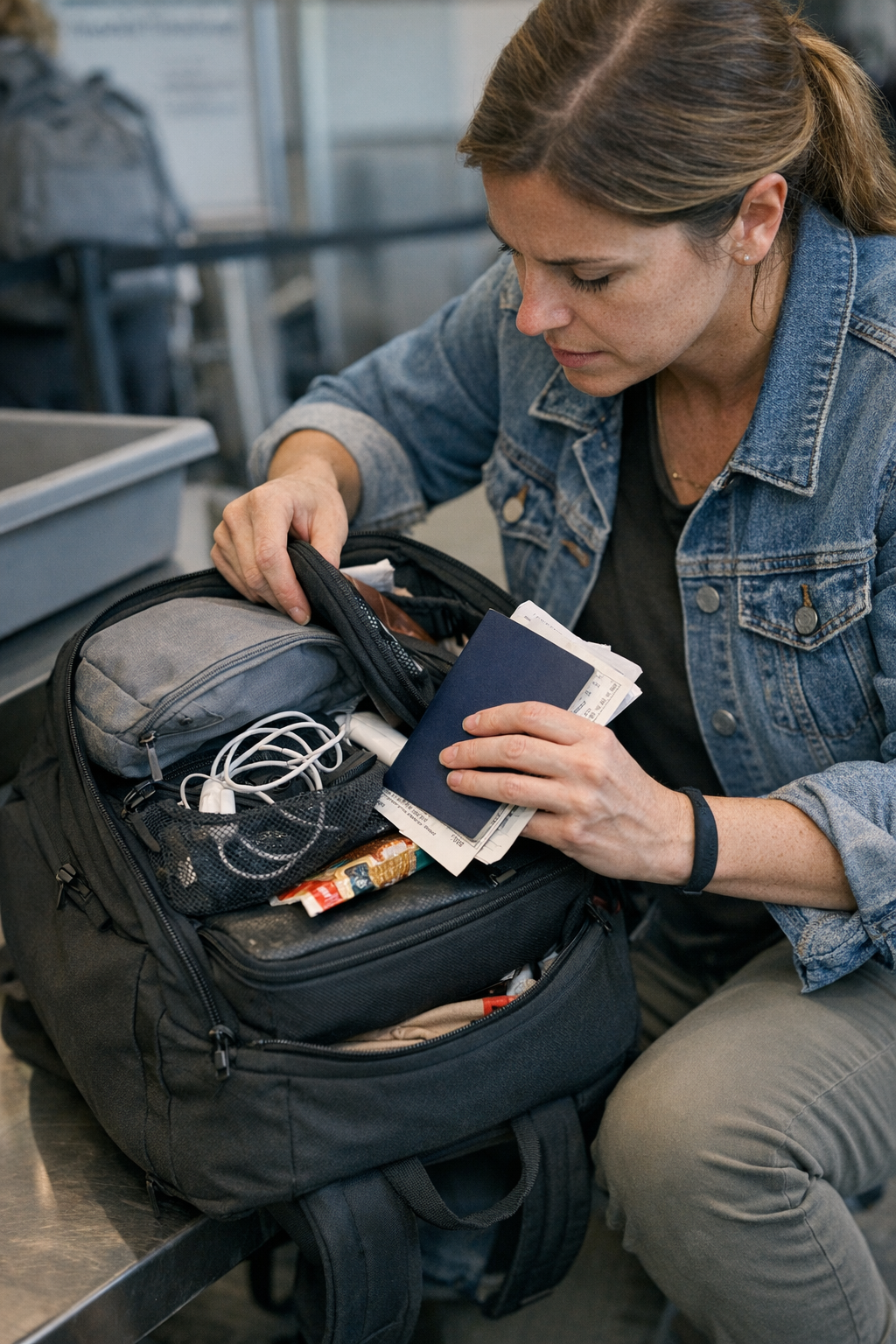
Order doesn’t equal speed. Your carry-on starts the trip looking sharp—zippers straight, every passport, cable, and charger snapped into its sleeve. But the moment you’re in line at airport security, digging past tech sleeves for a passport while an agent watches, that “organized” feeling dissolves fast. The real test isn’t how Tetris-neat everything looks in your living room, but whether you can grab what you need without a slow shuffle—over and over, all the way from drop-off to boarding and beyond. The difference hits the first time a queue stalls behind you at the gate or you fumble a tray at the X-ray conveyor: a carry-on setup that hides its friction at home will expose every weak spot under airport pressure.
The Organizer’s Trap: Looking Tidy, Moving Slow
Visual order misleads. Neatly stacking toiletries above cables, figuring a passport will be fine under a pouch, can feel unbeatable before you leave. But by the end of your first checkpoint, a few hard truths surface. Reaching for your ID often means dragging a charger out with it. Grabbing snacks in a hurry disrupts the whole stack. Each extra layer multiplies interruption—especially when you’re forced to repack pouches on the curb or while inching through the terminal, feeling each minute elongate as you return things to their “perfect” places.
Real Friction in Real-Time: When Order Slows You Down
The first security check might feel manageable, but friction builds exactly where it matters:
- Two zips to reach one cable, while other travelers squeeze by you in line.
- Pulling out your passport, now tangled with headphones or sliding behind your boarding pass.
- Noticing, too late, that a pocket you “just” closed is half open again after a rushed tray transfer.
Each move costs a few seconds. Stack up a dozen small interruptions over a multi-segment trip, and you’ve gained a real burden. “Well organized” in theory now means clumsy, slow, and distracting in practice—especially during consecutive checks or fast-moving boarding lines.
When “Neat” Crumbles Under Repeated Retrieval
Performance reveals itself in the airport, not at home. Between rapid-fire document checks, constantly shifting boarding times, and mid-transit cable grabs, an arrangement that forces you to dig through unrelated pouches feels less like smart prep, more like unnecessary drag. The exact same bag—same organizers, same pockets—responds differently once the sequence isn’t under your control. At every gate, every bin, every seat row, a setup built for visual order gets shredded by the actual pace and rhythm of travel.
Real-World Slowdowns That Reveal the Wrong Setup
- Seat-side scramble: Squeezing into your row, the item you need is buried—requiring rushed unpacking while others try to get by.
- Gate check freeze: Boarding called. You reach for your pass, but it’s snagged behind headphones tangled with paperwork—holding up the line at the worst possible moment.
- Security bin struggle: What looked ordered now means pulling three pouches and a tangled cord just to hit the next checkpoint as bins close in.
Repeating the same movement exposes design, not luck. If every “quick” reach involves three separate touches, your setup isn’t built for travel rhythm. Each repeated barrier means the structure breaks down where pressure is real—not on your kitchen table.
The Shift: Separating Essentials for Actual Flow
What cut down delays wasn’t more packing, but smarter separation. Essentials by type is different from essentials by travel action. Pulling all documents into a shallow outer pocket—where you can slide out passports or boarding passes with one move—creates its own rhythm: one step, one return, and you’re already thinking about the next gate, not the last shuffle. Cables and other small gear slot into a deeper zone. Now, grabbing your ID doesn’t dislodge a charger and force you to rebuild the whole stack on the spot.
The fix doesn’t make your bag Instagram-shiny all trip. Zip paths aren’t perfect and “real” turbulence means pockets take a hit. But in high-pressure transit—boarding, security, seat entry—you’re not lost in a pouch-juggling act. Fewer delays. Less repacking at awkward moments. You can handle mistakes—like dropping a pen or crumpling a snack wrapper—without unraveling your entire setup just to get to your documents.
Overlapping Pouches = Extra Steps, Every Time
Stacking pouches might look tight for a photo. In motion:
- Items block each other, forcing stop-start rearranging that adds up in a moving line.
- Multiple things leave your pocket at once, so you track what goes where and lose time fixing it.
- Mess comes back faster—interruptions multiply as you repack after each checkpoint.
But change just one thing—two dedicated outer pockets, one for speed, one for bulk—and the entire feel shifts:
- You reach once per checkpoint, not three times.
- Excess zipping and pouch shuffling drops off.
- Retrieval becomes a muscle-memory move even when you’re rushed and someone behind you sighs audibly.
How to Recognize It’s Time to Change Your Setup
Notice yourself double-checking—and correcting—your supposedly “perfect” pouch arrangement after every step? Or repacking the same stack after just a short line? These signals mean your structure can’t keep up. Hidden friction at home becomes exposed in real movement: Zipper paths slow at security, document retrieval fumbles in boarding groups, pouch order thrown off at every terminal shift. A carry-on that only works standing still isn’t built for real travel flow.
True order survives pressure and repeat use. It’s less about the look and more about whether your bag keeps pace when pace is forced on you. The best setups aren’t the prettiest—they’re the ones that cut friction from the first checkpoint to the last row of seats, staying functional as routines repeat and mistakes happen. For setups that are stress-tested for speed, not just stacked for photos, see what works at CarryOnSupply.