
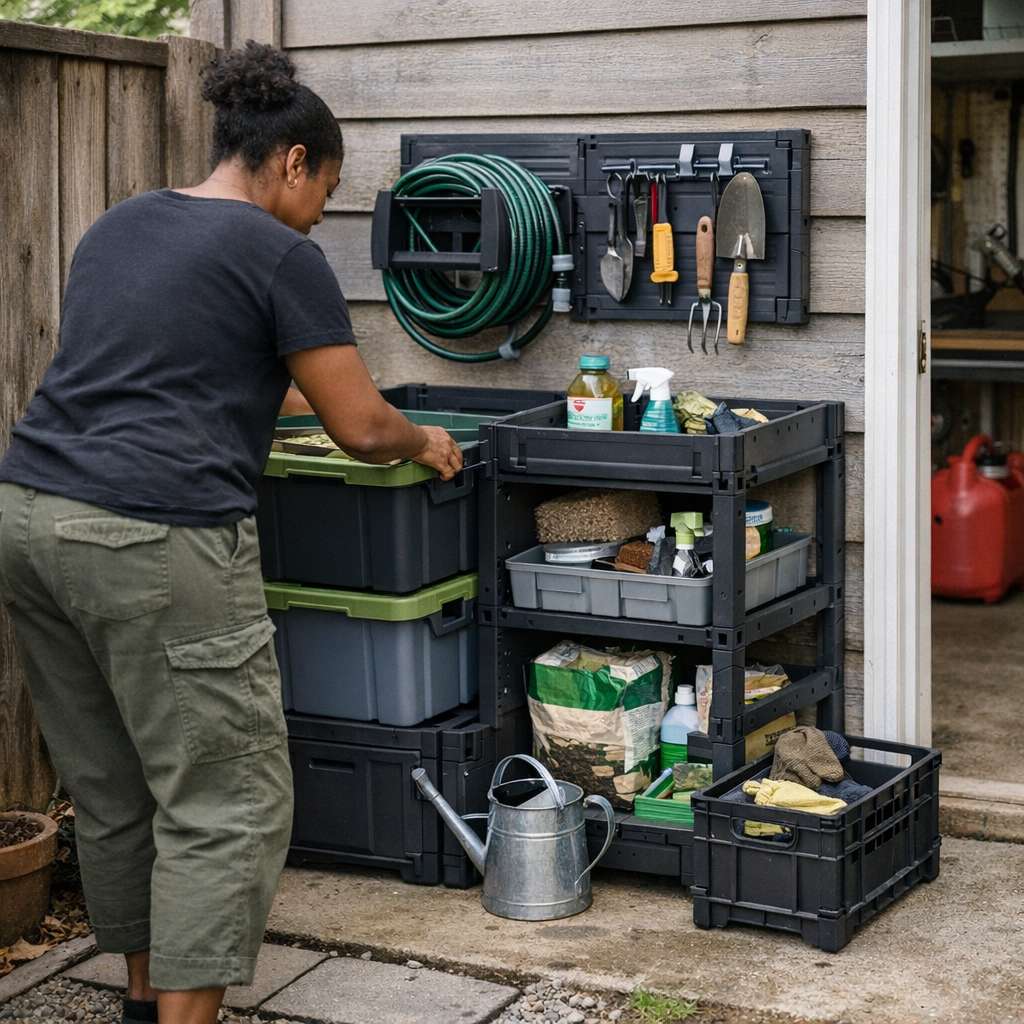
The illusion of backyard order fades the second your routine collides with real storage. Look past that freshly arranged corner or flawless rack on move-in day—what counts is how your pathway clogs, how bins bloat with overflow, and how “organized” turns to obstacle course. If you’ve ever heaved a deck box aside just to get the shovel, tripped over sports clutter in a narrow run, or watched your best walking route shrink under “temporary” bins that never move, you’ve seen how outdoor storage friction creeps in. It doesn’t announce itself; it builds, waiting for the next rushed return or rain-soaked reset to show its teeth.
When a Tidy Yard Starts to Feel Tight
Picture your side-yard strip: a couple of feet between the fence and house, barely enough for a mower squeeze. Add a storage bin with a lid that sticks, and every trip for a hose means an awkward shuffle. It starts neat—tools put back, path almost clear. But within weeks, a ball perches on the lid, a hose slumps over the edge, and every return becomes a negotiation with the last thing that wasn’t actually put away. Clutter always wins if your setup can’t clear itself on the fly.
It’s not subtle for long. By the second or third family cleanup, “good enough” piles collect on the flattest surface near the gate. Lids stay unlocked, overflow pushes out, and each person’s fix makes the next reset a bit harder. These are not messes—they’re signals: your current setup can’t handle the pace of actual use.
Diagnosing the Friction: Where Does Use Break Down?
It’s rarely about how much you can store; it’s about whether you can move and return items without a whole shuffle. Are you forced to reroute because a handle juts out? Is putting away one item a two-step dance? Hooks that send rakes swinging into your shin, bins whose wheels seize up, or modules that break their own logic—all whisper the same thing: your system is working against you, not with you.
- Wall racks that can’t carry their load: A system that sags with anything heavier than a broom turns into tangled handles and tools that slide out of reach. Each attempt to return a spade becomes a Tetris session—and the floor piles up again.
- Modules that break apart under pressure: Stackable bins sound flexible, but when getting to one lid slows you down, or pieces drift into new corners after one storm, “changeable” becomes “scattered.” Hunting that one missing lid shifts from rare to weekly ritual.
- Deck boxes that invite clutter, not calm: Closed bins only bring order if the return process is smoother than just dropping gear. Check what gathers in front of or on top of the box—a growing pile there means your storage route is jammed at the entrance.
- Mobile units that don’t match your ground: Carts and rolling bins look smart until they stall on uneven patio stones or flex when filled. If a “mobile” system needs two hands and a shove to clear a path, you start dodging the obstacle, not using the tool.
Wall Systems: Vertical Promise, Horizontal Friction
Mounting tools and gear seems flawless in diagrams—raised, visible, off the floor. Daily reality is rougher. Hooks at the wrong height turn the usual return into a stretch or squat, and heavy rakes or hoses end up slouching to the floor anyway. A wall of hardware that looked custom becomes half-used, as most-used items migrate to whatever’s closest at hand.
Some pain points hide until you try a real return: a corridor rack so tight you clip a shovel handle on your hip every time you pass, or hooks spaced perfectly for display but hopeless for actual reach. Slip past with wet shoes, arms full, and soon you’re snared by a dangling rake. A system barely used is just one step from surrendering the whole wall to chaos again.
Tip: Test your system with the bulkiest, most-used item. If it doesn’t go back on “autopilot,” adjust or move before bad habits set in.
Standalone Units: Closed Storage, Open Churn
Deck boxes and bins solve the dry-storage riddle, but they create their own kind of shuffle. In theory, everything has a slot—until a rushed return leaves the lid open or piles gear on top “for now.” Give it a month, and you’re spending more energy moving stuff out of the way just to reach the original item. Storage stops being a station and turns into a blockade.
It all comes down to the return: If flipping the lid or finding space takes even ten seconds extra, people skip it. So overflow builds precisely where you don’t want it—across the walk, on the nearest flat patch. By the time you notice, your “solution” is making you late, not organized.
Modules in Motion: Stack, Shuffle, Repeat
Modular containers sound like freedom: move things, reconfigure, adapt with the season. But a stack that doesn’t stay locked—lids that don’t nest, tubs that spread out, pieces that look similar but don’t play well together—turn resets into puzzles no one wants to solve. Each missing or stranded piece slows every session.
In any small backyard, one lost module or off-balance stack is the weak link. There’s never “just a quick fix”—one routine interruption, and chaos sneaks in. After a few rushed weekends, you end up with half a system and double the clutter.
Tip: Anchor extra lids or loose modules to a single, visible spot. Otherwise, tracking pieces becomes the next time sink.
Mobile Units: Promise or Pitfall?
Wheeled storage offers hope: move bins aside to clear space, bring tools close to the job. But if the wheels gum up or the handles bow with weight, you end up dragging, not rolling. Outdoors, a single uneven flagstone or thick patch of grass can turn “mobile” into “immovable.” The freedom you wanted gets replaced with one more thing to dodge every time you walk through.
A system that actually works lets you reclaim the walkway for dinner, then shift everything back without a fight. A flawed unit demands its own shuffle—sometimes two or three times a day as everyone uses the path differently. The best outdoor setups aren’t just moveable; they’re actually effortless to move, even after a surprise rain.
The Fence Line and the Overflow Zone
Every backyard grows a clutter magnet—along the fence, behind the shed, or that forgotten patio edge. Storage bins should tame those dead spaces, but many just tighten the squeeze, making the side yard or edge paths places nobody wants to fight through. If pulling open a lid boxes you in, or you consistently have to step over a storage stack, the setup has missed its mark.
Check your “return drift”: if most-used gear never quite makes it back, the layout is demanding too much effort. On paper, the corner stays empty—until real life piles up in the path after every game, barbecue, or gardening session.
Where Reset Really Breaks
The tell isn’t wild mess but slow, creeping friction. Every lap around the yard, your walkway feels tighter. The floor fills back in even with empty bins on the wall. The “weekly reset” is just moving piles from one blind corner to another. If your fixes don’t outlast a couple of busy weekends, the setup isn’t designed for your pace.
Reset can’t be a stretch—it needs to occur as part of using the space, not in a block of weekend chores. The more steps it takes to move, open, or return anything, the faster the frustration adds up and the harder your storage fights back against you instead of alongside.
What Makes Storage Actually Work?
Forget “most stylish” or “holds everything.” The only system that works in real outdoor life is one you nearly forget is there. It fits your boundaries, leaves a clear path, and lets anyone—kid, neighbor, or spouse—put things back as naturally as they took them out. That means racks sized for your heaviest gear and reach, not just empty wall; bins that stack only where stacking helps, not where it slows you down; self-contained units that don’t sprawl into walkways; wheels that actually roll over the ground you have, not just a showroom tile.
If you’re constantly dodging bins, shuffling gear, or scraping open a path just to start your own project, your system is sending a clear signal. The moment you spot where friction first appears—whether at the fence, the wall, or along a too-tight side path—you’ve found your starting point for a real fix.
See how outdoor storage setups designed for real return and movement can change your routine: Visit TidyYard