
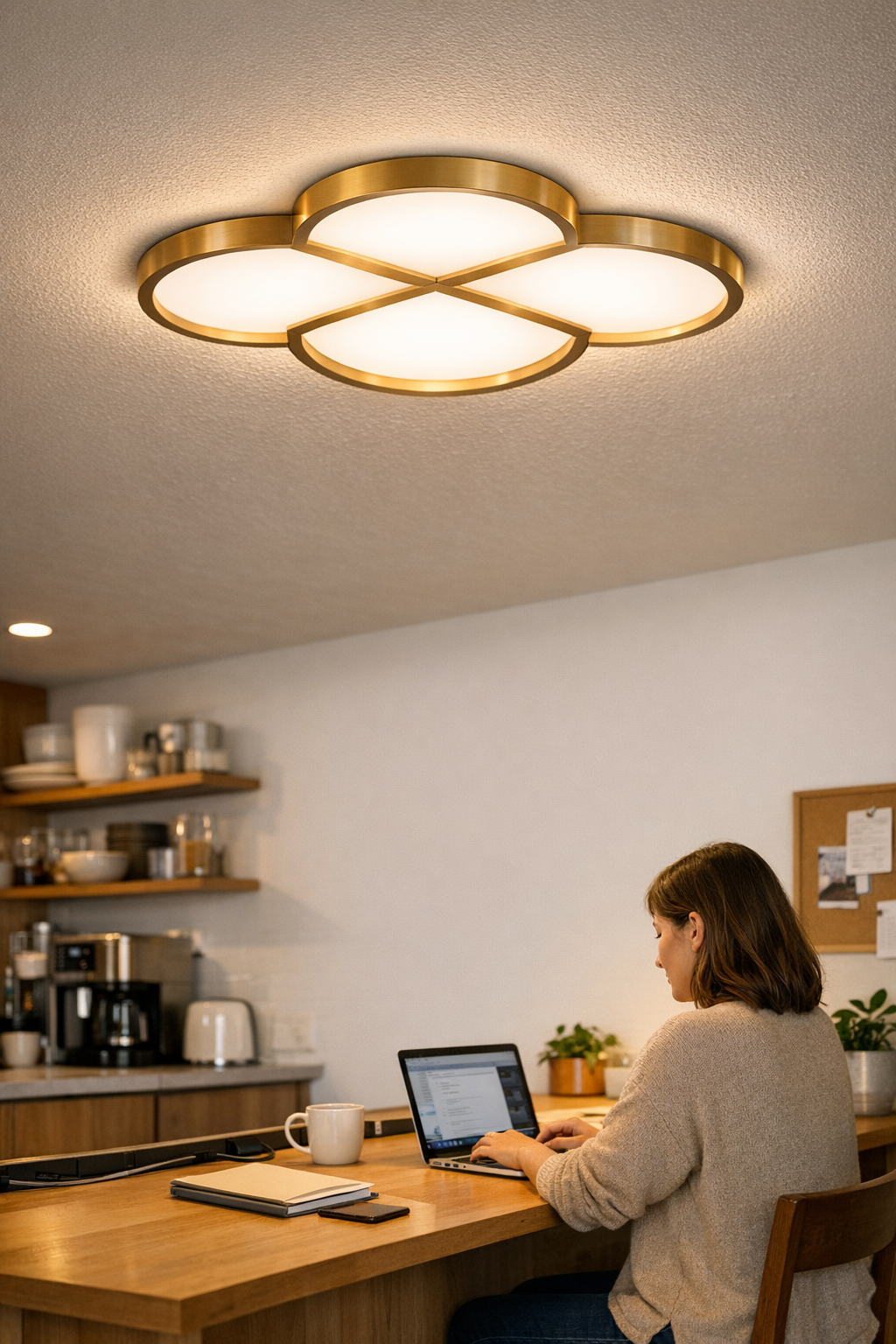
Lighting and support setups fall apart hardest after the first week, right when you need them to just work. The signs: glare streaks cutting across your screen every afternoon, cables that always resurface under your chair or beside your hand, and work edges that stay dim even though the fixture above looks crisp and central. In kitchens, studios, or any shared surface, it’s not the style that wears you down—it’s the creeping inconvenience: rearranged seats, improvised lamps at the edge, and a sense that the more you “optimize,” the more cables and shadows push right back in. This is the friction most lighting photos skip and most rooms keep repeating.
The Everyday Friction of Messy Lighting
If you’ve ducked to avoid a stray cable or caught yourself angling your work so you don’t block the one usable beam, you already know what weak ceiling planning delivers. Spot fixtures and statement pendants look decisive when first installed. Yet after a few days, it becomes a juggling act: overheads cluster together, cables snake along edges, and you’re physically working around the limits of the setup every time you reach, swivel, or pull up another chair.
Most installations chase symmetry at rest and forget the movement, repositioning, and adjustment that happens dozens of times in actual use. The centered fixture leaves islands of darkness at the margins; “clever” cable routes slide back into sight every time you reroute a device. Wall brackets that appeared flush on paper now occasionally jar elbows or narrow your reach at the busiest stretch. Even as surfaces seem tidier, every step or task reveals a new interruption.
How Linear and Panel Lighting Change the Equation
The shift comes with broad, low-profile coverage. Instead of clustering light in one spot and hoping the rest falls into place, linear and panel LED fixtures spread usable illumination right to the edges—eliminating underlit corners, reducing glare at the desk, and keeping everyday movements clean.
On long tables, counters, or shared setups with chronic cable creep, these fixtures adapt to routines instead of freezing them in place. You stop scooting chairs for the “bright patch,” stop fencing with desktop lamps, and start noticing fewer tripping hazards at the cable points. The daily annoyance isn’t defeated by looks—it’s resolved by an arrangement that holds up through dozens of uses, not just before the room photo.
Scene: The Narrow Table Dilemma
Imagine a kitchen-length worktable: one simple ceiling light, everything looks calm. But within days, every tool and notepad drifts beneath the only bright cone. Margins go dim. Extension cords and clamp lights sprout along the sides. Anyone grabbing a charger, shifting a tray, or pulling out a stool inevitably knocks a cable loose or knocks the light out of aim. No matter how neatly cables were tucked on day one, they keep sneaking back into view and snagging sleeves.
In shared rooms, every move multiplies the problem: a bumped cable tangles up two seats, an unplugged lamp breaks up the conversation zone, and glare sneaks in after each seat shuffle. Order unravels the instant the room is used by anyone except the installer. Clean lines overhead didn’t solve dirty friction on the ground. The setup looks better than before, but repeatedly feels unfinished.
Making the Shift: From Clutter and Glare to Clean, Functional Illumination
Actual clarity comes by replacing scattered points and piecemeal cable runs with a panel or linear fixture set to your surface—not just your ceiling’s geometry. If your desk is ringed by brackets and cords, a flush panel above the active work area instantly puts light where your hands and eyes land—removing the need to drag in side lamps, and letting shelving or monitors stay put without fighting for the “good” spot.
The difference isn’t cosmetic. That low-profile, edge-aligned fixture allows brackets and cable channels to stay invisible in the path of use. Corners that lived in shadow now pull their weight. Cables once crossing footpaths get routed clear in ways that actually last. Bracket and channel choices finally support the rhythm of work instead of blocking it—holding cables out of elbows’ reach, not merely out of sight lines.
After adjusting, you catch yourself not needing to adjust: plugging in the laptop doesn’t spill the charging cable over your desktop, notes stay visible regardless of the hour, and you aren’t twisting trays to chase a brighter angle. The fixture stops being a piece to manage and becomes a quiet piece of the space—support receding into routine.
What to Watch For with Every Setup
First-day neatness hides long-term annoyances. Even a flush globe, centered and “clean,” can blind you from the side or leave the busiest edge in shadow. Smart cable tricks fail if the lit area misses where you sit, read, or reach. Wall brackets that look invisible at a glance can still crowd hand space by the second week. Routine tells you what’s succeeded: if you keep moving lights, shifting posture, or hunting for clean cable paths, your support system is out of sync with your life, not just your layout.
Visual calm is an illusion if you’re still ducking glare or working around dark patches. Actual ease comes from setups matched to real, changing activities—not a frozen plan. If every day triggers the same workaround, your ceiling or mounting plan needs to do more than look finished.
Where Linear and Panel Fixtures Make the Biggest Difference
Linear and panel lighting transform zones that demand broad, reliable coverage—think dining tables where food and conversation spread, shared desks that host spreading paperwork, or long counters crowded with appliances and arms. These are not spots for decorative pin lights; they’re spaces where uniform edge-to-edge brightness and truly unobtrusive support hardware let the area function without daily improvisations, elbows hitting cables, or lights needing constant repositioning.
For nooks or very focused areas, task lamps still have a part—but they can’t match the core clarity or eliminate the small, nagging interruptions that creep in at the margins of high-traffic surfaces.
Real-World Tips for Cleaner, Smarter Lighting and Support
- Align light with use, not just the center line. Place fixtures where work or conversation actually happens—even if it breaks the “symmetry.”
- Map cable routes to real motion. Run cords to avoid daily stretches, open drawers, and the sweep of arms and chairs, not just to achieve the tidiest appearance.
- Test lighting across active zones. A surface that is bright everywhere is a surface you don’t need to baby or re-aim.
- If habitually shifting a lamp, dodging glare, or chasing a clearer corner, assume it’s the setup—not you—that needs the change.
When It’s Time to Rethink the Setup
When you catch your sleeve on a cable loop again, find a bracket blocking your notebook, or watch your best workspace stay dim regardless of “good” fixtures, it isn’t just a small annoyance. That’s your room telling you looks aren’t enough—the structure still isn’t working. Rethinking lighting and support isn’t a luxury fix: it’s what marks the line between a space that demands daily workarounds and one you actually want to use, without interruption.
Let your lighting and hardware serve your movements, not the other way around. Improvement isn’t proven by untouched surfaces—it’s found in all the routines you finally stop noticing: cables finally out of reach, the shadow that disappears for good, the edge that becomes part of your usable surface instead of a dead zone. That’s where light and support pay off.