
You mount a rail system on the garage wall, line up every hook and bin, and for a moment, the whole space looks transformed—pristine, logical, like it belongs in an organizing catalog. But beneath that picture-perfect order lurks the real test: not how day one looks, but what happens once the work begins. The first week is always the proving ground—when that new system faces muddy boots, hurried grabs, and the constant shuffle of real, unpredictable use.
When “Organized” Breaks Down in Real Life
The slide from order to friction happens fast. Monday morning, you grab a driver with one clean motion and move on. By Friday, those rails—seemingly rigid—have migrated just enough to set off a chain reaction. Handles jut where you expect open space. Bins that once slid out without effort suddenly catch on their neighbors. Returning a wrench becomes a fumble, not a reflex. The system still “works” on paper, but every motion stretches a little longer.
Disorder doesn’t arrive as a collapse. It shows up in nudges—a ladder propped flush against the wall, a broom bumped sideways, or the course-correction required to wheel a cart past suddenly-encroaching bins. Each nudge, each sideways tug, introduces play in the rails and throws the layout just a bit more out of sync. Flow gets interrupted, and throughout the week, the cracks widen.
The Damage You Don’t See on the Surface
Most setups still pass the “drive-by” test. At a glance, nothing seems amiss: rails are up, bins are hanging, nothing has fallen. But the experience in the space has shifted. Now, your path to the workbench means pushing the same awkward cart again, or using your hip to edge aside a once-tidy module that’s started to drift. Overflow piles up on the same stubborn corner shelf—close to the door, always in the way.
These micro-annoyances build momentum. The gap opens between “fits the wall” and “fits how you work.” In a cramped garage or a tight shed corner, a rail that drifts means turning a reset into a full-on scramble—minutes lost just because nothing lines up as planned.
From Day-One Order to Midweek Clutter: A Real Example
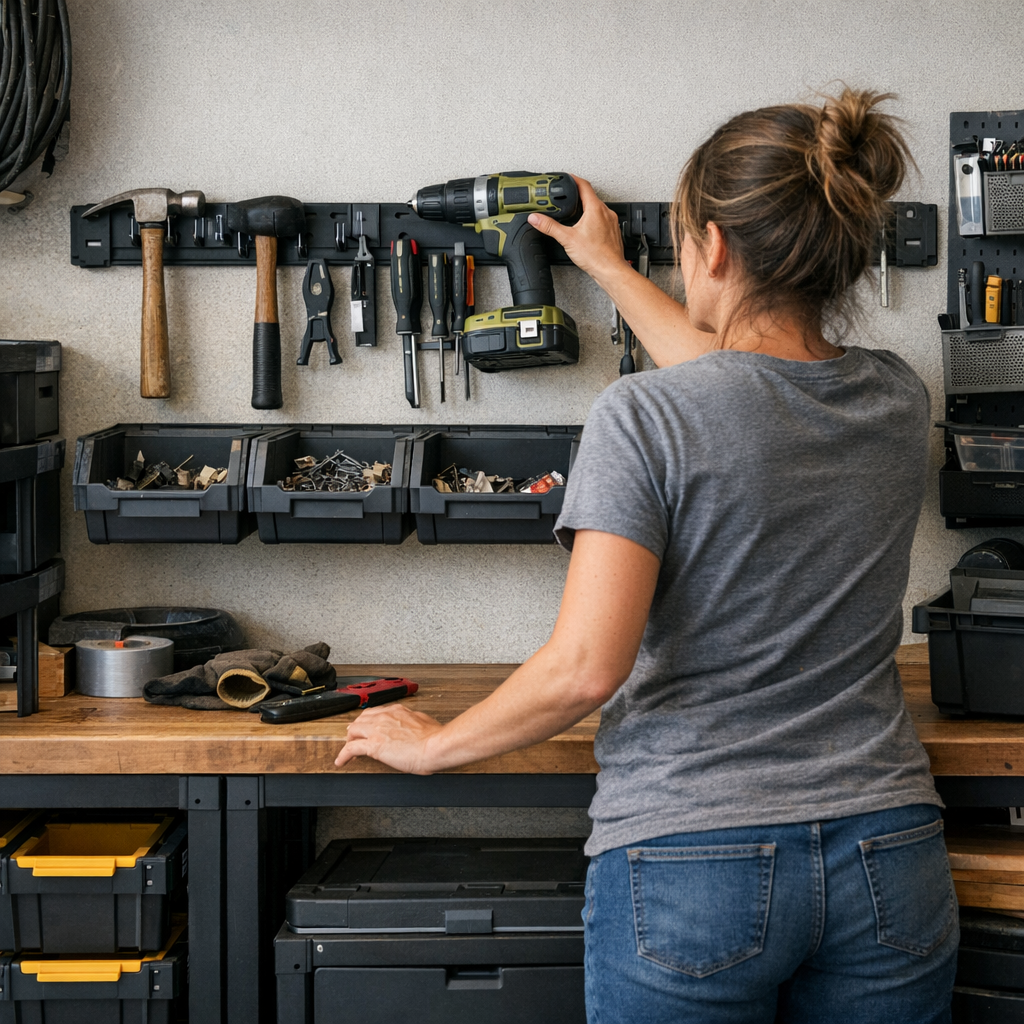
Here’s how it looks in practice: on my wall, everything was dialed in—hammers, small bins, the drill charger lined up beside the vice. Then, after a round of spring cleaning and a neighbor stacking hedge trimmers too close, the central rail drifted an inch to the left. Suddenly, bins jostled for space, hooks veered off their familiar pattern, and the “grab and return” motions got clunky. With each use, I found myself reaching awkwardly behind a creeping bin just to snag a socket, or gently lowering a driver back, hoping not to send the adjacent hook spinning.
It didn’t become chaos overnight, but it made everything slower. The flow of the wall—the ease that made the whole setup appealing—got replaced with hesitation and little corrections. Every micro-shift left a mark. A few seconds lost here and there became minutes over the week, and the space I’d organized became just another thing to manage.
What Really Moves Rails—and Why Most Setups Drift
The trouble isn’t vertical weight. Most rails will hold up heavy tools just fine on day one. It’s the sideways stress—constantly bumping, reaching, shifting tools and carts during actual use—that works against the weakest anchors and hardware. Slide a bin with the wrong angle, get careless with a rolling toolbox, or return something off-pattern, and suddenly the rail isn’t quite where you left it.
These lateral pressures are invisible in the instructions but relentless in practice. Over weeks, rails flex and creep; hooks twist loose; bins lose their “just right” alignment. The wall you built to smooth out your routine starts introducing little friction points into everything you do.
The Real Difference: Pretty Walls vs. Smooth Routines
Order isn’t just how it looks—it’s how it moves with you. Relying on what’s “straight enough” by eye means missing the slow drift: the repeated effort to scoot a cart aside, the zone that swallows overflow, the return trip for the wrench you should have been able to grab blind. Over time, real functionality gets hidden behind a façade of order.
What Actually Kept My Setup Solid
My fix was practical. I ditched the generic rail screws for hardware made to handle real side-loads—longer anchors set for both pull-out and shear force, especially in drywall sections without accessible studs. After installation, I torqued every fastener down, then checked for play after two heavy-use days. After the first week—half a dozen frantic project resets later—nothing had shifted. Each hook still lined up, each bin slid out easily, and returns landed in place on the first try. The space looked clean, and it moved cleanly, too.
Making Stability the Default—Not the Afterthought
If you share a workspace, wrangle gear in a small garage, or know the pain of a “just organized” space falling apart under pressure, anchoring for side-stress isn’t optional. It’s the move that separates walls you redesign three times a year from walls that actually serve the routine.
- Don’t trust “any screw will do.” Get anchor hardware rated for real lateral force—especially if your rails see carts, scooters, or garden tools coming and going at odd angles.
- Make the first month hands-on. Once a week, forget how the wall looks. Take a minute and deliberately shove, pull, and wiggle. Small shifts reveal weak points early, when they’re easy to fix.
- Understand mobile modules are temporary order. The more your system flexes or rolls, the more discipline it takes to maintain. For most setups, fixed rails deliver the kind of routine-proof stability mobile versions just can’t match.
What You Actually Notice After a Month
The change doesn’t announce itself—it just sneaks into the daily pace. A rail system that stays anchored stops bins from drifting and keeps zones from blurring together. Your path stays clear, resets shrink down to seconds, and the frustrating back-and-forth across the space fades away. You stop thinking about the wall entirely, and just move.
Shelves that used to end up as dumping grounds keep their shape. Dead corners become reliably useful. Reshuffling turns rare. Everything finally returns to where it belongs, without the sidelong glance or second adjustment.
Ignore the Subtle Creep, Lose the Fast Routine
Every modular system looks like order at first glance— but only setups anchored for real lateral use hold up to the mess of everyday life. You might not see the difference at a distance, but you’ll feel it every time you reach for a tool or slide by a crowded bin. Secure it for the way you actually work, and the reward is a workspace that’s not just tidy, but truly in rhythm with your routine.
Find reliable modular rail and wall systems for real-world organization at StackNest.