
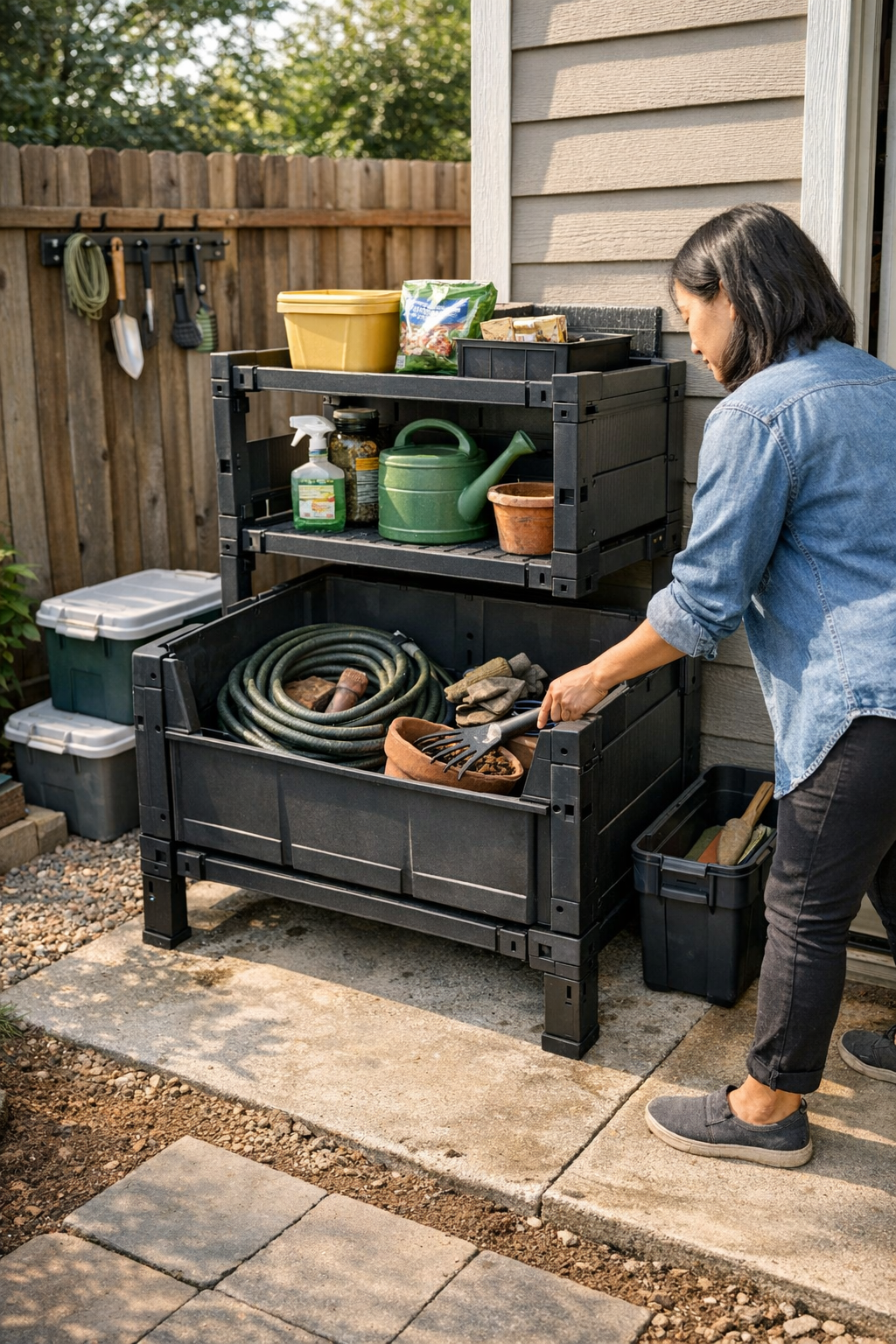
The real test of any outdoor setup starts at the threshold: that patch by the door where routines either flow or stall, depending on what gets dragged back in. You set down a bin, thinking you’ve bought yourself order—a place for muddy gloves, stray twigs, the hand tool you nearly leave on the lawn. For a few days, it works: less chaos, more space to step inside. But friction always finds the weak spot. Suddenly, clutter reappears in the corner of your eye, and the so-called landing zone is just reshuffling the mess, not containing it.
When Outdoor Entry Turns Into a Trap
Bare ground by the entry is the easiest invitation for chaos. By Tuesday, wet boots have laid a trail of leaves. Thursday, garden stakes from last weekend are still propped awkwardly against the wall. Every return from the yard adds another layer—one more item dumped, one more object blocking just enough of the path that you start sidestepping or shoving things aside on autopilot. There’s no clear zone, just a growing tangle in the spot you cross the most. A reset isn’t “set it and forget it”—it’s a lopsided shuffle, again and again.
When the Bin Makes Things Worse
So you add a bin. Maybe it’s a repurposed tub, a wide plastic tote, or a leftover storage barrel. One week in, the real pattern emerges. The bin’s too low, so you kneel or bend every time you return pruners. Its sides are wobbly, the rim’s too high, or the opening’s narrow—so tools, scraps, and debris teeter on top, sliding free at the first bump. Walking through means swerving around half-fallen piles. Even the quick job—grabbing gloves and dropping off sticks—means wrangling with what should have been a solution, not another obstacle.
How Overflow Steals Your Flow
Overflow destroys the rhythm: you notice when you have to nudge a shovel just to open the door. Rakes go from “put away” to balanced awkwardly against the wall, slowly sagging into the footpath. Each tool that can’t go inside is another barrier. Reset time stretches out—shuffle, scoop, shift, repeat. Sometimes the footprint looks “contained,” but it doesn’t feel clear; every reset reveals spillover creeping out, and you’re managing the zone, not moving through it.
Invisible Frictions Make Or Break the Routine
Most clutter doesn’t explode overnight. It grows from those in-between moments: you rest a shears on the rim “just for now,” toss a handful of sticks in the bin but miss, notice a child’s boots wedged under the tote lip. Before you realize it, the clearing by the door morphs into a jumble of items you meant to organize. Shared-use spaces—side yards, patio entryways, garage crossings—are the worst. Everyone’s routine leaves a trace, but no one’s system fits how the area is actually crossed during a busy week.
Why Bin Design Actually Matters
Most bins aren’t built for outdoor flow—they’re built for capacity or looks. A better design sometimes comes down to a single measurement. A lowered front edge (no more than a foot off the ground) and a sturdy, slightly elevated base transforms the return—no crouching, no fighting against a tall lip. The broom actually sweeps out the debris instead of scattering it. Oversized tools go in, not balanced precariously outside. It makes the “reset” invisible—a quick motion rather than a repeated struggle.
Spotting When the System Breaks Down
After a marathon weekend—kids cycling through yard projects, a big rake-up, rain-lashed boots launching leaves inside—the pressure test is not what the bin holds new, but how worn-in the space feels afterward. Look out for:
- Tools clogging up the zone beside the bin, stranded outside because there’s no real fit
- Scraps teetering on the rim or sliding into corners but never quite gone
- Needing to side-step your own system to reach the door
- Overflow forming a new pile in the direct walking line
These aren’t theoretical flaws—they’re interruptions you feel every single crossing. The difference between “looks sorted” and “functions clearly” is one too many resets that don’t actually clear anything.
Real Scene: When “One Bin” Isn’t Enough
Take a narrow strip running the length of a fence—a utility lane meant for fast grabs and landings. You set a plastic tote under the eaves, thinking you’ve finally contained the routine. Day one, it’s fine. But by Friday, the inside is blocked by a tangled hose. Old gloves pile on the far corner. Bags of soil slump against one wall, and there’s a slow ooze of twigs and mud trailing across the bricks. Suddenly, the “out of sight” look is hiding a jammed-up reset. Every time you cross, you have to dig or drag something aside before you actually use the path.
Now swap that for a bin that’s been considered: solid, slightly lifted, with a clear edge at sweep-height. The path clears for every trip, not just the first. Tools drop straight in; leaf litter flicks from broom to bin in under a second. The dead corner stays useful—no more awkward gaps waiting to swallow boots. Even on busy days, resets don’t balloon into a full cleanup, and the area feels passable, not provisional.
The Power of Noticing Small Setup Flaws
Every weak detail—bin placed too low, entry edge too high, base that sags—sets up the next cycle of slowdowns. If you’re pushing bags aside just to create a landing, or picking up the same scrap pile twice, the system isn’t broken but it isn’t working for you. The moments when you notice yourself hesitating or rearranging mid-task are the clues: the layout fit the space, but not the way you actually use it.
Entry Zone Reset Tactics That Actually Work
- Audit your resets. Check what collects outside the bin—do the missed returns form a pattern?
- Size honestly for returns. If half your drops are bulky or odd-shaped, upgrade to wider access and firmer sides.
- Lift your landing zone. Even a few bricks or a solid base create a target for quick sweeps—less bending, less sifting through mud, less impromptu flood control.
- Set a reset trigger by spill, not schedule. Overflow signals you’re about to hit a wall—reset before walking paths shrink to an awkward shuffle.
Function First: The Real Mark Of Organized Outdoor Space
A bin that just “looks good” lulls you into accepting slow, blocked movement and constant micro-resets. The setups that work are the ones you barely notice—where resets shrink instead of grow, and the only footprints visible are the ones heading in and out, not swirling around a tangle. Function in busy, real yards doesn’t mean zero clutter; it means every return finds a place, and each crossing happens without hesitation.
Find practical outdoor organization solutions at TidyYard.