
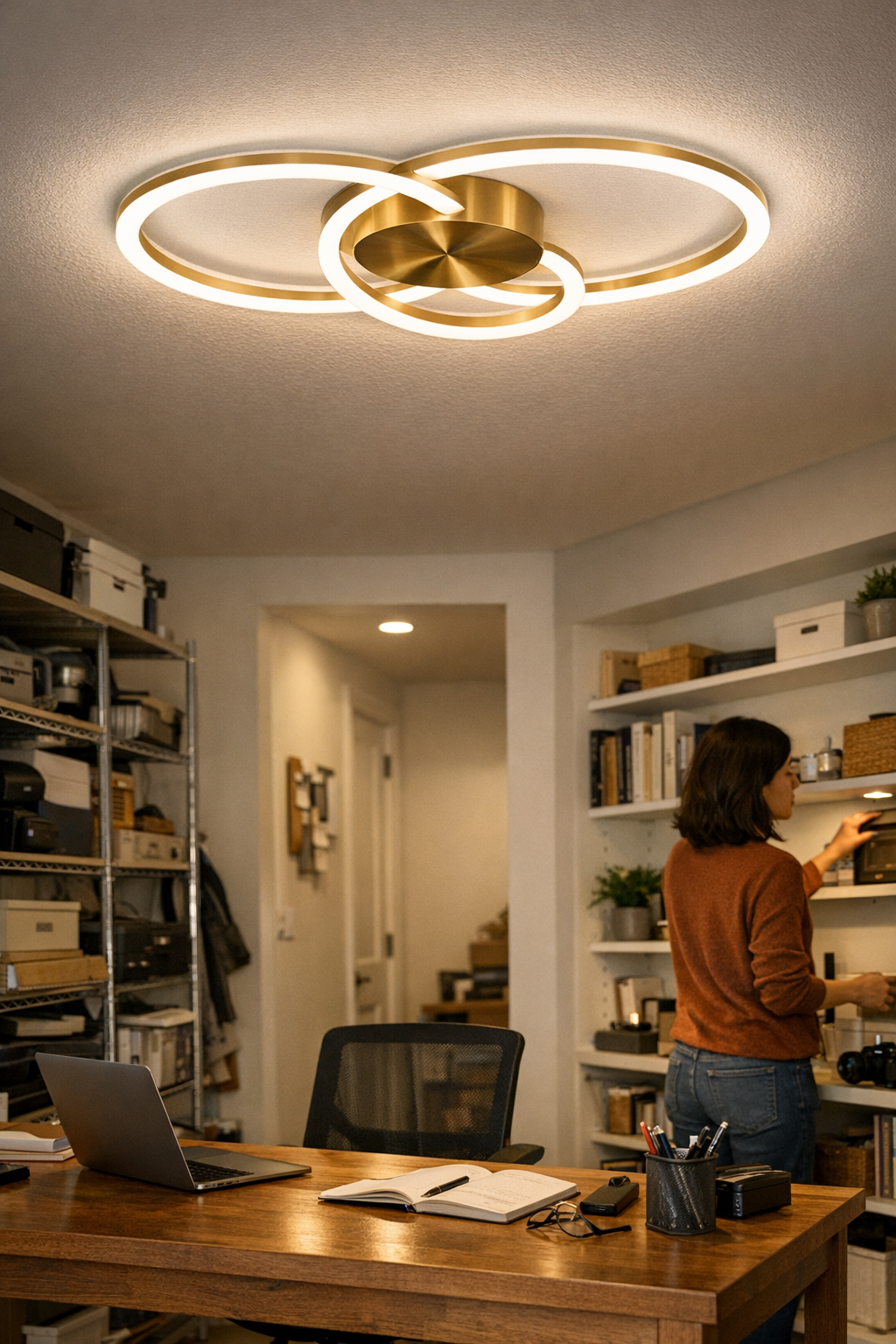
The real weakness of shared rooms filled with a mix of desk and floor lamps isn’t subtle—it shows up every time you plug in one more cord, shuffle the lamp for a better angle, or catch yourself glancing at cables before even noticing the room. A patchwork lamp setup might feel flexible at first, but in daily use, it turns into a sequence of micro-annoyances: dim edges just out of reach, exposed cords rerouted around chairs, and glare that never fully disappears. This quiet friction is what keeps routines off-balance: every “fix” for a dark spot creates a new loop of distraction, and the space keeps demanding more work just to stay useable.
The Patchwork Problem: Lamps Fix Spots, Not Spaces
Step into any shared room depending on freestanding lamps and you’ll see it. What started as a “smart” lamp in each activity zone—reading, working, relaxing—turns patchy fast. Each fixture throws a contained pool, leaving surface edges lurking in shadow. Add more lamps and the lighting never truly evens out; instead, cords start dictating paths around desks and under tables, forcing people to walk the long way or trip on a surprise slack loop. Suddenly, the urge to move the lamp or untangle a cord becomes part of the routine, and function slips while clutter creeps in.
The longer this setup stays, the more energy goes into managing the light instead of using the space. Rearranging cords becomes chore number one. Someone’s always nudging a lamp, shielding their eyes from glare, or stretching to see beneath a shelf. Spaces that double as work and circulation zones become tension spots: there’s always a task or a corner with a dim, inconvenient edge or a cable waiting to catch a foot.
Ceiling Lighting: The Step Up Most Spaces Need
When you swap scattered lamps for a ceiling fixture, the difference isn’t subtle—it’s structural. Ceiling lights cover the whole area, pushing even, reliable light across work surfaces and walking paths. Suddenly, you’re not rotating lamps between tasks or negotiating who gets the best lighting for that project. Surfaces stay visible; clutter drops. The drag of cord-removal, lamp-shifting, and glare-checking mostly disappears.
Put this to the test: try finishing a group project at a wide table. With lamps, there’s always someone caught outside the pool of brightness, scooting a light for edge papers, or stepping over a cable half-hidden under a seat. Switch to a ceiling panel above the main zone—now, nobody’s covering shadows with a hand, no one’s dodging a cord just to stand up, and the whole table sits in stable, consistent light. The only risk is a fixture positioned too far off-center or a panel that throws glare, but those are easy to see and fix; the baseline leap in usability is immediate.
Beyond Appearance: Why “Neat” Isn’t Enough
It’s easy to mistake a tidy lamp cluster for a working solution. Cord wraps and careful placement can make a space look settled—for about a week. Reality settles in when someone moves a chair, and the cord drags loose, or the lamp gets bumped off-angle. Routines devolve into endless small corrections: bending to re-coil cables, moving a lamp because a book or laptop blocked the spread, or trying to smooth the cord that’s always just a bit too exposed for comfort.
The right ceiling light solves this at the source: Raising the lighting up and off the surfaces frees every desk, shelf, and chair for real use, not cable management. It’s not just a better look—it’s a setup you don’t have to keep perfecting every day. The system becomes harder to break, and daily routines run cleaner because nothing is waiting to snag or shift at the edge of comfort.
Scene in Focus: The Shared Workspace That Stays Frustrating
Picture a narrow, lived-in workspace edged with shelves and scattered devices. On paper, several small lamps—one for the desk, one under the shelf—should be enough. In practice? Shadows show up at eye level and beneath shelves, right where small things disappear from view. To actually see into the corners, you find yourself leaning awkwardly, and cables bulk up in the tightest spots, waiting for a chair wheel, backpack, or shoe. Sessions start and end with two minutes untangling something, resetting a lamp, or tugging at cords to prevent a snag. Efficiency drops before the work even starts.
Introduce a ceiling panel—replace the lamp collection with one well-placed fixture overhead. Now the previously dull shelf edge stays clear even as daylight fades. The walkway is finally free—no more cable bumps at foot level. The main activity zone gets full light, so you’re not stuck staging everything under that one “good” lamp or splitting focus between shadows and glare. The disruption cycle ends: the space cooperates instead of fighting back.
Real Consequences: Routine Disruption Adds Up
The cost of lamp-based setups doesn’t just add up—it compounds. Each time you stop to adjust a light, reroute a cord for a Zoom call, scoot a lamp toward a drifting shadow, or shift your chair out of a half-lit zone, you lose time and focus. Shared spaces—coworking rooms, home-offices, anywhere routines overlap—get stuck in constant minor resets. Every new user inherits last session’s tangle and shadow, and the whole process repeats, creating a loop of small but real disruption.
Ceiling Lighting Is Rarely a Perfect Cure—But It’s a Better Baseline
No setup escapes trade-offs. Ceiling fixtures fix the repeated annoyances of lamp scatter, but only if they’re positioned to match the real work and walk zones. A panel set too far off pulls the shadow back in, and harsh bulbs can bounce glare if spread is ignored. Still, for most compact or mixed-use rooms, moving from a lamp patchwork to ceiling lighting neutralizes the main routine breakers. It means fewer cable piles, no clumsy lamp shuffle, and near-total surface visibility. Sometimes you’ll still want a small lamp for detail work or warmth—but you lose the endless cycle of untangling and readjusting for basic clarity.
Small Shifts, Lasting Gains: Where the Value Shows Up
A space can appear finished and still trip you up every day. The practical value of shifting to ceiling lighting reveals itself less in appearance and more in the vanished distractions: reaching for a file without fishing for a cord, scanning the shelf without squinting for contrast, setting up for a new task without needing to rearrange the room. The room stops announcing its lighting problems and starts quietly supporting whatever happens in it. That’s the shift between a space that’s just “put together” and one that finally works—routine after routine, even as needs and layouts evolve.
Find practical lighting and support solutions at LightSupport.