
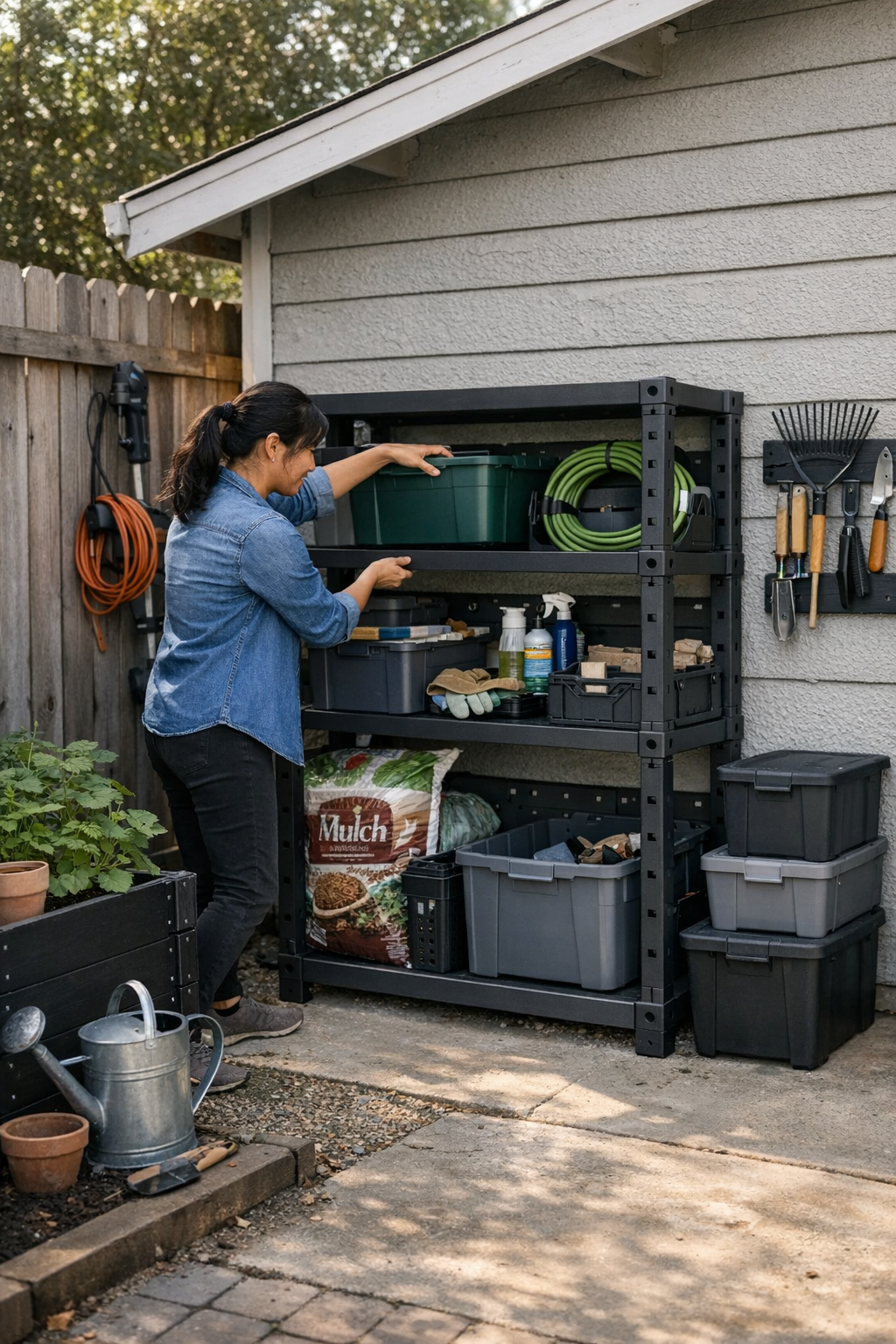
In a narrow backyard or tight side yard, outdoor storage can either make your life easier—or quietly trip you up every single day. It’s not just what you buy, but where it actually sits. Stick a bin, cabinet, or bench in the wrong spot, and soon you’re side-stepping bikes, shifting bins out of the pathway, and wondering why every reset feels like untangling a knot.
Where Storage Sits Is the Difference
Most people shop for outdoor storage by thinking about space: biggest box, tallest shed, whatever holds the most gear. But in small, hard-working outdoor spaces, the real challenge isn’t volume—it’s movement. That sleek bench or easy-access box looks sharp in the middle of a walkway or play area on day one. By the end of the week, it’s already in the way: bikes get wedged, trash bins block the main route, and what started as ‘organized’ quickly turns into a maze of obstacles you have to dodge just to take out the trash or carry groceries in from the car. Every time you squeeze past, the friction adds up: one awkward sidestep, one box nudged just enough to make the reset harder.
Most setups don’t fail all at once—they wear you down. That “nearly fits” layout that seemed fine at first becomes the silent reason you skip putting the rake away or leave the kids’ gear on the edge of the patio. Suddenly, every trip outside has a small but persistent hassle built in.
The Edges vs. the Center: Clearing the Pathways
In mixed-use yards and narrow strips—think bikes, bins, mowers, and a soccer ball all fighting for the same territory—storage needs to mark the edges, not the middle. Push gear up against the fence, under eaves, or flat to the wall, and you un-jam the main flow. Leave a bench or shed in the center and choke points form—sometimes slowly, sometimes instantly. Picture kids coming home and trying to park bikes along a path already squeezed by bins. Parents maneuvering the grill have to slide a tool rack out of the way just to reach the fence gate. It doesn’t take much before you’re shuffling every time you cross the yard.
Overflow piles up fast when there’s no buffer along the boundary. Centrally-placed storage ends up blocking every possible route after only a few new arrivals: stray toys on the walkway, chair legs sticking into the path, a garden cart marooned in the open because no better spot exists. Every pass-through becomes another loop around congestion. Eventually, even putting something away turns into rearranging half the zone first.
Real Scenes: The Micro Friction of Small Setups
Picture a Tuesday evening. The quickest way to the bin is blocked by a wheelbarrow slid too close to a storage box. You set a ball down ‘for a second’—now it’s a fixture for days. Routines slowly break down: putting things back takes twice as long, and stray gear ends up living wherever it landed last because the storage wasn’t truly out of the way.
Or it’s Saturday morning yardwork. You reach for the rake buried behind a half-open storage bin in the middle of the walkway. Getting it back means lifting lids with one hand, bracing a shovel, and squeezing past a bike that’s now wedged even tighter. Mowers roll through crooked, paths get bottlenecked, and eventually you give up and leave tools out. Small interruptions compound until ‘just for now’ clutter becomes semi-permanent, littering the ground you need to use.
How Shifting to the Edge Changes Everything
Sliding storage units right up to the fence or wall—even if that means losing a few centimeters of depth—instantly cuts down on awkward workarounds. The open path stays clear, so walking through with a bike or wheelbarrow feels unrestricted, not like threading a needle. When tools, bins, or toys need to go back, their return spot is obvious and friction-free. The reset becomes a few quick moves instead of a game of outdoor Tetris.
In one real-world fix, moving all racks flush to the fence (with just enough room for a handle or two) meant bikes once dropped on the patio found a repeatable home. Overflow stopped eating into footpaths. No more stalling while you figured out how to arrange everything just to mow the lawn. Edge storage gives the main area a clear job: for movement, not for parking clutter.
Test First: Walk Your Routine Empty
Before adding any storage, lay out the pieces (empty!) where you plan to put them. Walk through the space as if it were a typical weeknight—haul the bike out, pick up toys, imagine taking the trash to the curb. Is there a spot where you have to angle sideways or move bins twice just to keep moving? If so, that’s your pain point. Slide the storage to a boundary and test again until movement feels as close to automatic as possible. Don’t squeeze more in hoping to achieve ‘maximum storage’—protecting the flow is what keeps the yard functional.
Small Yard Pitfalls: Where Setups Keep Failing
Overflow traps and junk corners: If you notice a low corner always collects random clutter or you dread reaching for gear because it’s wedged behind something, your current layout isn’t holding up. Dead zones signal storage that’s “out of sight” but never easy to use or put back.
Wall systems that block more than they help: It’s easy to slap hooks up everywhere, but if you have to move a hose reel just to grab a broom, you’ll start defaulting to the floor. Wall space only counts if it speeds up—and never slows down—the routine.
Modular pieces becoming moving targets: Stackable bins and rollable benches are great in theory, but in practice you end up shuffling pieces anytime someone else needs to get by. If everything needs to move twice for one thing to go away, the whole system wears out its welcome fast.
Let the Edges Do the Heavy Lifting
Sticking to the boundaries isn’t a magic bullet—but it’s the single setup shift that pays off in time saved and frustration avoided over weeks and months. Even after a backyard barbecue or muddy yardwork session, you can shove things into their edge homes and keep the center usable—no epic resets required. Routines stick, flow stays open, and even if life gets messy, the clutter doesn’t blockade your basic movement.
Perfect yards don’t exist, but setups that work after real-life use are possible. When storage stays on the edge and movement remains effortless through the middle, there’s less reason to slip into bad habits—and way less time lost just getting things back under control.
For more practical outdoor storage ideas designed for real setups and repeated use, visit TidyYard.