
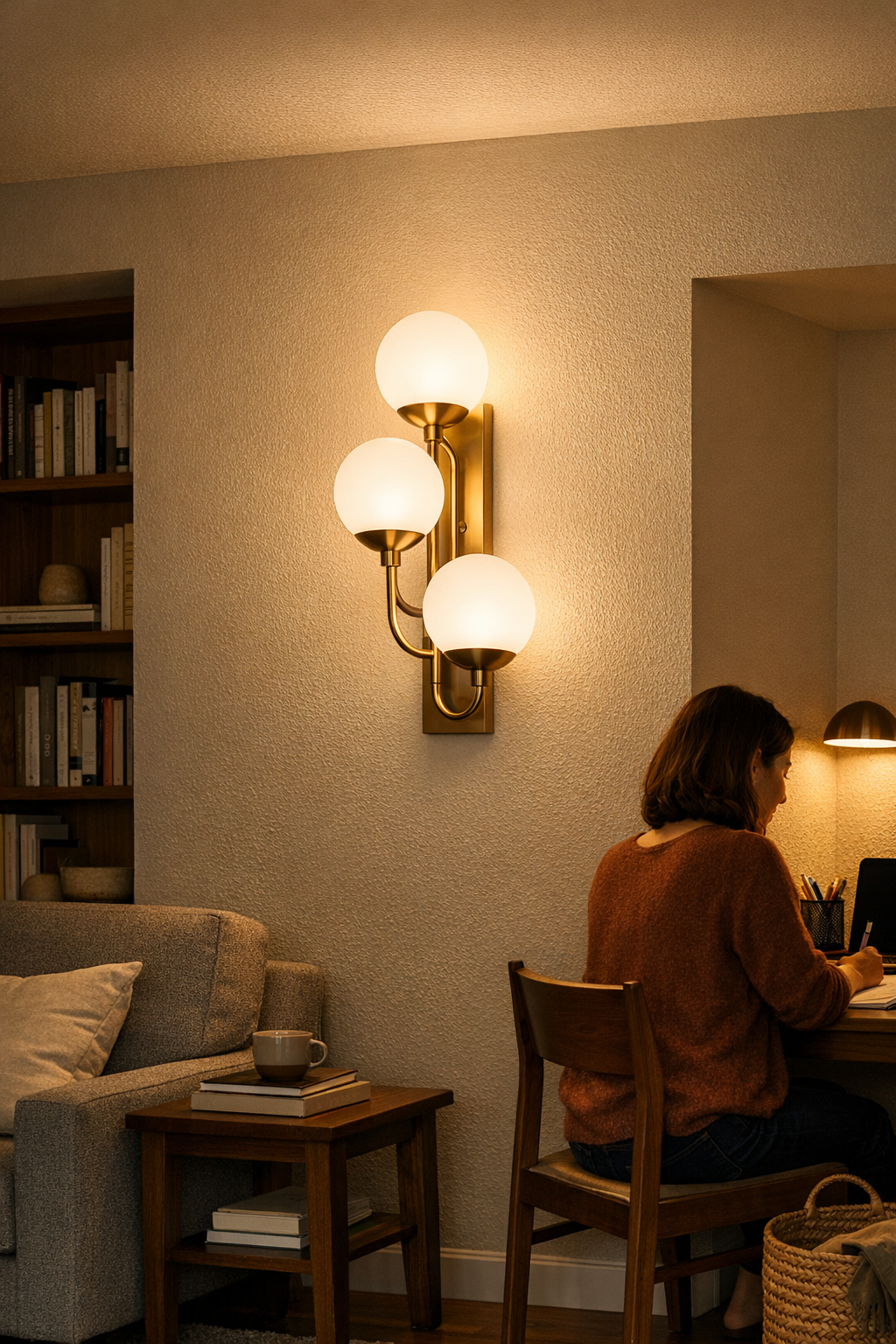
A ceiling light claims to finish a room, but it rarely finishes the job you need. Even in an uncluttered space, overhead-only lighting quickly reveals harsh gaps: shadow creeping over your desk as evening hits, the corner armchair left straining your eyes, workstation edges barely visible unless you lean and chase lamp positions. The cable mess might be gone—until you start dragging in floor lamps, clip-ons, or power strips, all in search of real, usable light where the clean ceiling fixture keeps falling short.
Ceiling-Only Lighting: A Setup That Stops Short
A single ceiling fixture promises order. No wires tangle across the floor, sightlines stay unbroken, and the room looks architecturally “done.” But the appearance is deceptive once you try to work, read, or relax at the room’s edge. Sitting at a side desk, you’re forced under a band of shadow. Typing late, the desktop feels consistently underlit and uneven. So the cycle starts: a floor lamp lands by your chair, a table lamp appears for the far end, then another along the wall—a patchwork escalation that never truly covers the gaps. The space stays tidy in theory, but whole work zones and room edges stay awkwardly dim in practice.
Where Overhead Lighting Falls Short in Everyday Use
Overhead fixtures spill general light downward, but the beam misses real-life surfaces: desktops along the wall, alcove workstations, or shelves where you fumble past shadows. The edges and corners always feel off, no matter how strong the bulb. The room’s center glows, but shift your seat closer to a wall and your own shadow—plus the shadow of the furniture and shelving—moves right across the task spot you actually use.
Another problem: glare becomes hard to avoid. Angle your chair wrong and that neat ceiling fixture highlights everything except your work, even reflecting right into your eyes when you glance up. No visible cables, but just as much arranging and readjusting now happens at the activity layer—not in the fixture plan above your head.
Adding Lamps: Patchwork Solutions, New Problems
The typical fix is to gather more lamps—one for the chair, one beside the desk, another clipped to shelving—each with its own cable that starts to show up before the light does. You get a burst of coverage, but at a cost: visible cords everywhere, an overcrowded surge protector, and a creeping sense that you’re working around the lighting instead of with it. Cables angle from power strips through open pathways, and walking across the floor now means navigating a maze of cords and unstable lamp placements.
Each added lamp brings its own problems. Bump a chair and the lamp shifts, casting an instant shadow where you just cleared one. Glare spots shift to new surfaces—never quite aligning with where your eyes or hands need help most. And that “dark spot”—often the same workspace or reading corner you aimed to fix—never fully goes away, proving that you can multiply lights but still miss the actual solution.
Why Effective Wall Lighting Changes the Routine
Wall-mounted fixtures address the recurring mismatch: a space that looks finished but never feels resolved. Instead of endless plug-ins, a well-placed wall light pushes targeted brightness straight to the chronic dim zones, without adding clutter or giving up floor space. The difference isn’t theoretical—it’s obvious the first week you actually live with the change.
Take a family room where only the ceiling light is fixed. The space looks clean until regular life kicks in: homework on a side desk, evening reading against the wall, or game night at a deep table edge. Shadows return to every surface you care about, and you end up back at square one, dragging a lamp around and unplugging cords just to open a cabinet or shift a chair. The whole lighting “plan” becomes nightly maintenance. Install a wall light above desk height and angled toward the seating or table edge, and the routine flips: the reading chair stays lit, the workstation edge is clear, the path is open—all without the cable sprawl or rearrangement ritual. Now the fixture supports how you actually use the room, not just how it looked at move-in.
Placement and Setup: Details That Decide Everyday Comfort
The real gain isn’t from more light, but from smarter light—delivered by placement. The sweet spot: mount a wall fixture above eye level, below the ceiling, so the beam stretches across both your task surfaces and adjacent seating without flooding the space. High placement misses the desk and drops shadows; low placement throws glare back at seated eyes. Mistakes show up fast: place a fixture too close to the corner and one half of the shelf or wall glows while the other is back in the dark. The right wall light is all about coverage that matches routine use, not just architectural lines.
Supporting Elements: Keeping the Setup Reliable and Clean
Support details decide whether your lighting becomes invisible—or a daily distraction. Flimsy brackets and loose wall mounts don’t only look precarious; they wobble after a week of accidental bumps, pulling the wire further into view and breaking the sense of stability. Cable runs left to dangle turn even well-placed lighting into a visual tripwire—especially in shared spaces or high-traffic zones. Tidy, solid support and controlled cable routes are what keep the actual space working: you move freely, adjust furniture, and the light never becomes part of the room’s daily struggle.
Real World: Before and After the Move to Wall Lighting
On the surface, ceiling plus wall lighting seems like a minor adjustment. But swap out scattered plug-in lamps for a focused, supported wall fixture, and the daily differences stack up. Reading in the old shadow corner stops coming with a head-throbbing squint. The desk’s edge—once a routine guess in low light—is now visible at a glance, making work, crafts, or night reading feel possible instead of patched. The cables you used to shuffle, dodge, or re-tape against the floor slip out of sight or disappear entirely. Both the floor and your line of focus feel less interrupted—more space to use, less clutter to manage or explain.
Most telling: when the setup slips, you catch it immediately. Cables in the open, new shadows at the workspace, bracket shake—the setup’s daily feel goes off before things even look wrong. These are signals: move the fixture, change the bracket, rethink the cable path. Wall lighting lets you tailor the room to fit you—so lingering mess is a warning sign, not something you have to just accept.
Tips From Repeated Use: What Makes the Difference
- Test light placement with real routines, not just by standing back. Sit, work, and read where you actually need brightness—notice where shadows land and glare begins, before putting holes in the wall.
- Prioritize cable control from day one. Even the best fixture makes the space harder to use if the cord slips out, sways loose, or bunches up near a desk or walkway.
- Use sturdy, well-matched support for every wall fixture. In shared, busy, or family rooms, a weak mount becomes clutter fast—bracket shake, lamp tilt, or cable tug all show up quickly and start to undo the solution.
Results That Hold Up—Not Just Look Good
Real wall lighting isn’t about style or first-impression neatness. It’s about the routines becoming easier—the desk edge finally clear, the reading chair finally relaxing, the floor finally open for people and cables out of mind. When lighting is set up to support what you actually do—and hardware, cables, and coverage match that routine—focus shifts to the things that matter, not the setup getting in the way. If you’re still shifting lamps, fighting glare, or ducking cables, the space is asking for change—make the fixture serve you, not the other way around.
For products and support that help you actually see and use your space better, visit LightSupport.