
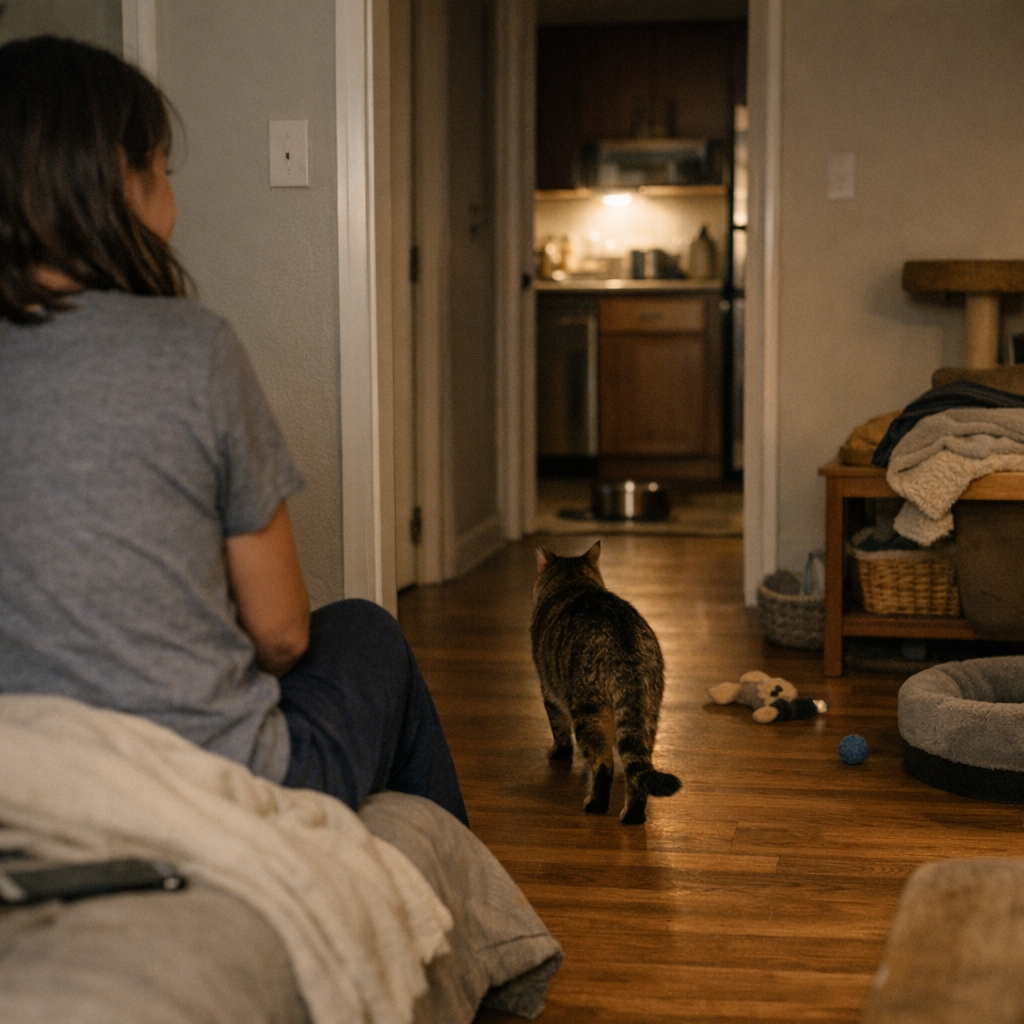
Late at night, just after you shut off most of the lights and try to pull the house into quiet, your cat is already pacing half the rooms. Not a one-off—this is the same routine that keeps popping up: bowl clinks, water just out of reach, a folded blanket nudged apart, toys scattered where you thought they’d all been put away. The evening was supposed to be done, but instead, you’re circling back to half-fixed cat setups, resetting spots you handled an hour ago, and breaking the wind-down rhythm that was almost holding. Every time an area looks finished but fails to hold up overnight, the whole space—kitchen, hallway, couch, mat—feels just a little less settled. This is the kind of nightly friction the right StillWhisker arrangement is built to reduce, if not remove.
The Unseen Cost of Nighttime Cat Pacing
At first, your cat’s nightly wanderings seem minor. But the small interruptions stack up fast—a half-empty bowl means one more detour, a blanket edge tugged loose means it’s never ready for you, a toy finds its way underfoot where you almost step on it in the dark. Nights that should wind down quietly now stretch, with unplanned resets and cleanup creeping into what was supposed to be rest time. The cost isn’t in one big mess; it’s in the rhythm that keeps breaking because one cue after another doesn’t land when you need it.
Every evening becomes a cycle of missed signals. The cat patrols the same paths, pauses by doorways, tests each “done” spot for unfinished business. Each trip is a test—spill, nudge, or rummage upends any fragile sense that the space is done for the night. What looked ready ten minutes ago now feels open-ended, and your own downtime keeps getting nudged further away.
When a Tidy Evening Hides a Repeated Problem
Maybe you straightened blankets, topped up bowls, dimmed lights, and put away tonight’s toys. But for indoor cats, these setups don’t always signal “the end.” If one piece is off—water barely enough, a toy rolling back out, a rest spot not quite right—cat routines fill the gap with another lap, another inspection. That “nearly finished” feeling only guarantees extra interruptions. You catch yourself, again, refilling water you just checked or fixing bedding you thought was settled. The surface looks tidy, but each overlooked gap creates another round of minor fixes—often after you’ve already started to relax.
This isn’t a problem you see in the moment, but one you feel as you’re pulled from a book or sidetracked on your way to bed because the setup “didn’t hold.” The home stays visibly neat, but the effort to keep it that way drags on longer and feels less satisfying each cycle.
Evening Routines That Keep Falling Short
Mistimed resets are all it takes for the friction to return: toys left in the wrong place, water bowls not double-checked before lights-out, litter that gets handled just a little late. Cats notice—and respond—with more searching and movement. Next thing, you’re tripping over a ball you meant to store, kneeling for a water splash on the tile, or grabbing a blanket already bunched up before midnight. The easy calm of the room gets chipped away by these small, repeated breakdowns—burying your downtime under a layer of small, necessary course corrections.
If every reset finishes out of order, or the tools to handle it aren’t where you need, your evening gets stretched thin. Even good organization loses its grip, and small failures show up in the slow drag of routines that never quite click into place.
The Light Shift That Quietly Alters Nighttime Pacing
One detail makes a difference fast: dimming lights 30 to 40 minutes before your cat’s usual pacing window, not after. Start early and the shift sends a clear, physical signal—“night is closing.” It isn’t instant, but after a few nights of preemptive dimming, patterns shift:
- Almost no pawing at water after 10pm—bowl checking drops off
- Blankets stay folded and used, not restlessly poked and left in piles
- Cats settle—actually settle—on beds or mats instead of fidgeting
- Cleanup for water, toys, or mess outside the “cat area” drops noticeably
It’s not a theory. If the signal comes early and every cue lines up (water, toys, blanket, light), you stop scrambling to “jump ahead” of your cat’s pacing. The new routine slides in with much less pushback, and late-evening work shrinks down to a few easy steps.
Why Syncing Cues Works—And Where Gaps Still Show
Lighting alone isn’t magic if the rest of your setup is stuttered or out of order. Miss a refill, or leave a toy behind, and the cat’s expectation for one more round stays alive. Repetition matters as much as timing. The smoother setups are the ones where everything clicks in at the same notch every night:
- Consistent feeding time—without nightfall drift
- Water bowl topped before the room goes dark
- Toys rotated and binned in the same order, not left for chance cleanup
- Litter handled in sequence, never lagging behind the rest of the flow
Cats don’t settle for dimness alone—they settle when the sequence closes down fully. Half-done resets, missed tools, or a piece forgotten at the edge all break the illusion of “night finished.” If everything aligns, the signal is clear; if not, the friction restarts.
Scenes from Real Use: Where Friction Builds Up
- Reaching for the water bowl, you have to move yesterday’s mug and a single stray toy, breaking rhythm. The cat lingers—a signal clearly missed.
- You straightened a blanket after dinner, but your cat circles, waiting for a better spot. By the time settling happens, you’re pulled into another room to wipe a corner missed during late cleaning.
- A toy bounces from bin to hallway—step on it at midnight, and the cat’s chasing behind. The “tidy” look lasted for six hours, and now it’s back to reset.
- Wipes or cleanup tools are kept nearby, but never within reach at spill time—the delay lets paws track water further than you intended, or the rug edge picks up what should’ve been avoided.
None of these scenes are dramatic—they’re just the drag of an almost, but not quite, finished setup. Gaps add up, minor corrections pile on, and the routine’s extra fatigue shows up long before you notice it in the general mess.
The Difference Between Looking Done and Feeling Finished
Give it a week with new cues: the room that’s held up well isn’t the one that just looks clean when you walk through—it’s the one that needs no double-checking by midnight. Bowls don’t need inspection later, blankets hold their shape, toys quit returning to shared space, and doors go closed for the night. The point isn’t perfection (cats will still pull a toy out of nowhere or nudge at a mat), but fewer interruptions, easier resets, and a routine that stops eating into relaxation time. What matters is that “done” now holds up through repeated, nightly use—not just for the first half hour but all the way to morning.
Adapting Routines When Lighting Isn’t Enough
If dimming lights before pacing isn’t possible—maybe you share space, maybe schedules collide—then success lives in predictability, not ambiance. What actually shrinks cat pacing and owner interruptions is a locked sequence:
- Feeding, play, and cleanup always in the same order, every night—no improvising, no last-minute switches
- Litter handled before the final feeding or play, not left for an afterthought reset
- Cleanup gear (wipes, vac, scoop) never in a bin “nearby,” but out and ready by the right surface and at the right moment—the seconds matter when you’re losing momentum
Even without early lighting, a reliable system trims down the cat’s drive to revisit “almost finished” corners, lowering your late work and interruptions that keep you from bed.
Small, Steady Changes That Don’t Quietly Unravel
No giant hacks needed—just routines that survive real repetition. Early cues, set order, tools where you actually need them. Every night your cat gets the same sequence—feeding, water, cleanup, close-down—means less roaming, less testing, and fewer surprise resets. When that one toy finally stops camping under the kitchen cabinet and blankets don’t pull up after midnight, you’ll see: the routines you keep are the ones that last, not the ones that simply look good the first time through.