
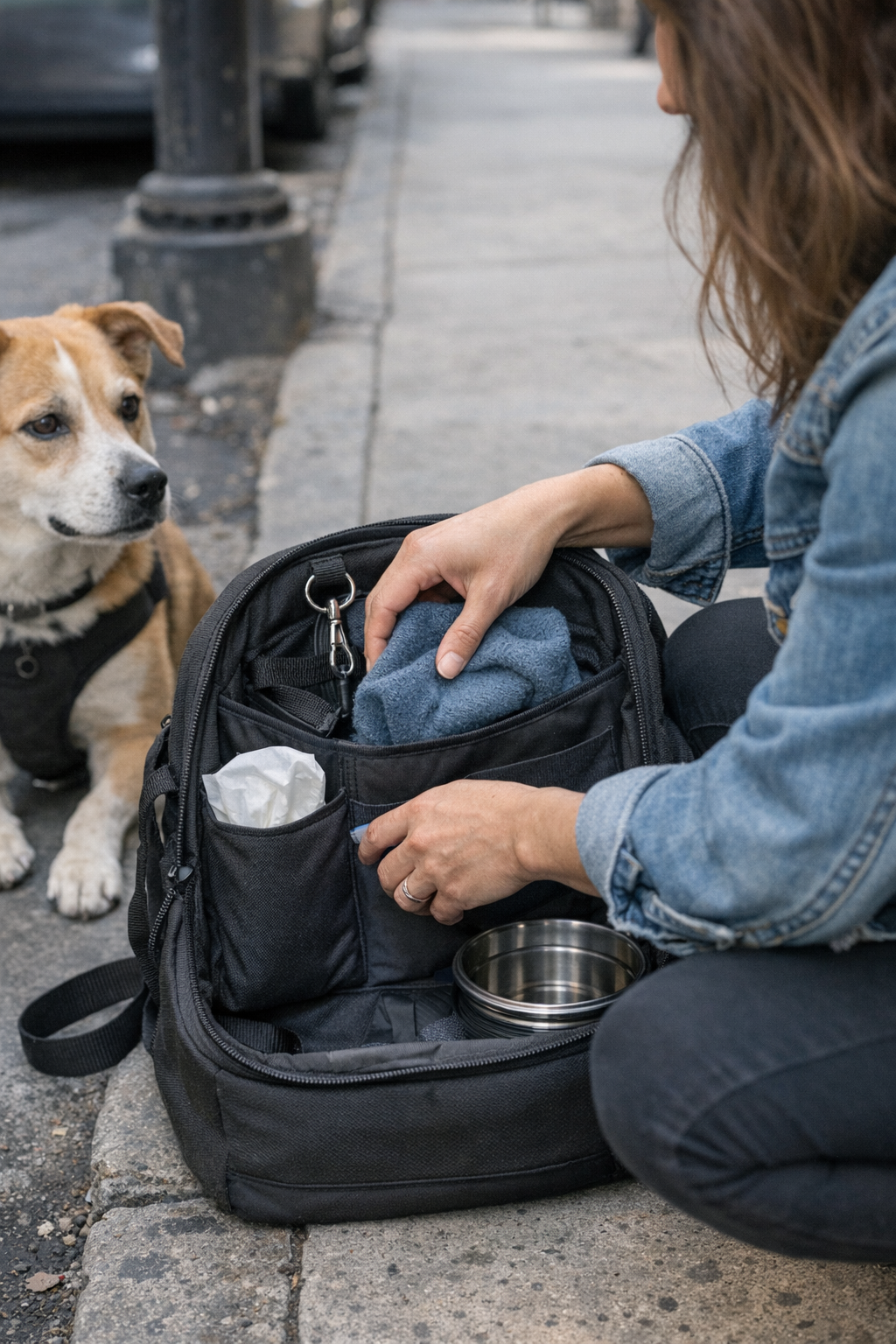
Every hurried stop with your pet exposes one silent flaw: a bag or carrier that looked organized at home quickly turns into an obstacle course after just a handful of real-world pauses. You think you’re set—leash coiled, wipes packed, comfort items within reach—but as you hit the third or fourth stop, your hand goes in and hits an unexpected wall of shifted gear. Instead of one smooth grab, you’re untangling, reshuffling, or blocking your own path, as every “quick” reach gets slower under actual travel use. That’s when an organized setup proves it’s not really built for repeated movement—and that’s where most pet-travel routines break down.
When “Ready to Go” Falls Apart at the Next Stop
No matter how tidy your bag seemed leaving home, repeated stops reset the deck. The leash ends up wedged behind crumpled wipes; the treat pouch migrates under a bowl. Each new pause creates more overlap, shifting items just enough to turn every restart into a search. Even the best-looking travel bags become less usable on the move: what started as “grab and go” now means digging and interrupting your pet every single time you reach for an essential. By the end of the walk, you’re working harder for every basic task—and your dog feels the shift in rhythm.
The Build-Up of Small Interruptions
No one dramatic snag—just constant drag. The real cost comes from how these frictions stack up: your pet waiting at your knee as you reach for the leash, only to dislodge wipes or wedge your hand behind a bowl that’s slipped out of place. Soft bags bend; sections blend. Gear disappears into corners or doubles up in the wrong spots, turning a routine stop into a series of unwanted delays. It’s not one lost item—it’s an invisible current pulling every grab out of sync.
Typical Scene: The Awkward Stop-and-Go Shuffle
Picture this: halfway through your usual city route, your dog’s on edge, focus slipping. You need the comfort toy now—but it’s buried, caught up with the leash, partly blocked by the bowl that wasn’t in the way this morning. You fumble, the stop stretches, your dog gets more distracted. What should be a steady routine is now broken by a scramble you can’t predict, and with each pause, both you and your pet lose a bit more flow.
The Invisible Mess: Why Superficial Order Isn’t Enough
Freshly packed, almost any setup can look under control. Zippers close easily, pockets feel snug, and you’re convinced the arrangement will hold up. But inside a soft-sided bag, lines blur fast: without defined separation, gear glides where it wants—wipes drift over leash handles, small comfort items vanish under heavier gear, and cleanup supplies become a two-handed dig. Once there’s no fixed place, the “muscle memory” you counted on disappears, and even the best plan starts failing after just a few stops.
Problem Pileups: When Structure Stops Holding
It’s silent overlap, not mess, that kills rhythm. Everything might look contained, but once you need something fast, tiny shifts create enough resistance to block every “quick” grab. That leash isn’t gone—it just isn’t where you left it. Missed reach turns into routine interruption, and the distraction trickles straight to your pet. Instead of a calm, seamless walk, you’re both stuck in a loop of half-second delays that build up across every city block.
How a Clear Structure Changes the Travel Loop
The answer isn’t shaving down your carry list—it’s locking key items into fixed, repeatable slots. Switching to a pet carrier with true structural dividers—dedicated leash rings up top, shallow comfort pockets, single-purpose wipe sleeves—means every essential has an anchored, no-guess spot. Even after stop number six, your hand lands where it needs to: leash, comfort toy, wipes, all in order. Your pet settles faster because you move smoother; you stop spending attention on finding gear and spend it keeping the routine calm.
Field Insight: The Power of a Defined Spot
By putting only a leash, one comfort item, and wipes at the absolute top—each inside its own sleeve, ring, or pocket—you avoid the classic travel drag. As soon as overlap creeps in, bag structure breaks down. But with fixed slots, your hand works by feel; reach is instant, not guesswork. By the fifth or sixth stop, most bags have slipped into friction. But with clear separation, every restart feels the same, your attention stays with your pet, and the walk regains rhythm instead of unraveling with each pause.
Unpacking the Real Difference: Fewer Items, Firmer Zones
There’s no perfect travel setup—but this solves the pain points that grind routines down day after day. Cutting clutter isn’t the magic; it’s structure doing the quiet work of keeping overlap and search time in check. You’ll still have the odd fumble, but the endless rummaging and repeated mishandling drop away. Pet travel days settle into motion because the bag finally supports the way you actually move, not just the way you thought you’d move at home.
Recurring Weak Spots: Where Even “Tidy” Setups Slip
If you’ve ever reached for gear on autopilot and come up short—wrong pouch, blocked access, a divider you didn’t expect—you’ve felt the distance between looking prepared and actually being prepared. That friction isn’t about forgetting; it’s what happens when bag structure can’t keep up with cycles of real use. Even subtle shifting inside makes your routine feel clumsy and makes your pet more unsettled, especially when stops become more frequent.
What to Watch for When Choosing Your Next Bag or Organizer
Ignore “clean lines” for their own sake. Look for:
- Rigid, real dividers instead of just stacked or soft sections
- Leash rings and attachment points anchored where they’re always reachable
- Single-use, well-marked pockets for your must-grab items
- Wipe sleeves fully separated from leash hardware and bowls
Resist over-packing. Never turn top access into a crowded zone. If you’re already slowing by the third stop, it’s not your routine at fault—it’s a bag that doesn’t hold up under real movement and reset pressure.
The Small Change That Sticks
Skip designer tricks and focus on the setup itself: does each essential have a defined home, reachable every time—at the tenth stop as easily as at the first? Structure that matches your movement means you and your pet don’t lose pace when travel routines demand repeat performance. Neat is good—but if your setup doesn’t move with you, it only feels ready for one block, not the full trip.
Find practical, trip-tested pet travel gear and solutions at PawGoTravel.