
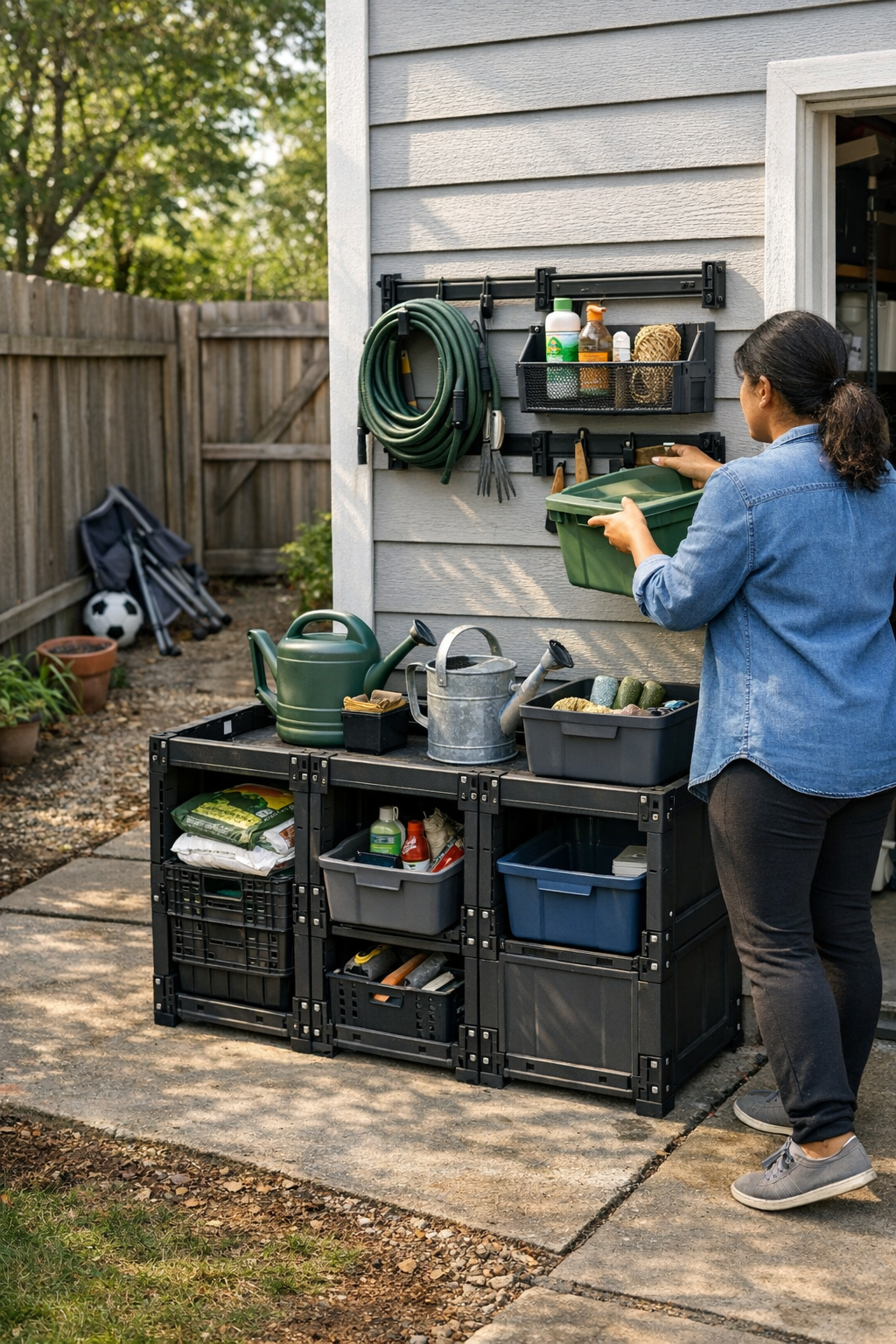
Every shared outdoor space has its illusion of order: bins stacked neatly along a fence, racks squared off on the garage wall, the walkway cleared for once. For about five minutes, you’re convinced you’ve finally tamed the yard. Then the real day starts. Kids track boots past the bins. Someone’s hauling chairs in for the neighbors—or out for the third time this week. Afternoon sees garden tools piled next to the toys someone meant to put away “just for now.” By Friday, you’re dodging toppled buckets by the side gate and re-clearing the same path for the fourth time—wondering why the organization never seems to last past Monday.
Floor Storage: The Reset Trap
Outdoor floor space always looks more generous on day one than it feels on day six. Bins and shelves line up like a container-store catalog after the initial reset, but in practice, real routines muscle their way back in. Groceries stacked on bins block the gate just as someone’s trying to roll out the mower. Balls wedge themselves behind bulkier gear. Before you know it, overflow piles are back in the walkway, each one tracing the path of an interrupted task. Clearing the floor on Sunday doesn’t fix how fast it chokes up by Thursday—especially when even a single forgotten shovel can trip the whole system.
Return Flow: Where One Move Unravels the Rest
You see it in a single moment: someone returns folding chairs, but parks them in front of the boots. Now to get the boots, you have to move the chairs—and in the shuffle, a bucket gets knocked over. Instead of the system working, every return becomes a mini reshuffling. The end result: constant micro-resets and confusion about where things actually go, because the arrangement never matched the way people actually use the yard.
Wall Storage: Useful Space or Out-of-Reach Hopes?
Wall racks, hooks, and shelves seem like the next logical fix—take back the ground, make your edges “work.” But wall storage exposes a different set of flaws fast. Put one rack slightly too high or behind a bulky bin, and you’ve only moved the frustration upward. A garden tool rack everyone meant to use? If the youngest kid can’t reach it, the shovels end up blocking the path again. Hooks hidden by bikes or out of the natural return route become ghost zones: everyone ignores them, clutter collects below, and floor space clogs up anyway.
The Reach Problem: When Storage Stays Just Out of Sync
Every multi-user yard hits this reality. You put up new wall hooks but watch as hoses and gear continue to stack up just beneath them. It looks like a discipline problem, but really, storage has to meet people where they actually drop things. If a hook’s too high, if the path is blocked, if a bin is awkward to access, items default to the nearest open ground. Systems that work only for the person who set them up lose their hold fast in mixed-family, multi-user yards.
The Reality Zone: Where Movement Bottlenecks
Choke points always show up in the same places: narrow side strips, the patio edge, the main walkway past the bins. These spots collect clutter not by accident but by design mismatch. Collapsible chairs nestle into the walkway corners until no one can pass with a wheelbarrow. Sports gear piles up by the fence, edging its way into the path after every Saturday. Each “organized” system starts to break where routines overlap—and it’s these pinch points where you feel the reset pressure most.
The Cost of Ignoring Real Traffic
No wall rack or bin system stays neat if it ignores these flows. Weekend returns never follow the clean-out order. Someone tosses boots aside to bring in a cooler, or parks a bike across the shed entry. The neat stacking collapses, and you’re back to nightly or weekly corrections—always reactive, never ahead. The burden isn’t the storage itself, but setups that can’t flex for the actual beat of the yard.
The Small Fix That Actually Sticks
Not every improvement means a full overhaul. Sometimes, moving a rack six inches lower or shifting a storage bin a foot closer to the gate finally makes the right action effortless. In one side yard, just adjusting garden tool hooks so kids could use them stopped the daily pile of shovels in the walkway. The setup stopped demanding daily resets. True organization never comes from appearances on Sunday; it shows up in how little you have to think about clearing a path by Wednesday.
Watch Where Gear Actually Lands
Before blaming “no one puts things away,” map the mess. Notice where the boots get tossed, where buckets stack up, what doesn’t get returned—these are the spots where the current design loses to habit. Lower the unreachable rack. Move that heavy bin out of the dead corner and into the main traffic line. Reorganize for where returning hands go by default. The less friction, the less overflow shows up next week.
Looks Sorted vs. Actually Working
A polished setup is easy to stage for a photo—much harder to sustain through real weeks with real people running in and out, tracking mud and dragging gear. The only test that matters is how often you’re forced to clear the same jam, move the same chair, or unbury the same boots. The trouble spots—the corner by the gate that keeps filling up, the wedge of bins that blocks the garage entry—are signals, not failures. The strongest setups flex for movement and make returns idiot-proof. That’s the shift: less time spent apologizing for the mess, more actually using the yard without resetting it every time.
No Setup Is Permanent—But Some Fixes Stick Longer
Unreachable hooks, bins that don’t open easily, and paths blocked before the weekend always out themselves fast. Fixes that work grow out of watching—really watching—how your outdoor space gets used. It’s less about installing the “perfect” solution, more about improving what keeps breaking down in daily life.
Get adaptable solutions built for real outdoor routines at TidyYard.