
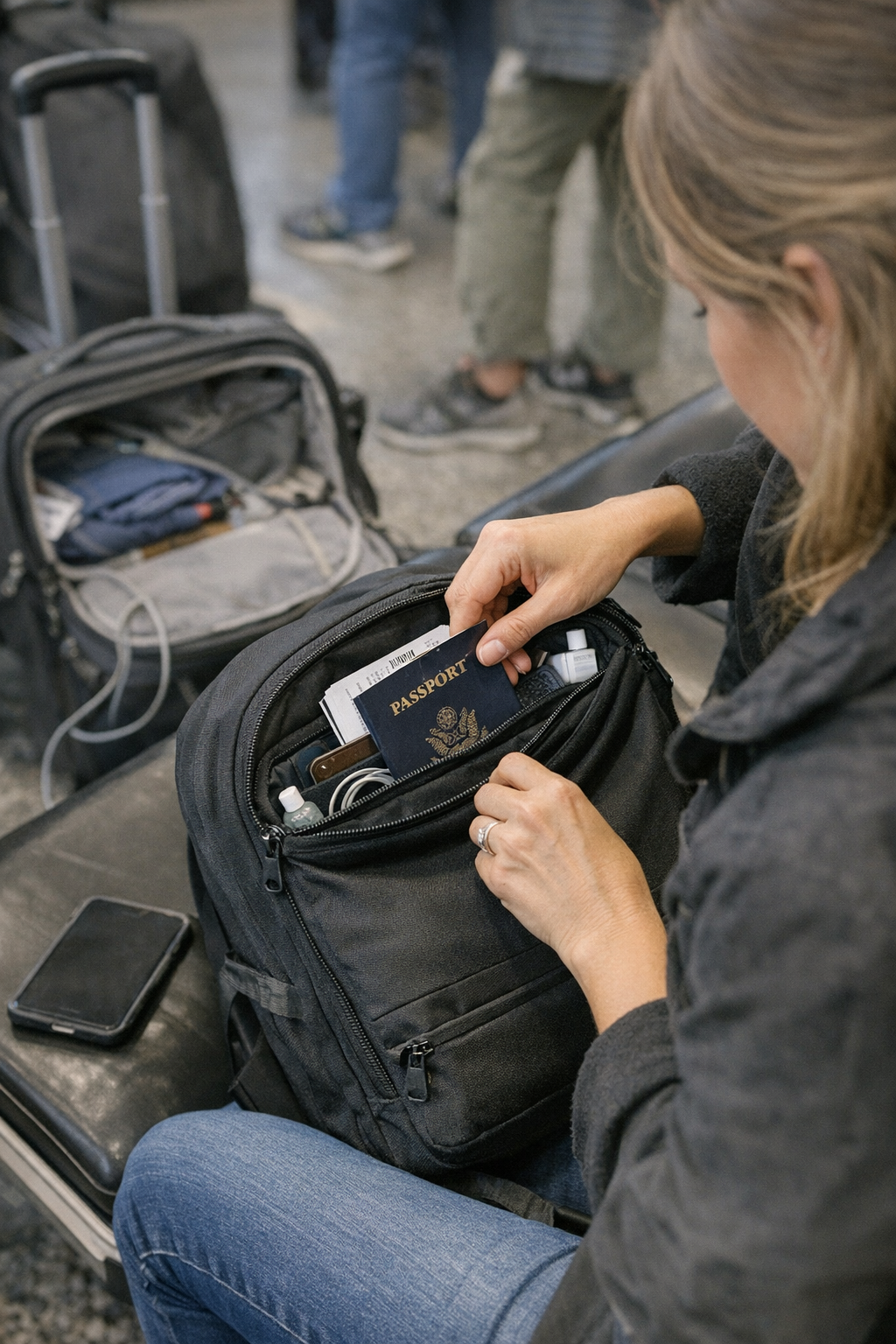
The gap between a carry-on that looks organized and one that actually works in real airport flow becomes blindingly clear the moment you have to pull your passport from a packed bag while boarding is already moving. At home, sorting everything—cables, documents, small comforts—into neat compartments feels like control. But under real pressure, what seemed “ready” turns stubborn: you’re digging through hidden pouches, unzipping main compartments wedged between armrests, and finding the same charger stuck beneath yesterday’s careful order. Actual travel exposes the limitations of setups built for stillness, not movement.
Where Order Cracks: The Hidden Friction of “Neat” Packing
The friction starts small: sitting at the gate, you unzip what you thought was a smart setup only to find your wallet under a toiletries pouch or your boarding pass buried past an unnecessary layer. Each retrieval turns into a mild scramble. You shift organizers aside, shuffle a sweater to reach a document, and every touch means extra seconds—just as space shrinks and your focus splits between announcements and crowd movement. Neatness back home becomes shallow currency the moment you need something fast; every reach interrupts the supposed order and nudges you out of flow.
These disruptions aren’t isolated. In busy terminals and between repeated checks, the seconds add up. Each time you dig past tightly stacked pouches or disrupt a “layered” compartment, bit by bit, the visual order you built collapses into a cycle of minor resets and new mess—just to get one thing out and back in without scattering contents across the airport floor.
Reaching and Repacking: Where Most Setups Falter
The repeated pattern quickly appears: every document pull, cord grab, or snack retrieval means reopening the same zipper, shifting at least one item out of the way, and fighting to put everything back without losing more time. The “orderly” look erodes after just two cycles: pouch stacks loosen, smaller items hide under bulkier ones, and the feeling of control gives way to uncertainty. If grabbing your wallet means lifting half your bag onto your lap, squeezing everything back into place, or propping the whole setup on your knee while others walk by, you’re living out a layout that values neatness over speed, and smooth airport movement pays the price.
What was designed to look tidy soon becomes a repacking burden—every quick access produces another mini reset, until the structure no longer fits the real movement of airport life.
Gate Pressure: Where Visual Order Fails Real Movement
It’s during gate calls and seat entry that weak setups betray themselves. The line moves, you’re juggling your bag in one hand while your phone buzzes for an update, and now the “safe” storage choice—an inner sleeve or a too-deep pocket—raises the stakes. A simple boarding pass check becomes an awkward two-handed dig; a missing charging cable forces you to crack open the main compartment in a bottlenecked aisle, drawing impatient glances. What worked for a packing photo fails under shifting bodies, crammed seats, and a real need for immediate access.
Even well-meaning “compact” designs backfire: the same tight layout that keeps the exterior clean now blocks your reach, forcing wide unzipping and extra balancing. The result is a recurring risk—contents slipping out, or your quick move stalling the line as you re-sort stray items. The setup that promised order exposes its limits as soon as you need real flexibility in crowded, time-sensitive moments.
Quick-Access Pockets: Moving Retrieval to the Front Line
The shift isn’t about packing less—it’s about where your essentials actually live. Placing your high-frequency items—passport, wallet, boarding pass, charger—into a single, quick-access pocket shifts your entire rhythm. Now, whenever you pause at a checkpoint, field a surprise request, or need to recharge, you open one zipper and solve the problem without touching the main compartment. There’s no chain reaction of shifting organizers around, no fear that pulling your phone will dump toiletries onto the seat or floor.
This structure lives at the intersection of speed and control: the main pouch stays fully sealed and visually untouched; the quick-access zone handles the chaos of movement. Each retrieval returns the essentials pocket to readiness, instead of resetting the entire bag, shrinking stress and keeping you mobile. The system isn’t just neater, it’s structurally lighter in repeated use.
Repeated Use: Where Efficiency Proves Itself
Most carry-on setups fail not in the first hour, but after multiple cycles: security check, waiting zone, boarding, stowing, mid-flight retrieval, hotel arrival. Every time you reach for something vital and have to unpack or repack more than necessary, the inefficiency compounds. The warning sign is familiar—a five-step routine just to charge your phone at the gate, or another fumble through three layers to show a document at a checkpoint. Each repeated scramble is attention lost and comfort drained right when you need it most. Every extra moment spent reorganizing cable pouches during a tray transfer is time you don’t get to unwind or plan for the next leg.
A structure that demands constant reordering wears on you—not because it looks messy, but because real movement always outpaces static design.
Small Shifts, Big Improvement: Making Access Frictionless
Most travelers don’t need a full makeover to avoid these frictions. Repurposing a front pocket as your essentials hub, adding a thin travel organizer, or simply moving key items out of layered storage to a dedicated top-access zone can completely change the flow. The move that matters is isolating frequent-use items—passports, chargers, documents—from the main cavity, and guarding this quick-access area from clutter. Now, even if you reach in five times in an hour, each retrieval feels fast, calm, and interruption-free. The bag’s outward order holds, but the internal flow now matches real airport movement, not just a tidy room photo. Forgotten tension fades each time you skip the old scramble, marking the shift from looking organized to moving with purpose.
Discover more setup-focused travel tools and essentials at CarryOnSupply.