
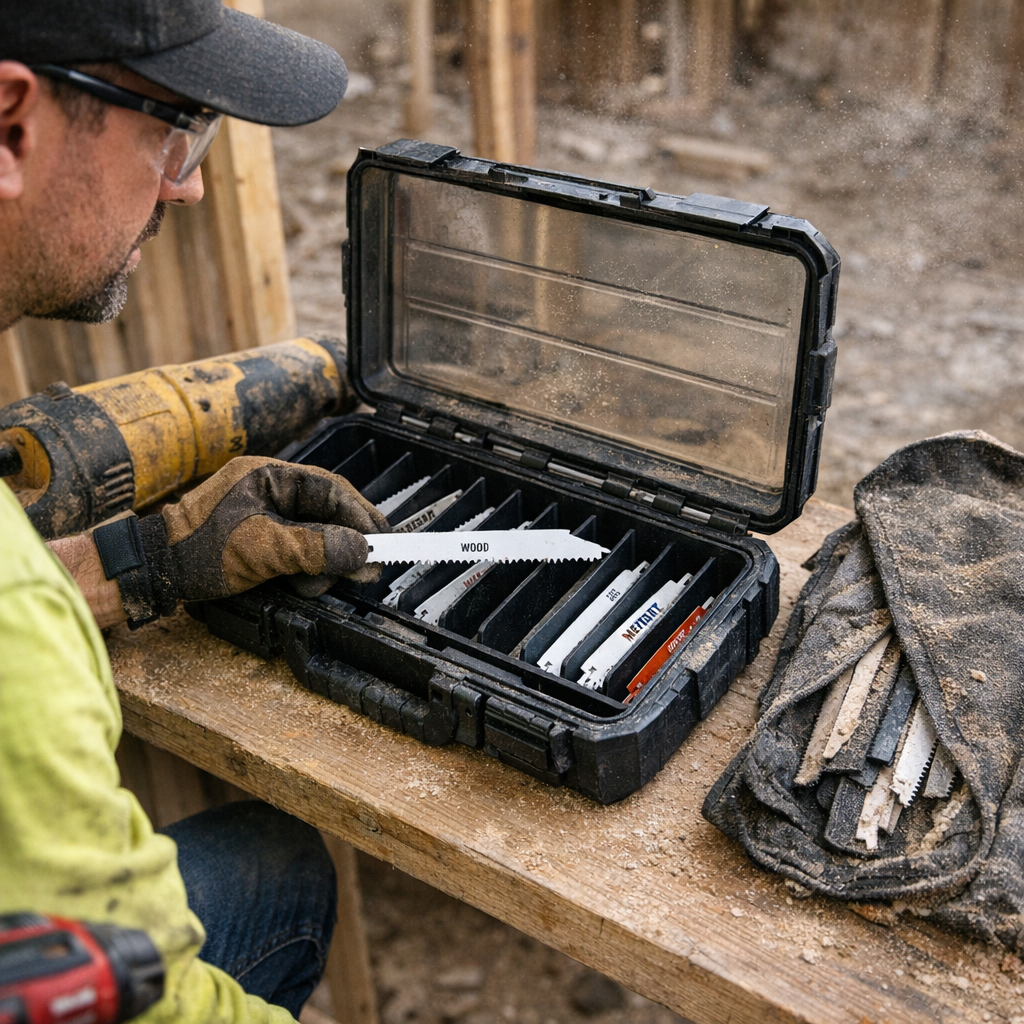
The moment you realize your saw blade storage is holding you back isn’t usually dramatic—it’s subtle, and that makes it worse. The teeth bite slower. Cuts drag. Your gloves get sticky with dust and pitch you didn’t notice building up. What should be a five-minute cut turns into a ten-minute cleanup, all because you trusted a sleeve or pouch that quietly sanded the edge off your blades job after job. On a site where every wasted second piles up—whether you’re demoing a wall, slicing conduit, or rushing to make finish cuts—blade storage stops being trivial the first time a cut stutters or veers and you’re left wondering where your edge went.
The Hidden Toll of Jobsite Storage
If you spend any time in a real-world workshop or on a jobsite, you know dust settles everywhere—on everything. No matter if you’re drilling through studs or slotting plywood, airborne grit gets into your gear. Reciprocating saw blades are built for abuse, but fine scratches from dirt and constant contact can quietly dull even the toughest steel faster than you expect.
When the pressure’s on, most tradespeople default to what’s fast and close: a flexible tool pouch or a cloth roll-up slung at the end of a saw bench. That “grab-and-go” mindset works well—right until you start noticing friction. Soft sleeves might seem nimble when you’re flying between demolition cuts, but every pull drags dust-laden fabric across the blade’s edge. Over a day, that fabric becomes a sandpaper trap, embedding grit on the toothline and prepping your next blade for a rougher ride.
The Subtle Signs Your Blade Storage Is Failing
It’s easy to miss how quickly tool performance shifts until you’re compensating for it. The blade struggles through a door jamb, or the saw starts to buck and whine midway through a flush cut. That vibration you feel in your wrist isn’t always the tool—it’s often a barely-there dullness, invisible until the finish splinters or the wood darkens where it should’ve been a clean slice.
Try this for a week: bounce between dusty fabric sleeves and a hard, slotted case. Odds are, blades from the sleeve come out coated—sticky, gritty, and inconsistent. Glove after glove gets grimy. Cuts end rougher. Each small annoyance—the tightening jaw, the second pass over seams, the “why did this take so long?”—traces back to those silent abrasions in your pouch.
Why Hard Cases Quietly Change the Game
A rigid, compartmentalized hard case isn’t flashy, but the difference is immediate if you pay attention to your workflow. Slots keep blades apart: no tooth-on-tooth grinding, no dust caked into edges, no mystery dullness halfway through a job.
Imagine the riot of a busy day—dust swirling, hands already tired, and deadlines closing in. Grab a blade from a fabric pouch and you’re often scraping off residue before you even line up the saw. That nagging burnt smell on the first stroke? The blade picked it up in your storage, not your cut. Seconds slip by as you wipe and fidget, the line wavers, and tool control just isn’t crisp. Now try pulling a blade from a hard case: it’s cleaner, edges bite instantly, and you’re pushing through with no stall or ragged pull. The job doesn’t just speed up—you end it with less rework, less frustration, and cuts that look intentional, not salvaged.
Measured: What You Actually Gain With Better Storage
If you stack up real numbers, the gap widens. Side-by-side on mixed material runs—studs, PVC, composite—blades from slotted cases kept their cut quality for twice as many swaps. After two dozen cuts, those blades still worked sharp, while sleeve-stored blades started dragging after barely half as many uses. That’s the difference between swapping out for a fresh blade every hour or risking rough seams and extra sanding by day’s end. The time saved isn’t just in the cutting—it’s the headache you skip from not having to fix and fuss every few boards.
Daily Storage Friction: Where It Adds Up
No jobsite operates in a vacuum. There’s always drywall in the air, a battery recharge to track, and someone else’s debris settling wherever you stow your gear. “Just toss it in” makes sense—until repeated effort creeps in. Each pause to wipe a blade, each time you lose your grip on a sticky handle, every offcut that veers—blade storage is right behind those moments.
These aren’t one-offs—they’re the rhythm of the workday. Reach for a blade and get a face full of grime. Pull out what you think is a sharp edge and find yourself babysitting the saw, nudging it slowly rather than letting the tool do the work. Even a few lost seconds or a single crooked plunge eats away at your pace and your patience.
Controlling Cut Quality Without Overcomplicating
Sort Blades By Life—And See the Difference Instantly
A slotted hard case doesn’t just keep things cleaner—it builds in a workflow advantage. Fresh blades go in one row, retired ones in another. One glance, and you know what you’re working with. No confusion, no unplanned “test cuts” to check for sharpness. It’s a system that eliminates guesswork, so you don’t have to relive the frustration of realizing too late that you swapped in a spent blade in the middle of a crucial cut.
The Small Switch That Pays for Itself Fast
If blade swaps are rare, the payoff might seem minor. But in the middle of stacked routines—three projects at once, tools getting handed off, debris clouding everything—a hard case is a shift that locks in more performance than almost any new accessory. Your blades last. Your lines stay straight. And you quit wasting time bringing subpar cuts up to standard by hand.
Details That Compound—And Matter Most When Time Is Tight
The deeper you get into hands-on work, the clearer it is: the smallest changes aren’t just “nice to have”—they’re often what keeps entire projects moving. Saw blade storage isn’t glamorous. But neither is having to resaw or re-sand everything after a marathon cut session. Every hour lost to dull edges or unpredictable tool behavior is time—and money—down the chute.
Switching to a better storage system won’t show up in your highlight reel, but it’s one of those “invisible upgrades” you feel at the end of the day: less fatigue, sharper control, fewer surprises. Small discipline at the bench or truck means cleaner work, faster turnarounds, and less second-guessing when it counts.
See practical blade storage and workshop solutions at Gumboll.