
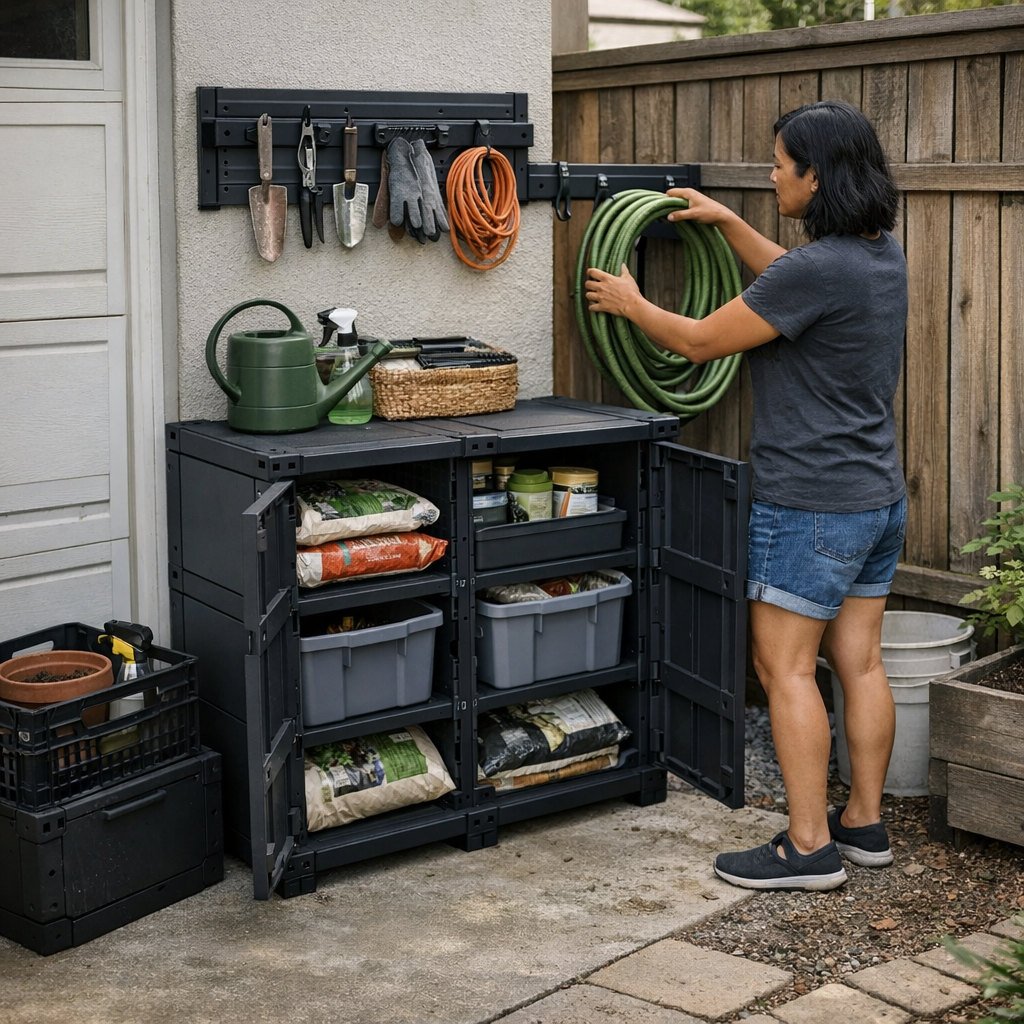
When outdoor storage can’t keep pace with your real routine, it’s not subtle—it’s everywhere you look. You set up bins or wall racks with good intentions, but within a few weeks, the supposed order starts breaking down. Garden trowels wedge themselves along the footpath; half-deflated soccer balls and garden gloves end up stranded right by the patio door; every “quick return” turns into a small, silent argument with a pile you already dealt with. In the controlled mess of real outdoor use, things drift, pile, and double back—exposing the difference between setups that only look tidy and those that actually make moving through the space easier.
The Creep Problem: When Storage Designs Fight the Way You Move
Every backyard, side yard, or patio is an experiment in whether a storage zone can survive real habits. On day one, the fresh wall rack or lidded bench seems to answer every problem. Fast forward a few weekends: is your “solution” quietly jamming the return path or turning drop-offs into mini obstacle courses?
Here’s where the friction sets in—the places design misses reality. A bin next to the fence looks convenient until you’re elbow-deep, hunting for a trowel buried under discarded dog toys. Hanging hooks along the walkway keep tools visible, but once the jackets and hoses take them over, you’re unhooking half the row just to free a garden fork. Suddenly, storage designed for efficiency is creating its own resistance, and resets slow down after every round of use.
Wall Storage: Clear Floors, New Headaches
Wall systems promise open floors and easy access. For the first few weeks, there’s a satisfying stretch of clear concrete and tools lining up in full view. But it’s rarely that simple. Racks spaced with optimism become a game of shuffling brooms, rakes, and loppers just to hang up one more tool after mowing. Narrow shelves display spray bottles while heavier gear—bags of soil, bulkier hoses—creep onto the ground anyway, forming a new, unplanned pile beneath the “organized” wall.
Family members improvise; “designated” hooks lose their meaning. The return routine stalls: stowing a single cord or trowel becomes a juggling act when the wall’s already at capacity. If putting something away takes too long, it gets abandoned mid-reset—and the clear walkway degenerates into a maze of obstacles.
The Trap of Closed Storage: Clean Outside, Chaos Inside
Closed benches and modular storage units look like a win: clutter disappears with the swing of a lid. But inside, entropy rules. Certain slots overflow while others never fill, and one awkwardly shaped watering can means everything else gets dumped on top—masking, not solving, the actual mess. Every reset becomes a blind rummage, making you dig through cords, gloves, and broken tools just to find the one thing you need.
The tension is clear: wall systems demand relentless tidiness, while closed bins swallow clutter at the cost of access. If the setup doesn’t match your natural return flow, neither holds up for long. Soon enough, piles re-form near gates and doorways, and each reset brings the familiar dance of stepping over spillover—no matter how much storage is on paper.
Setup Under Pressure: Life in the Side Yard Corridor
If you want to see a storage system’s fault lines, look at a cramped side yard that pulls double duty. In a 48-inch-wide passage, a wall rack offers a fresh start—rakes and hoses neatly hung, footpath open. But the first muddy boots or armful of sports gear throws off the balance. Hooks are just out of reach, bins are one step too far from where you enter, and suddenly the overflow gathers by the gate. That tidy bench at the far end? It attracts all the gloves and loose parts everyone is too impatient to walk across for.
Now you’re shuffling bins just to fit the mower through, shifting sports balls to clear the path for the garbage cans, or pausing to relocate a planter box that always migrates to the footpath. The storage “solution” introduces new choke points at exactly the moment you need the space to work fast. Just moving one tool back means first clearing a detour you didn’t plan on—and day by day, the zone gets tighter, not looser.
Overflow, Backlogs, and Slower Resets
This is not a rare breakdown. One return brings a bulk bag of compost, but last week’s planter buckets are already blocking the storage corner. A coiled hose should hang on the wall, but the hooks are buried under jackets and extension cords, so it loops onto the ground, creating another tripping hazard. Want your trowel? Get ready to pull half the contents out of a deep bin while balancing on a stepping stone.
Every time, it’s a micro-delay, a minor shuffle, a footwork adjustment—until the whole area signals that the layout fits in theory but not how you actually use it day to day.
Small Shifts That Break the Cycle
The difference-maker rarely comes from buying bigger bins or more hooks. It’s about small, practical shifts—matching the layout to your real path and sequence. In one side yard, simply swapping two shallow storage bins for a single deeper, covered unit chipped away at the perpetual overflow on the ground. But the breakthrough was moving a row of shoulder-high hooks right beside the entry point—no more reaching, no bending, just one flick of the wrist to drop gear as you come in.
Clearing the main aisle didn’t mean less stuff got stored—it meant the stuff that came back most often had frictionless access, while overflow just couldn’t pile up without someone noticing. The system had a built-in brake: too many things on the hooks forced a rethink, not another pile by the footpath. Resets sped up. Blocked paths opened without drama. The storage finally started to pay back the space, instead of competing with it.
Force Zone Limits—Not Overflow
Here’s the simplest shift: don’t let any zone become a catch-all. Bins too deep or hooks too high become graveyards for rarely used stuff and drop-off points for anything you can’t be bothered to store properly. Instead, tailor the zone. Put high-touch items at elbow-level and in arm’s reach. Mark one hook as always clear and enforce it. Set up a shallow tray for gloves, pruners, or tennis balls—stuff that enters and exits daily—so nothing has to move three things just to add one more.
Don’t wait for a space to get “full” before you rethink the setup. If the return path feels blocked or drop-offs are happening in the wrong spot, it’s time to shift the container, change the hook height, or slim down what stays outside.
It Doesn’t Need to Be Perfect—Just Less in Your Way
No outdoor system will send every stray glove or hose into perfect lines. The win is visible: faster resets, fewer detours, and a flow that works after a typical, messy afternoon. Storage that matches the real rhythm of your returns—whether in a tight side yard, along the garage, or at the edge of your backyard—makes the difference between feeling organized and actually moving through your day without repeat friction. The goal isn’t showroom order. It’s getting out the door, or back from the garden, with less to dodge every time.