
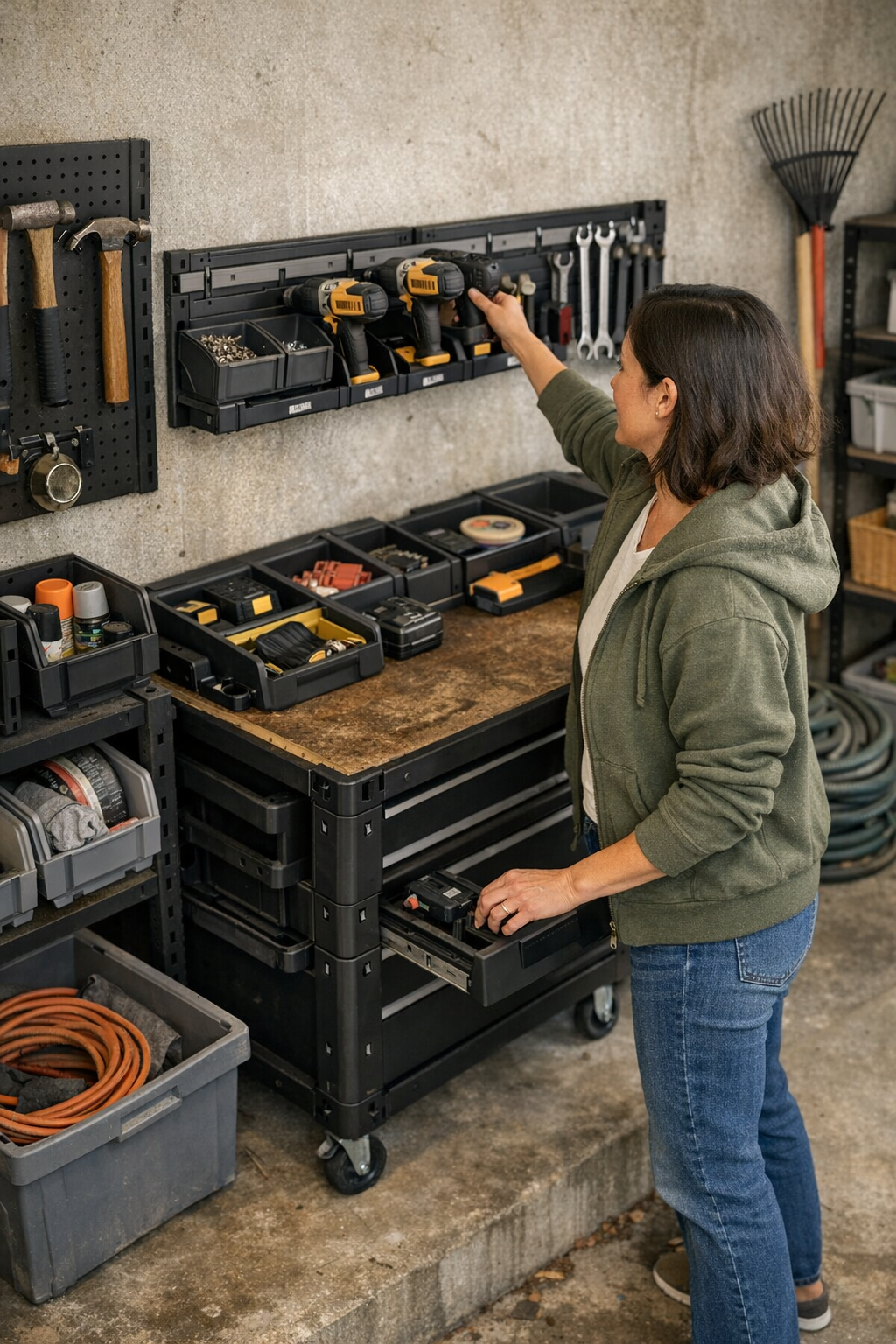
The first day with a fresh modular storage system fools you. The bins nestle perfectly along the garage wall, the rolling cart tucks under the workbench, and every hook and rack gleams with possibility. You stand back, satisfied by order and newfound potential. Then, within a week, reality creeps in. Tools are returned just a little askew. A cordless drill is jammed at the end of a rail, because that’s faster than finding its original spot. Carts edge further from the wall, walkways press inward, and the utility zone you thought you solved becomes a maze of tripping hazards, overlapping gear, and improvisational storage that takes longer to use each time you walk in. The setup looks modular, but the routine feels stuck.
When “Flexible” Storage Becomes Friction
The sales pitch is always about control: rearrange, reconfigure, adapt to your needs. And at first—after installing a rail or rolling in a new cabinet—you do feel in charge. For maybe a week, every socket returns to its place. The shop vacuum rolls out and disappears in minutes. But the nature of real work cuts against the optimism of setup day.
Start a quick repair, and tools scatter onto bin edges instead of being put away. Tight on time? You shove gear to corners “just for now.” By Friday, the cart meant to glide easily along the wall blocks two feet of walking space. The drill bits migrate from their labeled drawer to a catch-all tray, simply because the label is easier to ignore than to respect. The invisible logic that made setup satisfying dissolves under the real tempo of a busy week.
The weak spot isn’t the system—it’s the lack of boundaries. Flexible layouts don’t keep gear from drifting. Rail ends invite piles. Flat-top cabinets turn into landing zones for whatever you can’t deal with immediately. Drawer organizers without clear dividers become jumbles of mismatched hardware. Each small shift edges you closer to the same chaos you set out to fix, only more annoying because you can see how neatly it could be—if only it would stay that way.
Overflow at the Margins, and a Slowdown with Every Use
Take a narrow garage or workshop: in theory, every inch gets used. But once flexible storage loses discipline, you’re stuck nudging the cart sideways just to pass. The wall space you thought you’d maximized now hides random handyman extras from past projects, shoved to the far end because that section is “open.”
It’s the repeated detours that grind you down. Need a wrench? It’s behind three spray cans and a tape measure that rolled away from its zone. Want to plug in the battery charger? The outlet is blocked by the mobile toolbox you left a few inches off-target after the last reset. Every visit to the space becomes a low-level obstacle course that sometimes isn’t obvious until you’re in the middle of a job and lost fifteen minutes looking for the right attachment. The modular plan remains—on paper—but in action, boundaries blur and every task takes longer.
Dead Corners: Where Flexibility Falters
Worst are the corners and nooks left over after the main install. Flexible racks never quite fill them, so they become dumping grounds: a broken clamp here, leftover tile grout there. At first, you promise to come back and organize it. But over time, these dead spots grow into minor junk zones. They aren’t really useful, but you can’t reclaim them without disrupting everything else. The space is technically “used,” but never in a way that helps.
Boundaries: The Quiet Fix for Daily Flow
The key change comes when limits get added back into all this freedom. Boundaries—bumper strips at shelf ends, painted place markers on the floor, labeled zones in drawers—restore just enough structure to keep the arrangement serving you, not working against you.
Suddenly, the rolling cart stops inching forward because its wheels have a painted box to park in. Bins don’t fill with random odds and ends, because their slots are sized and labeled. A stop strip at the end of a rail keeps batteries from migrating into the next “category.” It’s not a full lockdown, just a real-world nudge that asks every tool: “Do you really belong here?”—and keeps your return flow brisk and automatic.
The improvement isn’t showy, but it’s felt: no more pausing to recall which bin the wire strippers belong in, no more slow creep of overflow into walkways. Cleanups shrink from a weekend project to a fast sweep. Most importantly, your workspace feels as organized in mid-use as it does when you first set up—because the system tells you, at a glance, when things stray.
Real-World Routines: Where Boundaries Prove Themselves
- Blocked by the classic cart drift: You roll in to grab a chisel and find the cart off its mark, boxed in by tool piles. The cart with a marked parking spot and clear zones? You’re in and out—no detour, no juggling.
- Overflow always finds the same spots: The end of the workbench rail, once pristine, becomes a logjam of tape rolls and loose hardware. A simple label or physical stop forces a category reset—if it doesn’t fit, it doesn’t stay. Finding gear is straightforward again.
- The permanent “big sweep” shrinks: Without boundaries, resets balloon into unmanageable chores. With marked zones and limits, restoring order becomes a set of small, predictable actions. It takes minutes, not a half-day, to get back to clear pathways and categorized shelves.
Making Flexibility Last Through Real Use
Modular looks neat on day one, but the real test comes after weeks of heavy use. Can you walk the aisles without shifting tools out of your way? Does the wall space help you work, or does it slowly swallow your organization?
The right boundaries make flexibility something you can actually count on.
- Add end stops or bumpers on rails and shelves so gear has a reason to stay in-bounds.
- Label bins and drawers—especially those you share with others or use for mixed categories—so tools remember their home, even if you forget.
- Mark floor “parking zones” for mobile units. If a cart wanders, you know exactly where to return it—instead of guessing where it belonged.
- Pay extra attention to those high-traffic transition spots—the tops of carts, edge shelves, the open end of racks—where overflow wants to collect first.
The difference is practical: less time shuffling gear back into place, fewer surprise blockages in tight aisles, no “mystery zones” of random hardware collecting at the edges. The footprint stays predictable. You move around easily. And the area finally works in flow with your routines instead of throwing up new obstacles every week.
Boundaries Build Dependable Spaces, Not Just Organized Ones
The appeal of modular and mobile storage is real—but only when guided by real limits. It’s not about getting showroom perfection or maximizing visual impact. It’s about whether your setup lets you work, move, and reset—without stalling on clutter or wondering where things should go next.
Create boundaries, mark your zones, and protect easy movement. That’s how you reclaim every square foot—and keep your area working through daily use, not just on setup day.
Explore practical, adaptable storage solutions at StackNest.