
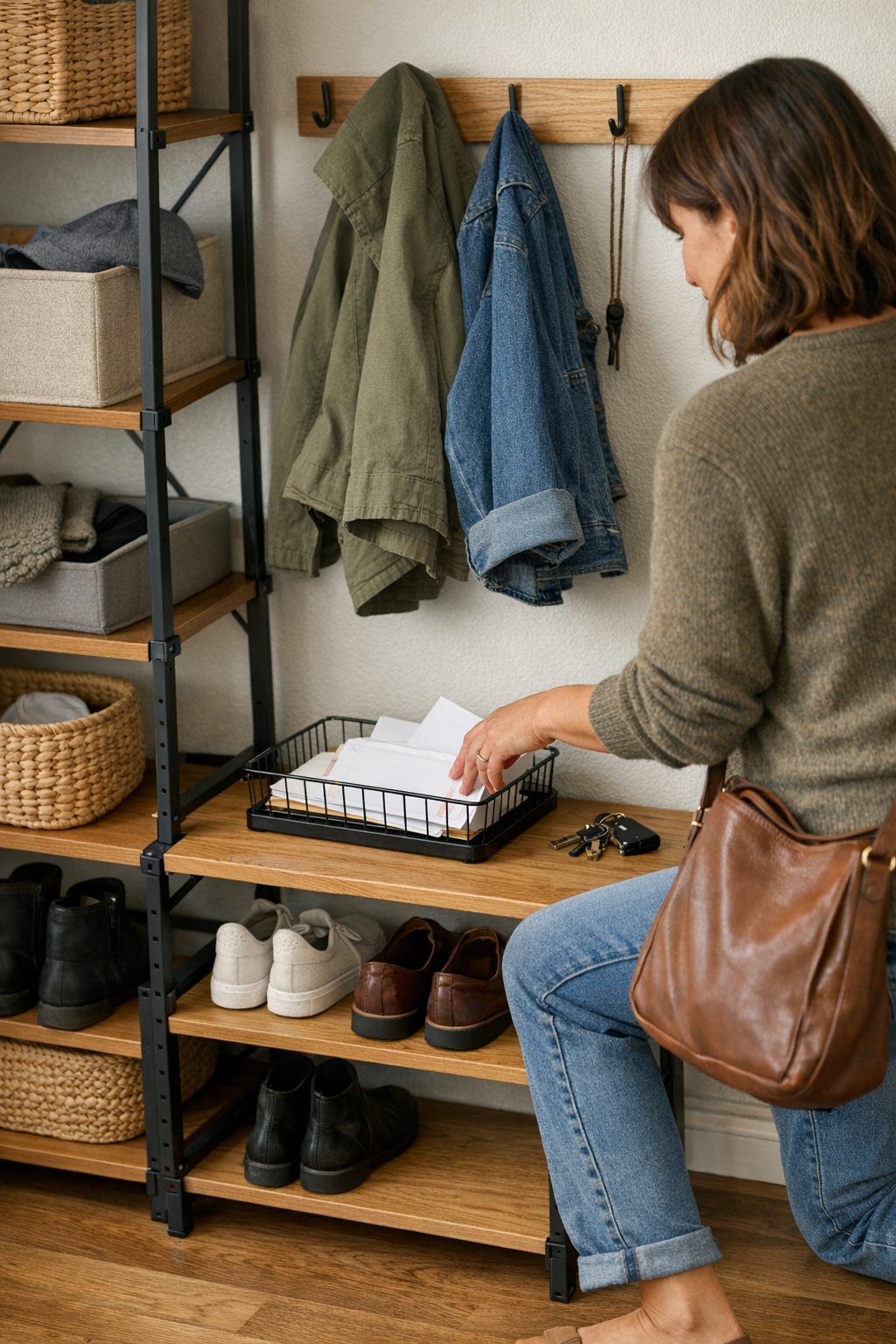
Paper rarely invades your entryway all at once—it seeps in, claim by claim, until walkways close and essentials vanish. One afternoon, a single envelope lands at the bench’s edge. Within days, flyers drift across the shoe row, bills wedge under bags, and forms scatter near the coats. The problem isn’t a minor eyesore—it’s blocked seating, drowned-out storage routines, and the frustration of hunting for paperwork that slid away the very moment you meant to act. If your entry setup seems organized on Sunday only to clog by midweek, it’s likely because mail and loose paper migrate further every time someone cuts through, drops off bags, or tosses a coat—setting off a slow-motion takeover that resets the whole point of your transition zone.
How Fast Paper Drift Breaks Down Routines
Setting today’s mail on the bench never feels disruptive—until you come back and find last week’s flyers layered beneath new arrivals and crushed beneath a laptop bag. Add one after-school backpack or a wet jacket tossed carelessly aside, and the ripple spreads: paper clings to shoes, piles creep into seating, and a single missed recycling pick-up turns small drop zones into congested no-man’s-lands. You thought you only needed to clear the surface once a week, but now every return triggers half-hearted shuffling, blocking both the walk path and the reset you keep planning to do.
This isn’t just mess—it’s friction on repeat. Each threshold pass means a new interruption: shifting piles to find the bench, stepping around a glossy flyer while reaching for shoes, realizing your keys disappeared beneath a delivery insert. Entryways—especially narrow or high-traffic ones—suffer the quickest. Any surface without a true boundary is an open invitation for paper to sprawl and hide what matters, leaving you one forgotten envelope away from missing a bill or stepping on a soggy postcard where you expected clear space.
Why a Defined Mail Tray Changes the Pattern
A mail tray isn’t decorative—it’s triage for paper sprawl. The difference is sharp: when every envelope drops into a fixed, bounded tray in reach of your real landing zone, paper stays contained. In routines built on quick entries and faster exits, the tray turns a chaotic stream into a manageable stop. By day five, the absence of drift becomes obvious. Papers hang together, shoes stay accessible, and you no longer need to rescue mail that slipped off a slanted bench or hunt for appointment letters under a pile of grocery ads.
The Subtle Threat of Improvised Order
Benches, shelf corners, and ledges seem to corral mail at first. But mixed-use surfaces always lose to the crush of bags, wet coats, and daily exits. Even a neat row of envelopes unravels after a single heavy bag drop or a hurried grab-and-go. The bench meant for shoe-tying becomes an overflow tray. Within days, paper flares out—half under bags, half dissolving into unrelated piles—often at exactly the time nobody has energy for sorting. Improv containment never keeps up with actual traffic.
Realistic Arrival Scenes
Picture coming through the door with three envelopes, a grocery tote, and a muffled ringtone. There’s no pause to sort; the mail gets nudged onto the bench. By evening, someone lines up the shoes, only to find a flyer wedged into the middle pair. By week’s end, important documents have slid toward the mud trail or merged blindly into the recycling bag. Every arrival presses clutter further, each exit making the reset slower—and sitting down to clear it means unpiling layers that never meant to be together.
Placement is Everything: Where the Tray Should Actually Go
Function beats appearance, every single time. For the tray to break the drift, it must absorb paper at the natural drop point—where you drop keys, bags, or today’s sunglasses. Wall units placed behind the door or awkward shelf nooks just recruit more clutter; anything that forces you to bend past bike helmets, reach across shoe cubbies, or move a row of umbrellas won’t be used. The right spot is within arm’s reach of your main pass-through—a location you hit with your elbow or hip without thinking. When the tray lives where paper already tries to land, it finally wins the territory back.
Why Decorative Containers Can Backfire
Baskets and bowls promise to catch everything—so they do: pocket change, pens, lanyards, hair ties, and two weeks’ of receipts. Paper, meant to be visible and short-lived, gets buried in the mix, avoided until a deep clean turns into a dreaded, hour-long purge. A flat, clearly-bounded tray with sharp edges shouts a single rule: “Mail only.” It stops paper from getting sucked into the tide of everyday debris, keeping each sort quick and forward-moving—never lost to the jumble you meant to deal with “soon.”
The Repeat Benefit: Resetting Without the Hassle
What actually shifts? Not just less stuff, but less resistance to clearing it. Those minutes spent scraping up flyers from the boot path or sorting damp letters off the bench vanish. Instead, the tray turns “resetting” into a two-second sweep: a one-hand drop as you enter, a one-hand clear each week. Busy stretches don’t spiral into multi-step recoveries—access stays open, and routines don’t stall every time the mail is late or someone dumps their gym bag on the fly. The system serves your habits, not the other way around.
How Often Should You Empty the Tray?
Weekly works for most—unless you’re bombarded by mail. Don’t let the tray become long-term storage: once it’s full, that’s your cue to process or toss. Leaving overflow means the drift tries to escape again, sneaking back to anywhere that isn’t the tray. Reaching the reset while it’s easy—when you see paper start to stack—is the real preventative, not just for mess, but for momentum.
Visible Difference: Controlled, Not Just Neat
The tray’s job isn’t perfection—it’s daily containment. Mess happens, movement is constant; what matters is that shoes, bags, and gear can shuffle around while paper stays strictly boxed in. The fifteen-minute nightly shuffle collapses to a quick paper sort. Over weeks, you gain hours—plus a threshold zone that actually works for repeated in-and-out, not just for show. The clarity isn’t just visual; it’s felt by everyone pushing through, especially on the days when routines barely hold together.
Seeing the Difference Over Time
Setups fool you when they look tidy day one but fail by day five. The grind starts when groceries fill the floor, muddy boots edge into the path, and flyers try to join both. Over time, a bench or shelf without real boundaries can’t defend itself—a misplaced bag or a random flyer on a rushed Thursday, and the reset shatters. A well-placed, flat mail tray stays useful, because its role is obvious and easy to follow, even when arms are full, zones are tight, and the drift is relentless. It works with the pressure, not against it.
A mail tray isn’t a miracle cure. It’s a quietly stubborn fix that matches how entryways are actually used: quick drop-offs, jumbled returns, constant incoming clutter. Habits and hardware finally team up, letting your threshold zone work with normal life—not just in theory, but in every repeated, everyday pass-through.