
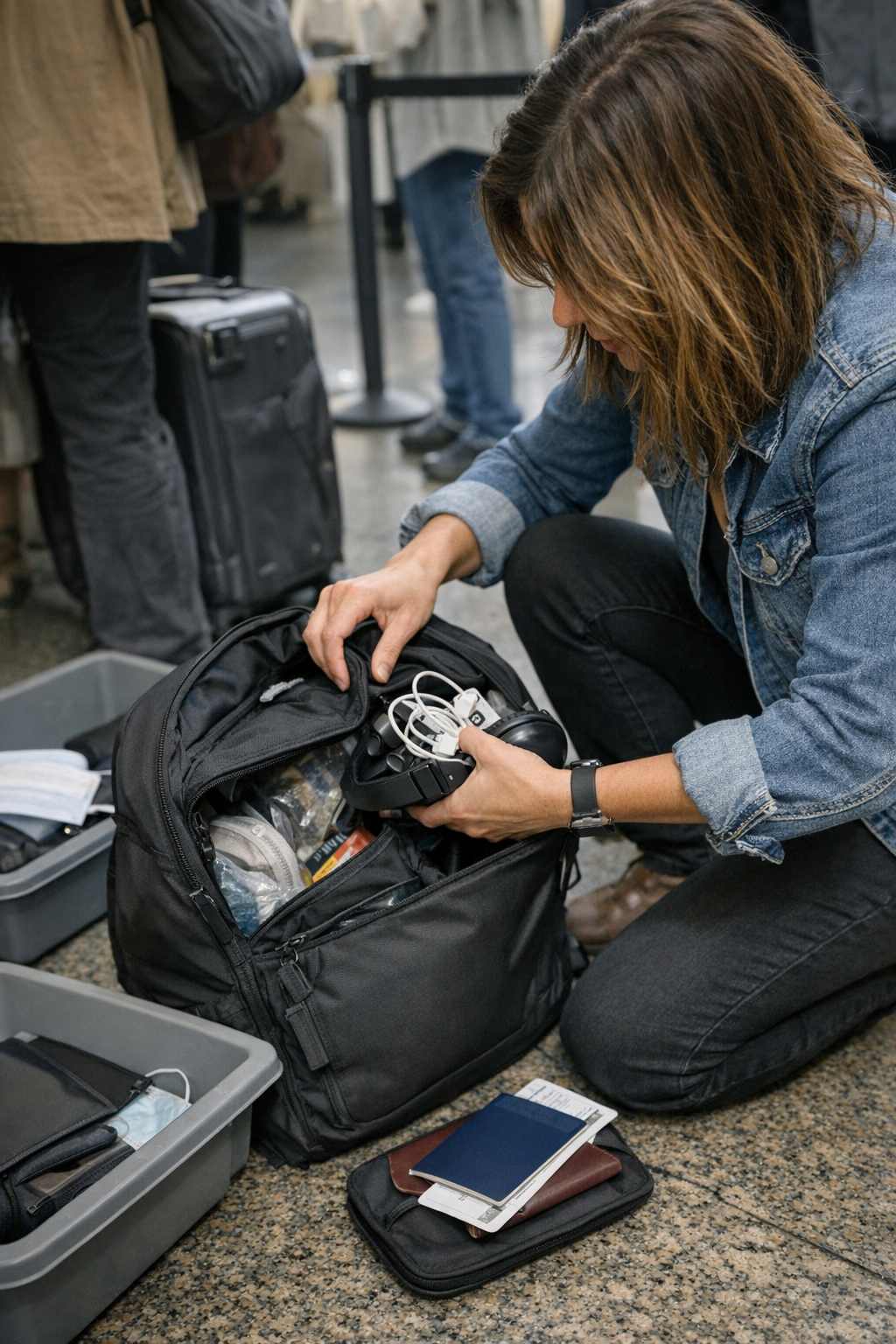
“Organized” on the bed, awkward at the gate. The problem becomes obvious only when you’re forced to move: lined up at boarding, crowd pressing in, travel documents somewhere “safe,” but now trapped behind over-planned layers. It’s the moment a color-coded, zippered setup—designed for order—turns on you, interrupting each flow point: ID check, security tray, sudden boarding change. What looked neat at the start becomes a repeat access bottleneck, especially as you cycle through more airports in one trip. That’s the real risk: a bag that resists you the more often you try to use it.
Why neat isn’t always efficient: the hidden cost of tidy layers
The appeal of a hyper-organized carry-on is strong. Lined compartments and stacked pouches give a sense of control—until actual movement starts. As soon as you hit the first security line, or get called for a surprise gate check, the logic of “everything in its place” turns into a slow-motion unstacking. Your passport is secure, but buried; your charger’s packed, but always under something else. Every retrieval requires a mini-repacking. The very structure that looks sharp in a hotel room quietly works against you on the move, exposing a gap between visual order and speed of access.
Where friction builds: the frequent-use pinch points
Most carry-on setups break down fast at touchpoints that repeat—moving trays at security, finding a seat with hands full, making a quick grab for a pen or ID mid-line. Weaknesses show up at these pinch points:
- Tray transfer stall: If your ID or charger is deep inside a tech pouch, the whole line waits as you work backwards through your own system, under watchful eyes.
- Seat-entry block: When boarding rows clog up and you need your pass fast, any buried item means you’re blocking traffic, arms overstuffed, patience running out.
- “One too many pouches” fatigue: Need headphones? That means opening a pouch, then another, just to find them—while juggling a jacket or snack, losing the rhythm you had on paper.
What starts as a single moment is repeated, accumulating into a low-level drag. By the third or fourth round, this “organized” friction leaves you more mentally spent than you’d expect.
Repeated repacking: a silent drain on focus and energy
In theory, repacking after each gate or checkpoint is minor. In reality, it’s a draining loop: stacking cables and documents again and again until every checkpoint becomes a small reset. What felt controlled back in your room turns into constant, low-stakes maintenance—especially visible after two or three full transitions. You’re not just losing time; you’re slowly training your focus away from the airport flow and onto your own bag’s problems. All that precision is useless if key items require a mini excavation every time.
When structure gets in the way: a real travel example
During a late connection at Frankfurt, my carry-on’s “secure” system folded fast. I’d buried my passport under a layer of snack pouches—great looking at 5 A.M., but a hassle under time pressure. At every random check, I stopped, balancing a pile of contents on the open bin as the aisle jammed behind me. After the third dig, it was clear: the setup wasn’t helping. It built visual order but failed every time speed or access mattered most—proving neatness is only as strong as its first interruption.
Making intentional changes: outer-pocket efficiency
The solution wasn’t another organizer. It was making high-frequency items—boarding pass, passport, key electronics—live in a shallow, outer pocket. One zipper, no buried pouches, nothing fragile. Suddenly, every checkpoint and sudden request became a one-move process. The urge to constantly reset my bag disappeared. Travel rhythm returned: efficient movement, less self-correction, no more line-blocking for a missing document or charging block.
Next rounds through security and boarding? Faster, lighter, less tense. Key items moved with the trip instead of tripping up the process. It’s not about the appearance—it’s about cutting the real resistance every time you have to reach for the same essentials.
Packing decisions: where easy access outpaces visual order
The real difference isn’t how organized your bag looks in photos. It’s how little it interrupts you once you’re moving. Most travel stress isn’t from one big mistake but from a small, repeated ask—digging out a passport for the third time, unzipping a pouch for headphones, searching for a pen at customs. A functional carry-on uses a single, memorable home for high-access items. Deep pockets are for “just in case” gear, not for anything you’ll need before landing. That switch flips your bag from a personal filing cabinet into an in-transit tool.
A carry-on that adapts with you, instead of one you’re always adapting to, is the only one that actually delivers its promise—order without extra friction.
Recognizing a reliable setup in daily travel moments
Real practicality shows up in the quick-draw moments—boarding with the crowd, flashing ID at an unexpected checkpoint, slipping a device out on the move. The outside of the bag might signal order, but the shift is internal: friction points are gone, and the mental load falls away. You notice the difference not when you pack, but when routine disruptions become non-events instead of show-stoppers. Energy goes to catching flights, not reordering headphone cords or snack wrappers after every stop.
It’s subtle, but measurable: less downtime, quicker recoveries, more flexibility if a gate changes or a line forms. Not resetting your own packing system at every stage frees you to focus on the trip, not your tools.
Practical guidelines for less repeated repacking
- Place your most-used items (passport, device, pen, mask) in a single outer or top-access pocket—avoid stacking, avoid nestling.
- Use main compartments only for bulk items or anything you won’t need until after landing (spare batteries, backup snacks, extra layer).
- If you’re opening two layers or more for anything you touch each transit, your setup is costing you tempo. Rethink access first, order second.
- If retrieving something disrupts you at every checkpoint—no matter how neat it looked before—move it to the fastest pocket, even if feels a little less perfect in the mirror.
Carry-on order that works: moving beyond the surface
The carry-on that actually works isn’t flawless—it’s frictionless where it matters most. Getting through trays, aisles, and quick checks without falling out of sync, resetting, or building new obstacles is the mark of good structure. You won’t eliminate all disruption, but you can turn your bag into a moving tool rather than a moving target for minor frustration. Each trip, each routine, new airport or familiar one: if access flows, you’re set up for less drag and more momentum—no matter how perfect the packing looked on the bed.