
Most garages fail at the threshold. The transition from garage to house is more than just a storage problem—it’s a grind of daily movement, bottlenecked by whatever sits in the flow. Shoes creep into the walkway, bikes intrude, grocery bags and backpacks sprawl and multiply, all pressing into the narrowest part of the route. Put a fixed bench or static table in that traffic zone, and you start losing clear passage fast. What’s meant to help—extra surface or “organized” storage—turns into an obstacle after enough rushed drop-offs and messy returns. Piece by piece, reset by reset, the main entry shrinks until all it takes is one bag dropped at the wrong moment to block the path and break the routine.
Why Fixed Surfaces Fail in High-Traffic Garage Entryways
The idea of a built-in workspace collapses under repeated use. Permanent benches promise helpful order: somewhere for tools, a place to sit, maybe a landing zone for gear. But real flow dismantles that logic after a few weeks. The bench edge collects dropped bags, the top becomes a stacking point for mail and stray gloves, and shoes always find their way underneath—expanding outward, swallowing the first step off the threshold. By midweek, you’re shifting three things to reach one, nudging a backpack just to swing in groceries, or sidestepping a creeping shoe heap just to get through. The so-called working surface isn’t a workspace at all—it’s a magnet for overflow, soaking up the spill but never clearing the path.
The friction isn’t always dramatic, but it’s constant. Fixed benches make the area look managed at first glance, but if you’re actually coming and going each day, it becomes a cycle of partial resets—one tidy row in the morning, chaos by sunset. What solves clutter for guests who never step in won’t solve it for the family who lives in the zone. If every return trip means threading through a pinched lane and reshuffling clutter just to open the door, the setup isn’t working, no matter how solid or polished the furniture might look.
How Fold-Out Wall-Mounted Work Tables Change the Flow
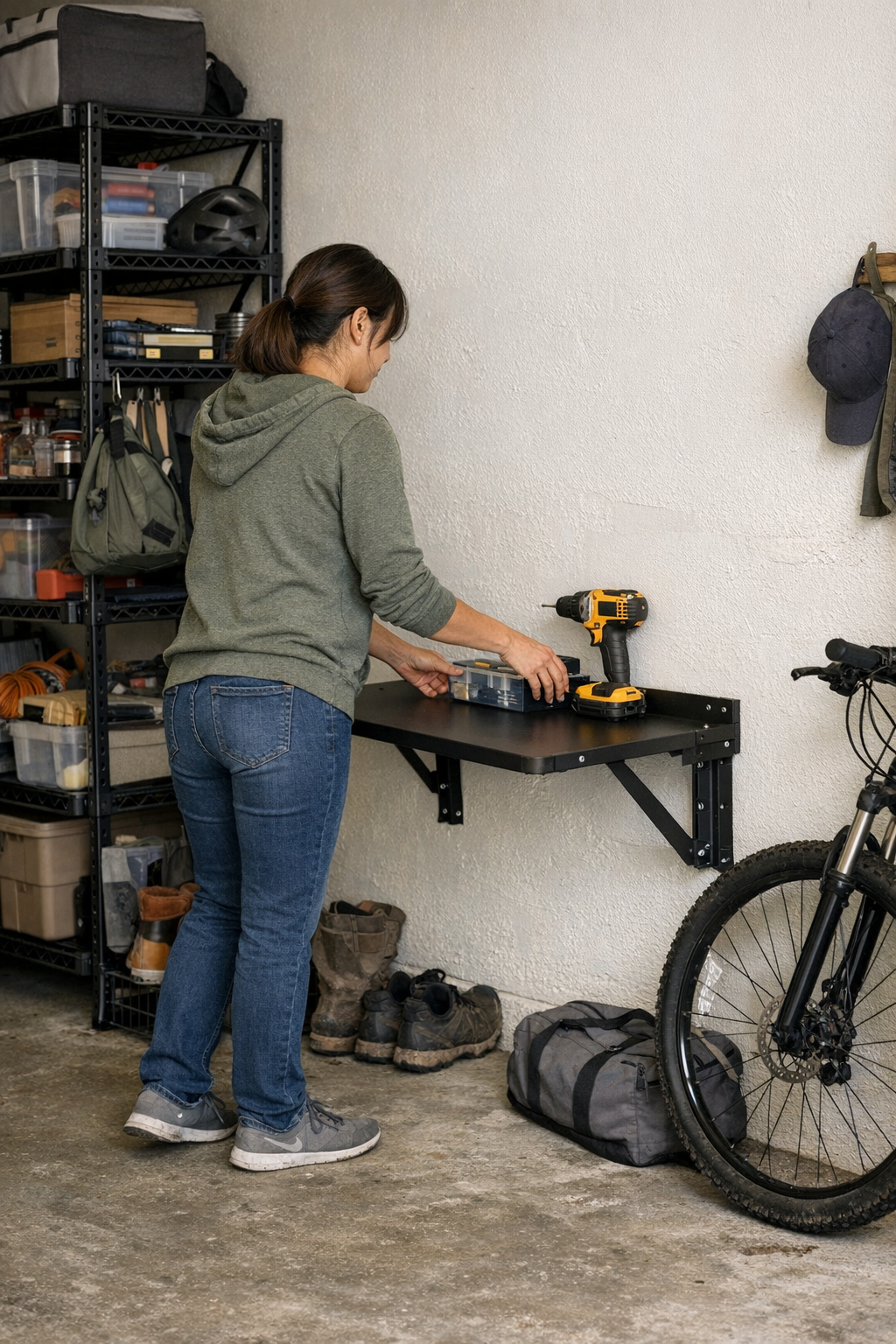
Wall-mounted fold-out tables don’t just reclaim space—they stop the entry zone from collapsing under pressure. Unlike a fixed bench, a fold-out disappears when you don’t need it. Park it flat against the wall and regain vital pass-through width. It’s not surface space for its own sake; it’s an on-demand tool that refuses to build up clutter out of habit. Mixed routines—muddy shoes, bags, groceries, a fast bike grab, three people moving at once—don’t overwhelm the space. There’s no “surface gravity” sucking random items into a pile, because the surface literally isn’t there unless you choose to use it.
It’s a different rhythm. Prep a tool or sort mail when it fits your routine; fold the table up immediately after. The act of putting the surface away is its own minor reset—forcing a return to open floor and neutral zone, even if the shoes aren’t perfectly aligned or the bags are still in the car. Reset doesn’t mean perfection; it means you don’t forfeit the whole entry each time one routine overlaps another. That’s the real payoff: you might have a muddy day, a heavy grocery haul, or the classic after-school gear ambush, but your pathway keeps rebounding to usable shape—not just an illusion of control, but actual room to move.
Everyday Scenarios: The Difference a Fold-Out Truly Makes
Imagine hitting the garage late, arms full, rain on your coat—under typical setups, the fixed bench is already losing the battle: shoes block your toes, backpacks sag half-off, mail sits untouched. You do a one-footed shuffle trying to carve out enough space to step through. Now, hit the same moment with a wall-folded table. There is no extra “catchall” to attract overflow or stall your momentum—the floor is open, even if everything else is messy. Drop your bag or not, the path still holds. Even the after-school chaos gains an upgrade: instead of islands of overflow radiating from a bench, you handle the gear on the table, then erase the surface, so the entry route snaps back, ready for the next round. No semi-permanent clutter, no bench-edge drift, just the lived relief of not having to “fix” the same zone every day.
The Reset: Why Clutter Never Fully Gains a Foothold
The fold-out table is built to force a habit—actual, physical reset—right into your routine. You unlock real control when the surface disappears by default: no lingering drop zones to decay into clutter, no excuse for shoes or bags to anchor themselves in the middle of the passage. Folding the surface away is a tiny inconvenience compared to the constant friction of maneuvering around fixed-edge buildup. The passage regains width fast; shoes spread but don’t sprawl into a blockade. Precarious piles never get a chance to build, because the “bench” doesn’t exist unless you open it. Real order doesn’t mean total tidiness—it means making the return to ready state so automatic that the entry zone stays usable for the next round, not merely for show.
What to Watch For: Getting Placement Right
A fold-out table only works if you respect the flow it’s protecting. Mount it on a clear wall where the main foot traffic passes, but don’t crowd it above bins, piles of shoes, or a bike’s front tire. Get it wrong, and you’ll avoid using it, or worse, leave it permanently unfolded—defeating its whole point. The best placement is within easy reach, fast to open and close even when the garage is busy, and never a new place for overflow to settle. If you can’t fold and unfold the surface in one motion amid normal mess, rethink your wall choice. It’s the act of disappearing that restores movement, not the surface itself.
Build and Use: What a Wall-Mounted Fold-Out Table Can (and Can’t) Do
Anchored securely, a fold-out table can handle the real tasks that pile up at garage thresholds: quick fix-its, bag sorting, unloading groceries, corralling gear. It’s not a workbench for car rebuilds or deadlifting bulky bins, and it shouldn’t invite permanent storage underneath. Its power is in its invisibility between uses—full support when project time hits, then vanishing again so the area doesn’t accumulate more than daily reality can handle. You flex between zero and full workspace, matching your habits, not imposing a new surface that competes for the same square foot you need for actual movement.
Two Quick Tips from Repeated Real-World Use
- Pair with vertical storage: Mount narrow cabinets or sturdy hooks nearby. Hang gloves, dog leashes, or simple tools above arm’s reach—never on the fold-out. That way, relaunching the table is always instant, never delayed by leftover mess.
- Make folding up part of closing out: Build the fold-in into habit—last step before you re-enter the house or after you finish a task. A small move, repeated, keeps the fallback zone clear and stops short-term clutter from calcifying into long-term blockage.
The True Impact: Open Pathways, Faster Resets, and Fewer Frustrating Moments
The real win isn’t cosmetic—it’s practical mobility under pressure. Garages and mudrooms fill up fast, and only a setup that flexes with the grind of daily life keeps the entry passable. Take away the trap of the “just drop it here” surface, and you reclaim the zone as an active, usable boundary—not a slow-growing junk strip. When resets are frictionless, clutter doesn’t get to take root, and you stop losing daily time and motion to bottlenecked, narrow paths. The difference may not show in a photo, but it’s unmistakable in a week of rushed mornings and disorganized returns.
For more transition-space storage designed around real, daily use, visit Betweenry.