
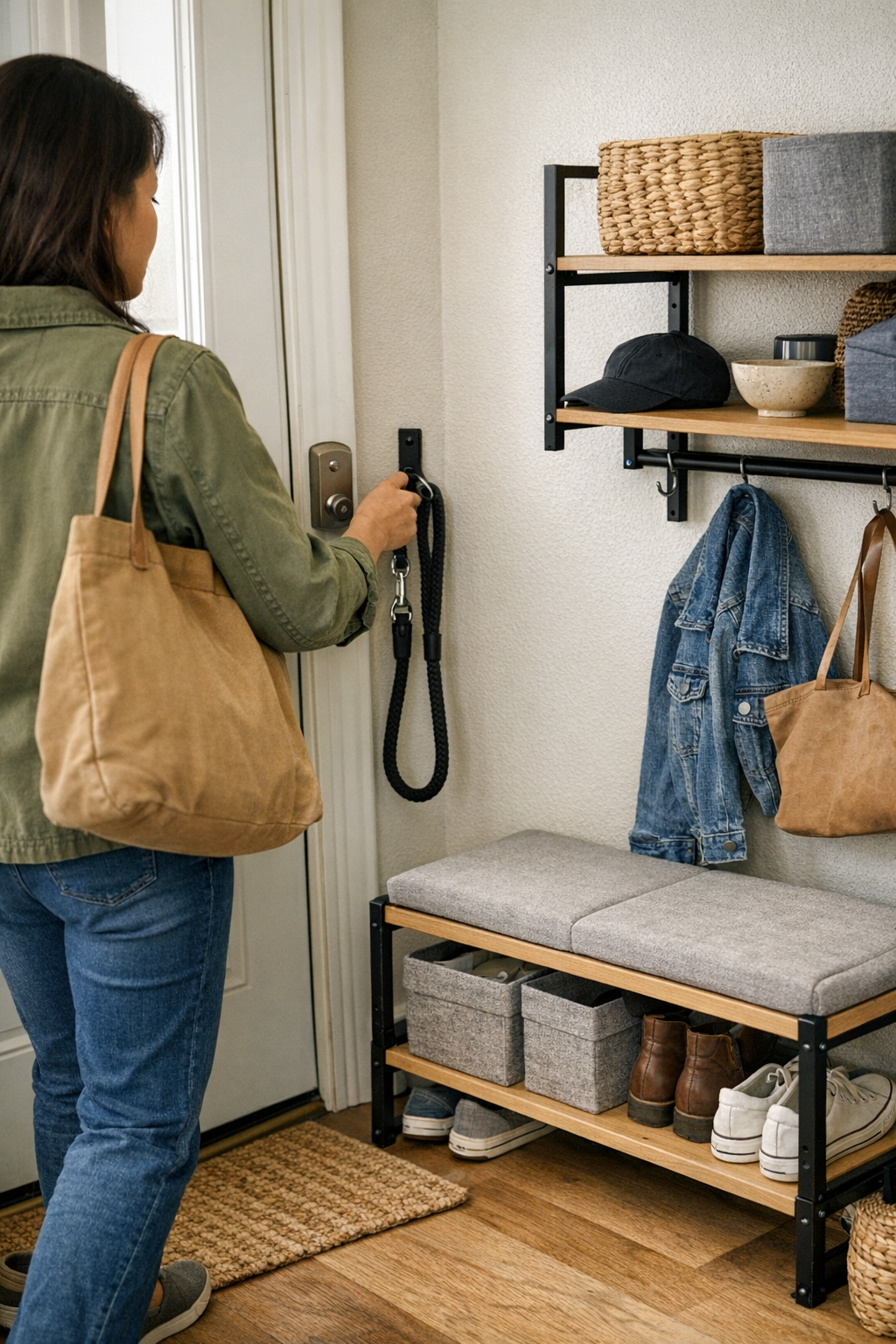
In most entryways, the smallest mistake—like mounting your leash hook too far from the latch—quietly turns order into ongoing clutter. The difference shows up the first time you drop your groceries, reach for the leash, and realize it’s tangled in shoes or looped over a bench instead of where you actually need it. Between a routine that flows and a threshold that breaks down, the setup of your hardware decides if you walk out smoothly or stumble through daily reset.
Threshold Storage Isn’t Decorative—It’s a Routine Lifeline
Magazine entryways show tidy racks and “statement” hooks, but they never reveal what happens on a real Tuesday afternoon: your arms full, your dog already lunging, and the leash not where your hand lands. Install the hook flush with the door latch—squarely in your natural reach—and every exit gets faster, every return simpler. Miss that zone, and the leash rarely goes home: today on the bench, tomorrow buried under a bag, then looped around a knob, another object added to the daily trip hazard. Your “system” looks neat on paper and fails where routines meet real life.
“Order” That Interrupts the Routine
Even entryways with plenty of racks, bins, or cabinets end up failing after a week of normal use. Systems break down not from neglect, but from collision with how you actually move through the zone: shoes creep outward, yesterday’s bag lingers on a seat, the leash joins the clutter perimeter instead of returning to its “spot.” The weakness always appears when storage is designed to look contained but doesn’t map to real motion—especially those hasty, loaded entries and exits that blur any sense of control.
Why Leash Hooks Drift (and How Placement Really Works)
Most leash hooks get hung where the wall looks balanced or where they “fit” the decor. But two days in, the actual pattern sets in: if it’s even a panel away from your route, the leash stops making it back. On a rushed morning—with dog tugging, bag sliding off, shoe rack crowding the way—the hook too far is just another unused prop. The leash lands on the bench edge or a knob as a stopgap. As this repeats, the intention behind the setup fades, replaced by whatever object is easiest to grab or drop at the moment.
The Slow Creep of Threshold Clutter
What starts as a clean bench edge and lined shoe row warps fast. Each return brings a bag left “just for now,” shoes spreading until they block the flow, and the leash looped on any knob in arm’s reach. These detours pile up, forcing you or your family to step over last night’s shuffle just to cross the threshold. The original setup isn’t guiding the routine—it’s quietly being pushed aside by the pattern of actual use.
Arm’s Reach from the Latch: Where the Fix Actually Sticks
Sustainable order comes down to one simple placement: mount the leash hook right at the door latch, at waist height, inline with your step-through path. That way, you don’t detour around bags or shoes—your hand finds the hook in one move, making cleanup a non-decision for kids, guests, and whoever else passes through. The difference is immediate: clip, hang, go. No re-training, no elaborate system to remember—just a routine that reinforces itself by matching how you actually enter and exit.
One Small Change, Noticeable Difference
The instant the hook shifts to the proper spot, the overflow drops. On a crowded morning, you’re not hunting for the leash under a coat or shoe pile; it’s always where your hand expects. The bench stays free for sitting, not for overflow storage. Shoes line up instead of drifting wider, because the leash no longer floats, claiming random real estate. The threshold clears itself by design, not by luck or repeated resets.
Missed Hooks Become Set Dressing, Not Storage
Hooks or racks even a foot off-route slowly go unused. Everyone defaults to whatever’s in their path—bench, knob, shelf edge—and the original fixture becomes part of the background, a “storage” feature observed but rarely used. That gap between where things should live and where they actually land is the source of most daily entryway mess, making every reset a bigger job than it should be.
Practical Tips from Real-World Use
- Install at waist height, lining up with the latch. Anyone from adults to older kids can use it without stretching or stooping, and it matches your entry motion.
- Choose wall-mounted hooks for reliability. A fixed hook doesn’t wiggle, get buried, or fall behind jackets like flimsy over-the-door solutions after a week of real pressure.
- Make the hook single-purpose. Hold just the leash (maybe one essential), and resist piling on extras—more hooks often invite more sprawl, not less.
Small Moves, Fewer Roadblocks
Entryways are built-in bottlenecks, especially in homes with families, pets, or tight hallways. One misplaced hook or drifting storage fixture ripples into blocked paths and routine detours by day three. The right fix isn’t about aiming for perfect order, but letting your setup absorb repeated chaos and snap back—ready for whatever tomorrow’s entrance brings.
If you want less clutter and fewer resets, start with one change that matters every time you walk through: place the leash hook as close to the latch as habit allows. That quiet shift keeps mess one move further away, making your entry zone do its job, day after day—no extra ritual, no fresh round of frustration.