
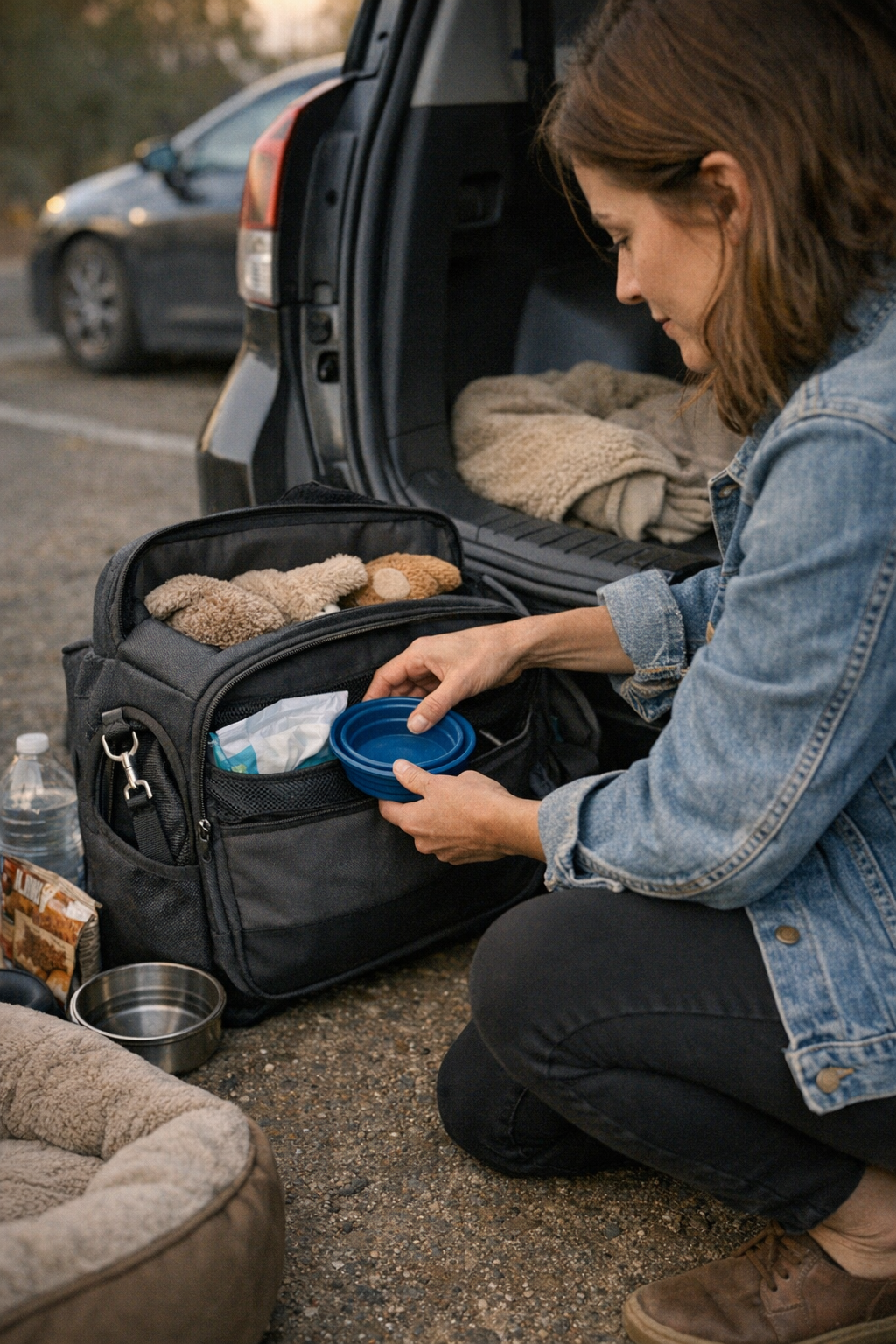
The gap between a “packed” pet travel bag and a bag that actually works on the road is bigger—and more annoying—than most owners expect. Your setup looks neat at home, zipped and ready on the floor: bowls, treats, wipes, everything in place. But three stops in—balanced on the edge of a car seat with a restless pet and your hand fishing for that buried water bowl—the design flaws show up fast. What’s missing isn’t a supply; it’s the ability to reach what you need, when you need it, without breaking the flow of the trip.
What a Pet-Travel Setup Looks Like—And How It Actually Works
An organized bag is only a win if it keeps pace with the trip. On Day 1, every item has its pouch; by Stop 2, routines splinter. That comfort blanket, useful at night, now blocks quick wipe access. The leash tangles around bowl handles; a pocket that held treats at home forms a cluttered blockade after things shift in transit. After a few cycles—out, back, reach, repack—the kit becomes a guessing game, not a solution.
The real test comes at that late-night rest stop or a gas station pull-over, when speed matters. Each time you unzip for one item and get another, you feel the setup dragging time and patience. Worse, the pet senses it: their rhythm breaks, waiting extends, and the short pause for rest turns into yet another moment where everything waits on the bag.
Overlapping Items, Blocked Access, and the Rise of Travel Friction
Travel friction is often invisible—until it slows you down, again and again. Leash and wipes tangle together just when you need to act quickly. That toy that soothes your cat on the move? It’s now wedged across the cleanup pouch, blocking speedy access. Each reshuffle to grab one thing presses others further out of reach. At home you see “organized”—mid-journey, it’s just another obstacle.
Minor, repeated inconveniences don’t feel dramatic, but they stack up fast: leash clips hidden by bedding turn a planned one-minute break into three. A cleanup bag under dog treats turns a spill into a fumble. Outwardly tidy, the kit inside is layered confusion—especially after repetitive stops break whatever order you started with.
Recognizing the Real-World Weak Point: Repeated Access Demands
The reality check on your pet-travel setup isn’t that first, fresh departure. It’s at Stop Three, with low energy, an impatient pet, and urgency rising. If your hand goes into the same “organized” pocket only to find a jumble, that’s your weak link. With each repeated dig, the initial promise of order is replaced by the predictable chore of repacking or spreading everything across the seat to find a single wipe.
Picture the scramble: your dog tugs at the leash, water bowl trapped under the blanket, and you’re shuffling through layers with one hand while blocking the exit with the other. Each round, the “prepared” setup feels more like a set of hurdles than a helping hand—a source of pause rather than the flow you expected.
When “Prepared” and “Usable” Fall Out of Sync
Every pet owner recognizes the shift: what starts as a well-packed bag slowly becomes something you work around. By the fourth stop, the only way to find supplies is to empty half the bag onto the seat or memorize the flipped-around layout. Instead of smooth movement, you wind up building temporary workarounds—wedging zippers open with a finger, tucking treats into bags they weren’t meant for—just to speed up the next reach-in.
How a Better-Structured Bag Changes the Routine
Structure, not just organization, is what relieves the grind of repeated stops. A split compartment design—a wide opening for bowls and wipes right near your reach, a side pocket that always presents the leash clip—transforms the routine. On the move, it means one motion for water; another for cleanup; each high-use item in its own predictable spot. No digging, no car-wide reshuffle, no waking your pet just because a towel is at the bottom.
The effect compounds over the trip: less rustling, a pet that drinks before they get agitated, cleanup that wraps before frustration sets in. Repetition no longer erodes order; it reinforces it. The bag stops being the bottleneck and starts syncing with real-world travel rhythms.
Example: No More Seat-Side Scrambling
It’s 10pm in a dark parking lot, your pet riled up and you balancing awkwardly on one foot, bag gaping on the back seat. In the old setup, it’s a five-step circus: hunt for the leash, chase loose treats, unearth bowls by unfolding the blanket—nothing you need is where you expect it. With a compartmented design, the leash slides out first try, bowls are in their slot, door closed before tension builds. The visual difference is small; the moment-to-moment relief is real. Every stop feels less like a reset, more like part of the flow.
Practical Tips: What Actually Helps After Several Stops
Prioritize true one-step access for anything you use more than once per stop. Wipes, bowls, and leashes belong in separate anchor points, never buried below low-use supplies. If anything blocks a routine grab—even something comforting, like a blanket—it needs its own lane. Avoid “bucket” interiors: they look flexible at first, but turn chaotic with use and tired hands.
Internal organizers or inserts, even a single divider, cut down overlap that delays every move. A side-access wipe pouch at bag’s edge saves yourself the full search. In practice, the least fussy setups are the ones where you know—always—what lives where, and you never have to upend half your travel kit just to clean up a mess.
Why “Organized” Isn’t Always “Easier” in Repeated Pet Travel
A pet-travel setup that looks organized isn’t enough—it has to behave under real repetition. The right structure absorbs rough handling, resists mid-trip chaos, and makes restarting after any pause frictionless. When bowls, towels, or leads slide back into their own pockets without guesswork or reshuffling, your own tension drops, and your pet’s routine settles with it—again and again, through every stop.
That’s when a well-built organizer justifies itself—not because it looks neat, but because it takes the drag out of repeated movement, makes each restart easier, and keeps messes contained to a single moment, not a cycle of delays. Small structure choices shift the whole experience—from stalling at every stop to feeling like the trip actually moves on your timing.
Find more practical travel setups at PawGoTravel.