
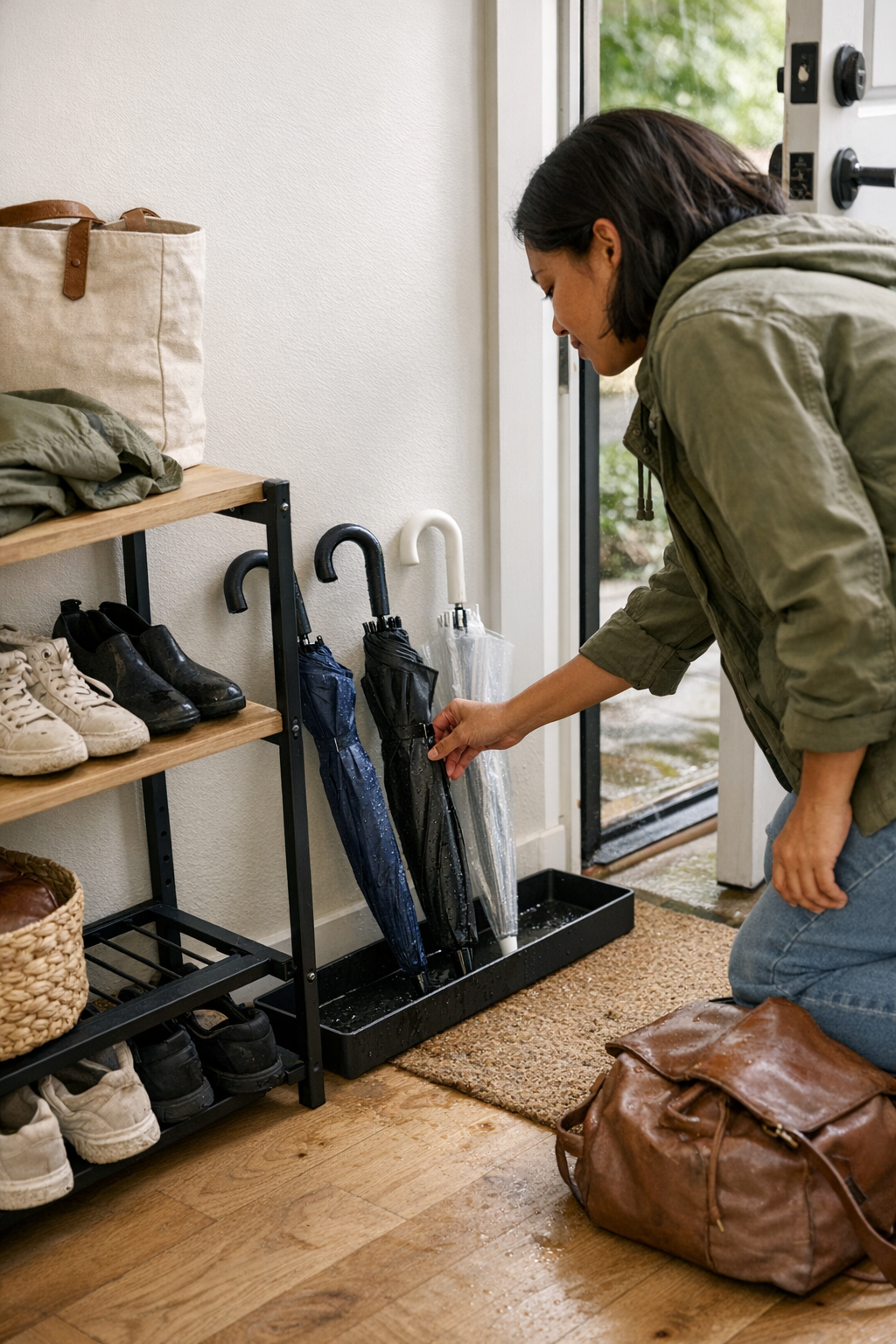
If you walk in from a downpour with no umbrella tray, you don’t just carry in water—you set off a slow, spreading mess that’s almost impossible to contain. Drips stream from your umbrella, slide down the doormat, sneak under shoes, and edge into baseboard seams. The chaos isn’t dramatic, but it’s relentless: a tidy entry mutates fast. What started as daily routine—drop bag, step out of wet shoes, move on—becomes friction. One rainy day means a damp mat. Two or three, and the “quick reset” dissolves: shoes wick up water along the row, bags brush into soaked corners, and bench legs get splotched, with new stain marks forming where the wall meets the floor. Instead of a functional entry, you’re stuck repeating cleanup cycles just because water has nowhere specific to go.
The Unraveling of Entryway Order: When Rain Becomes Routine
Most clutter problems creep in quietly, but water announces every weak point after one storm. Wet umbrellas land “just for now” by the bench, against the wall, or hiding in a catch-all bin—each placement starts a new patch of seep and spread. From the first misstep, zone lines blur: shoes edge out to dodge puddles, bags lose their drop zone to moist intrusions, and what “worked” on a clear day now wastes time and patience every time multiple people come home at once. The more this repeats, the more the original layout crumbles—invisible on sunny days, unavoidable when wet weather sets in.
The trouble gets sharper with repetition. Monday’s damp spot is a warning. By Thursday, your “organized” entry is a shifting puzzle of soggy shoes, overtopped mats, bag bottoms never quite dry, and unpredictable streaks along the walkway. Each return trip forces you to guess: Will the only dry spot be covered by someone else’s umbrella? Should the bag go higher? The threshold is no longer a reset point; it’s a bottleneck people step around, stall at, or—worse—start ignoring, letting damage spread further each week.
Pretend Order: Open Storage’s Hidden Trap
Open storage feels adequate—until the first stretch of wet weather proves otherwise. Lining umbrellas along a wall, tossing them in a decorative basket, or assuming that “open space” absorbs extra gear only works when everything’s dry. On a rainy streak, the system breaks: shoes get pushed wider and wider to avoid dampness; bins become soggy catch-alls; and that “show-ready” bench tops out as overflow, making each pass-through clumsy. Open storage blurs the problem just enough that resets get skipped, and the zone’s original separation of wet and dry is erased by slow, random movement and water drift.
A Relatable Threshold Scene
Picture this: three people rush in from rain, no umbrella tray in sight. Wet umbrellas collapse wherever there’s room—across the doormat, propped on a bench, or leaning at the edge of a shoe row. Without a real landing spot, drips disperse underfoot and sideways. Shoes, lined up for order, start creeping along the wall for safety, taking up twice the intended space. Bags dropped on semi-dry corners catch the runoff, silently soaking through the bottom. After a few cycles, the “entry zone” is more guesswork than system—every pickup clogs the path, and the original layout has vanished into a patchwork of awkward placements and avoidable mess.
By your next departure, you’re dodging soaked runner edges, checking benches for wet spots before sitting, and resigned to starting the morning with “clean-up before go.” The open basket or the lucky “free spot” by the door wasn’t neutral; it slowly multiplied the reset burden, making what once felt like short-term convenience an ongoing maintenance problem.
How a Good Tray Puts Water in Its Place
Adding a purpose-built umbrella tray isn’t about achieving visual perfection—it’s about containing chaos at the entry point before it invades the rest of your setup. Put a slim tray tight to the door, and suddenly umbrellas no longer crowd shoes or force wet acrobatics. The tray draws the mess to one predictable zone, so the entire movement through the threshold changes: instead of constant shifting—mats, shoes, bags—it’s one action, one destination. Your reset shrinks from a full mop-and-repeat cycle to a check—empty the tray if needed, and move on, with the rest of the threshold under control.
The full value is visible at the boundary. Raised tray edges lock water where it lands, keeping every drip in sight and off the rest of the floor. The next morning, shoes are dry, the bag drop zone is unmistakable, and no one has to risk a wet bench. The difference isn’t abstract: with water isolated in a defined space, the entry stays clean in function even when chaos repeats outside. “Reset” moves from scrambling to a one-boundary wipe down.
The Importance of Fit and Flow
Tray dimensions matter. Too small—a single storm leaves puddles that escape the first use. Too big—and you crowd the pass-through, trading one problem for another. A realistic choice: a slim, roughly foot-wide tray that sits flush along the wall and matches the real umbrella count. If it fills, it’s an immediate cue to empty—not an invitation to let things build up. Entry routines stay simple and maintainable, not stretched by a bin that can hide neglect or a tray that creates new obstacles.
What Doesn’t Work: Common Workarounds That Fail in Real Use
Multi-use bins? Water seeps downhill, undoing both organization and cleanliness. Wall racks without trays look tidy at eye-level, but drips collect at the base—wet spots that turn up as surprise staining, warped boards, or hidden mold. Decorative baskets just delay disorder: the first storm, and water runs right through, forcing you to clean three spots instead of one. These fixes don’t just “work less well”—they multiply the friction that a good tray eliminates in real conditions.
Everyday Setbacks Without a Tray
- Bag drop zone disappears: Bags edge into wet territory, and there’s no reliable spot that stays dry after a rain cycle.
- Shoe rows creep across the floor: Dodging puddles forces the lineup wider and less accessible, tightening pathways—or creating trip risks.
- Benches become the backup landing zone: Finding a dry seat means scanning for water shadows, not just tying shoes and heading out.
- Thresholds clog up: Grabbing an umbrella or shoes means shifting a pile, slowing every routine departure.
- Resets bog down: One quick tidy turns into rounds of mopping, drying, and re-lining every zone after each wet return.
A Small Fix Makes a Big, Repeatable Difference
Umbrella trays don’t create entryway magic—they create predictable boundaries that survive repeated, imperfect routines. Instead of water drifting unchecked, containment becomes automatic: wet goes where it should, and dry stays reliable. The real gain is in reduced reset time, easier movement, and a threshold that stays workable—especially when the weather refuses to cooperate and the sequence of entries and exits is never neat. The difference isn’t in perfection, but in how few problems you’re forced to solve each week.
Shop Betweenry for practical entryway and transition-space storage solutions.