
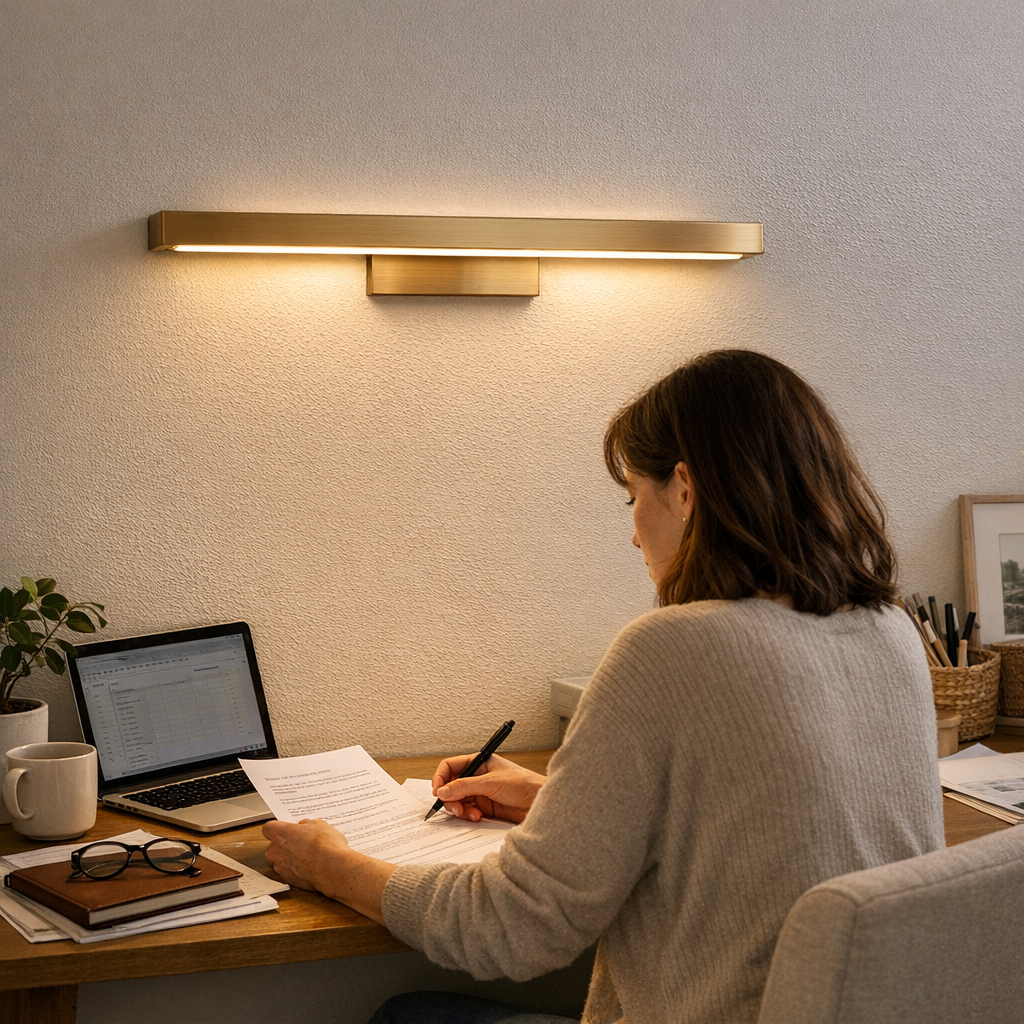
A “bright” workspace can still leave you squinting, frowning, or restless after an hour. Step in, flip on the overhead light—everything looks officially lit. But ten minutes into reading or sorting papers, shadow bands stretch across your desk, glare bounces from polished surfaces, and the outside edges fade into gray zones. You start shifting left, leaning closer, or stacking paper just to chase a clear spot. Every small movement feels like compensation for a ceiling fixture that claims the room, but loses your workspace detail—the difference is not subtle after a week of returning to the same chair.
When the Ceiling Light Isn’t Enough
Most home offices and work corners fall for the simple idea: a single ceiling light checks the “bright enough” box. Plenty of rooms hit technical brightness targets, but real use makes the cracks obvious. Every day you notice:
- Shiny desktops flaring up when overhead beams hit the wrong angle
- Your hands or a laptop edge suddenly casting deep shadows on the page
- The far corners of your surface dropping into murky half-light
- That ritual of dragging your chair or supplies, chasing the one spot that’s just usable enough
It feels minor until the interruptions stack up. You end up fighting unpredictable daylight, uneven spread, and a constant need to “work around” the lighting instead of through your routine—every trip to the desk means a new round of workaround habits.
The Hidden Cost of Shadow and Glare
Unlike hallway or entry lighting, work-area lighting proves its worth only when the task in front of you gets easier—not just brighter. Rely solely on the ceiling, and the consequences multiply:
- Half-finished tasks because eye fatigue sneaks up fast
- Paperwork and screens shifted back and forth, searching for a clean spot with no shadow
- Unconscious hunching and squinting that turn into tension headaches by the end of the week
No single moment is dramatic, but every small stretch, squint, and shuffle is a sign that the “official” lighting is quietly underperforming. All those micro-adjustments slowly build a workspace people avoid instead of use smoothly.
How Fixed Task Lighting Changes the Everyday Use
Adding fixed task lighting shifts the room from “bright in theory” to actually workable—all day and night. A well-placed task light—whether wall-mounted, under a shelf, or set beside your usual reach—aims the beam onto your work zone directly. You stop compensating; the light covers your surface, not just the room at large.
Immediate, Practical Changes
- The far side, corners, and edges of your desk stay equally clear, not just a spotlight circle in the middle
- Your notes and printouts read sharp at 9 PM, not only when the sun is out
- No reflex to push your chair or laptop “into the light”; the whole zone works without shifting aimlessly
- Shadow lines from hands and screens shrink or disappear, especially for detail or craft work
Task lighting doesn’t just make the space brighter—it stops the routine loss of focus caused by poor coverage, restoring the desk to a tool, not a blind spot.
Real Use: The Subtle Comforts
The first week with a true task light, the difference is easy to test: you catch yourself sitting back instead of hunched; you aren’t dragging papers to the strip of light in the middle. Finishing a project doesn’t fall apart just because an overcast afternoon made the corner unreadable. The best cue? You stop noticing the light at all and just get on with the job.
Getting Task Lighting Placement Right
Mounting matters as much as the fixture. Precision beats power:
- Positioning just above eye line shines cleanly across the surface with less glare
- Angling at 30–45 degrees knocks out harsh shadows that would otherwise cross your work or notes
- Running light side-to-side—from the far edge to your reach—means that even with papers or tools scattered, everything stays visible without searching for lost edges
If you’re tight on space or sharing the surface, a slim under-shelf or edge-mounted strip stops the “one user at a time” compromise. The setup follows your use—not the other way around.
Avoiding Old Frustrations
If you see yourself moving piles, hunching, or rotating your work to line up with the best patch of light, that’s a direct signal the current structure is failing. Task lighting solves this at the source: no more habitually working from the least-worst spot of the desk because the lighting forgot your real routine.
What About General and Task Lighting Together?
A ceiling fixture alone is never enough for real work—no matter how “bright” it looks at first glance. Overhead lights handle walking, cleaning, or general movement. But any pattern that involves reading, sorting, or making a decision at your desk exposes the ceiling-only limit. The common cycle: move back and forth, get frustrated by shifting shadows, and end up stacking more bulbs without solving the real problem.
General lighting gives broad coverage. Task lighting brings focus and comfort to repeated, precise activity. Getting both working together means the simplest job—like checking one invoice or jotting a note—never gets derailed by your own workspace.
Everyday Signals That Your Lighting Set-Up Needs a Change
- You shuffle papers or drag your laptop, but never find a spot where everything’s equally clear
- Eye strain creeps up on gray days or after longer sessions, not just late at night
- Headaches and irritability fade only when you leave the task area
- The work surface “looks” bright until you try to use its last inch—then the clarity drops off fast
If these habits repeat, it’s a lighting structure shortcoming, not simply a need for more wattage. Upgrading bulbs or swapping fixtures without rethinking the light’s direction and spread only postpones the frustration.
Why Lighting Structure Outweighs Decorative “Finishing”
The most “finished” workspace isn’t always the easiest to use. Reliable surface clarity—at any hour—beats decorative edits or cosmetic tweaks every time. A truly functioning lighting structure means the full desk is usable, predictable, and interruption-free, with no hourly rearranging or squinting just to keep momentum going.
Functional lighting disappears from your attention. If you keep fighting shadow, glare, or awkwardly bright spots just to work in what looks like a well-designed space, the fix is rarely one more decorative touch. A simple, fixed lighting change—like adding a wall-mounted or under-cabinet fixture—solves shape and reach issues design alone will never touch.
Removing the Invisible Obstacles
Whether you’re sorting bills, typing late, fixing a broken hinge, or finishing craft projects, the right structure takes lighting from background annoyance to invisible support. A better routine doesn’t waste energy adapting around light—or lack of it. The best setups turn the workspace into something you use by choice, not endure by habit.
If you want to make your workspace—and the rest of your home—less frustrating and genuinely easier to use, LightHelper is focused on practical, reliable indoor lighting for every real-world zone.