
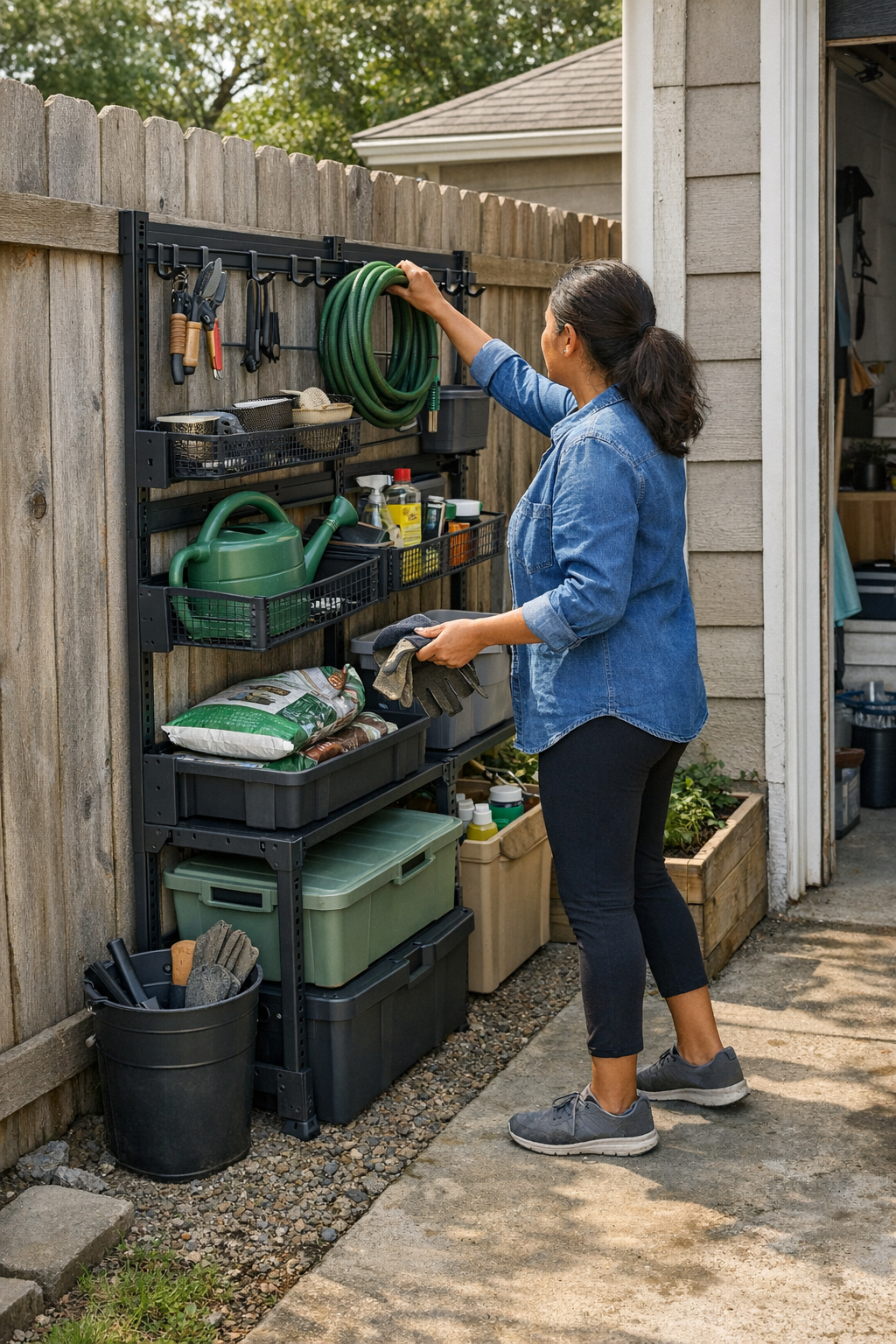
In a tight backyard or a narrow side yard, you never have to wait long to see if your outdoor storage actually holds up. One tool out of place or one deck box left ajar turns into a tripping hazard half an hour later. There’s no luxury of unused space to absorb mistakes—each loose soccer ball, tossed garden glove, or half-blocked bin instantly becomes an obstacle, and every attempt to fix it feels like starting over. The cycle is familiar: you juggle too many items, push past piles in the walkway, and realize—by sundown—that your “reset” never finished the job.
One Zone or Many: The Cost of Scattered Storage
Dividing storage across your yard sounds clever in theory. Hang the rake by the gate, drop balls in bins on the patio, stash gloves by the steps. For a day, it can even look managed. But then a regular weekend hits—kids rush through the side yard with bikes, someone drags out the grill, the dog launches itself at the fence—and suddenly, every carefully chosen storage spot is in the way of something else.
Repeated use finds every weakness. Going for the hose means nudging aside a stack of folding chairs that migrated “temporarily” to block the compost bin. The soccer ball left near the patio gets buried under a bag of charcoal. A solo gardening project ends with trowels on the fence and knee pads stranded on the deck. Each “for now” drop-off crowds another path, and by midweek, your neat plan has split into disconnected piles.
Why ‘Convenient’ Turns Into Chaos
Every new “handy” nook gets claimed as another dumping ground. Hand tools end up behind bikes, a coil of hose lands on the grill, that outdoor cushion shifts between three hiding places—all faster than anyone remembers or returns them. These corners and bins aren’t really organized zones; they’re waypoints for every item that fell outside the main routine, growing muddier with every day of use.
The small stuff drifts the fastest. Gloves vanish behind the trash cans. Clippers are always farther away than you remember. At cleanup, the effort just multiplies—items get moved, not put away, and the quick reset becomes a scavenger hunt. The more scattered your system, the faster clutter sneaks back in, and the longer it takes to find the walkway again.
The Side Yard Stress Test
Picture a narrow, concrete-paved side yard—four feet wide from back door to gate, no cushions or planters to hide what’s really happening. You try spreading storage out: cushions stacked by the door, helmets on hooks halfway, hand tools in a tote wedged against the fence. It feels accessible. But as days pile up, so does the tension. Stray soccer balls kick straight into the deck box lid, bike hooks snag backpacks, reaching for one thing always means shifting three others. Instead of open passage, the main path tightens. Resetting is rarely a single trip; it’s a series of shuffles, bumps, and blocked corners that never seem to clear for good.
Centralized Outdoor Zones: Where Clarity Begins
This isn’t about stripping your setup bare. Blank-slate minimalism isn’t practical when your side yard does triple duty: kids, pets, gear, gardening, and the endless in-between. But one clear, shared storage zone changes everything. With a single, well-defined spot, everyone knows where to drop gear—no more guessing, no more scattering.
How does this actually show up day-to-day? Replace the clutter of bins and hooks with sturdy wall shelves or modular racks just inside the side gate. Suddenly, the daily route in or out runs straight past one reset zone—one shelf for shoes, one set of hooks for tools and helmets, one organizer for garden odds and ends. Even with less than three feet of wall, things funnel into a predictable return lane. When something’s missing, you notice it right away. Out-of-place items glare, instead of blending into messy corners. Unused wall sections finally earn their keep, and the floor stays passable instead of shrinking week by week.
Looks Clean—But Can It Survive Real Use?
It’s easy to judge a storage setup right after a big cleanup; almost anything looks orderly when it’s been staged for a photo. But real results reveal themselves after normal traffic: the wall rack actually stays in use, the walkway isn’t blocked by Monday night, and bringing in muddy shoes doesn’t force you to step over a fresh pile. A strong single zone quickly shows which details still need attention—maybe a kid-height hook, a tilt-out bin for random balls, or a shelf trimmed to fit tight against the wall.
Habits don’t change overnight. If “return drift” creeps back—old piles forming outside the new zone—a small nudge can help: a marked mat, an obvious container, or even just a bold label to re-focus the reset routine. Organization isn’t about spotless looks, but about handling a stretch of real, messy days without losing control or blocking yourself in the process.
Small Fixes for Fewer Frustrations
You might not be able to rebuild a side yard, but a few honest upgrades make outsized impact:
- Install hooks or slim shelves on the path you actually walk. When you physically have to pass the reset zone, the odds of gear ending up elsewhere drop fast.
- Mount modular racks for daily-use items. A tool hung at elbow height is ten times more likely to come back, and less likely to migrate to the next “empty” corner.
- Mark the drop-off area with purpose. A painted line, a waterproof mat, or even an outdoor label broadcasts, “This is the finish line.” No guessing or silent drift.
The payoff isn’t a spotless yard—it’s a clear separation between “put away” and “left in the way.” Five minutes of cleanup stays five minutes, not half an hour. You find the gear before you trip over it. The walkways open up enough for two hands or one muddy dog at a time. And the space feels like it belongs to the routine, not the other way around.
Real organization in small outdoor spaces is measured by what doesn’t get in your way: open ground for a passing bike, a tool that returns to its spot, a wall that actually earns its space. No system is flawless. But shaving down the frustrating resets makes every corner feel less like a trap—and more like a part of your actual yard again.