
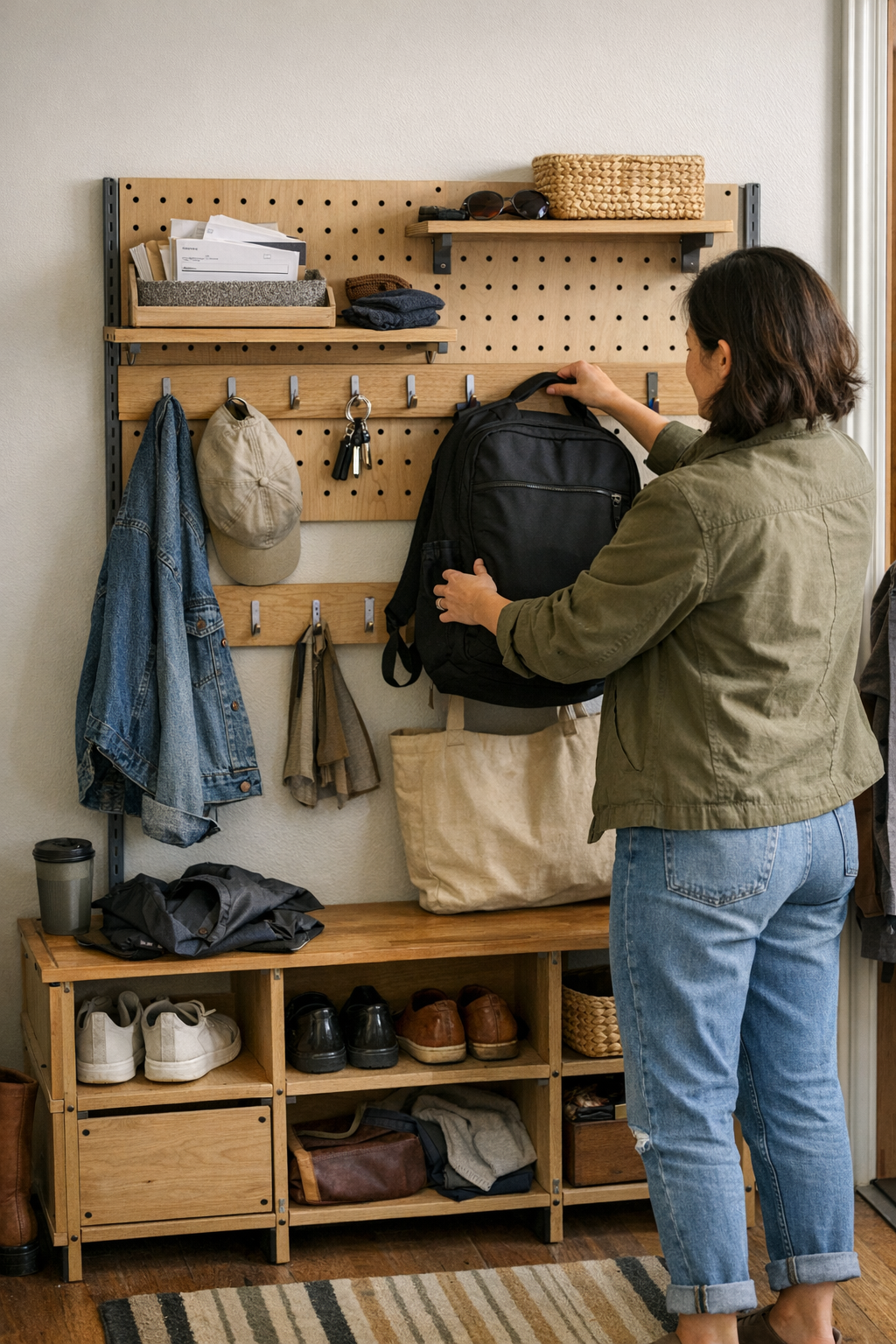
Pegboards look like the ultimate entryway fix: everything visible, each hook holding a job, no mystery about where things belong. But in the rhythm of real life—busy departures, rushed drop-offs, two bags instead of one—the neat layout quietly unravels. The problem isn’t just visual clutter. It’s bottlenecked motion, overflow landing in the walk path, and the slow grind of resets you can’t keep up with. The promise of easy access quickly meets the reality of missed categories and extra steps. That pegboard? After a week, it stops feeling like organization and starts feeling like maintenance you didn’t sign up for. This is the threshold problem that Betweenry storage is built to address: not how clean it looks for a photo, but whether your exit path stays clear and your routine survives repeated, imperfect use.
When Organized Access Slows You Down
Entryways always start fresh: pegs ready, trays empty. By midweek, that’s fantasy. One person comes home with rain boots that don’t fit their hook; next, someone double-hangs bags in one hand—now the remaining hooks are buried. Mail and keys that began in their slots spill out, mixing with earbuds, gloves, chargers. The difference isn’t dramatic chaos—it’s the margin of friction: losing ten seconds to move a bag; pausing because stepping past a dropped shoe narrows the route; bending to rescue something blocking the door. The system calls for resets, but resets now mean sorting other people’s overflow, not just your own. Clutter spreads and so does delay.
Why Pegboards Look More Adaptable Than They Feel
Pegboards are sold on adaptability—move a hook, shift a tray, create any arrangement. That holds up only if patterns don’t constantly collide. In real households, schedules clash: one user’s gear lands across another’s setup. Young kids, late arrivals, shared roommates—nobody’s routine fits a single “ideal” slot. Shoes stack over one another, overflow migrates to hat hooks, and suddenly that “flexible” wall becomes a tangle that nobody wants to maintain. A setup that feels dynamic the day you install it starts demanding attention just to hold the line. Now the question isn’t innovation—it’s whether the structure can keep up with the mess it was meant to contain.
Everyday Drift and the Shape of Clutter
Clutter doesn’t announce itself all at once. It’s shoes squeezed onto whatever hook is closest, shoulder bags layered three deep, junk mail stacking atop keys. The original logic dissolves when “just for tonight” turns into the new normal. Compare with a bench and open bins: toss in shoes, slide in a backpack, done. No technical beauty—just function that absorbs the excess. Pegboards only outperform in spaces where boundaries stick and users recalibrate on autopilot. Most homes, though, see the slow drift—items finding new spots each day, categories quietly falling apart.
The Real-Life Test: Entry and Reset Pressure
Dense setups betray their weakness at crunch time. Picture one person dropping a muddy backpack across the central pegs, shoes propped on a flat tray “just for now.” The second user can’t find a free hook, so their gym bag lands in the path. The walk through the entry slows. Nobody wants to reshuffle someone else’s stuff, so items stagnate. Repeat this a few cycles, and order tips into chaos: the board becomes the very bottleneck it was meant to solve. Thresholds shrink, resets get put off, and temporary piles become fixtures blocking clean entry or exit every day.
What seems organized on Sunday stops functioning by Thursday. Not through a sudden mess, but by slow, repeating compromise—until even basic movement through the door requires extra steps.
Comparing Simple Storage and Pegboard Performance
Bring in a basic bench with bins or a small utility cabinet and the contrast is plain. No, it won’t line up every shoe or assign a hook to every scarf. What it does: swallows overflow fast, tolerates sloppy return, clears pathways. Need a reset? Shove, close door, walk away. Pegboards demand item-by-item sorting—if your categories break, every reset slows down. Simpler storage trades layout for forgiveness: no wall of visible order, but also no delayed exits or awkward reshuffling every morning. The hidden price of “perfect” organization is attention—the margin for error is slim, and function falls apart when the routine changes even slightly.
Recognizing the Signs: When a Pegboard Isn’t Helping
- Shoe rows creeping upward, overrunning hooks that weren’t meant for them.
- Bags tangled together, layers hiding what’s beneath and blocking grabs.
- Mail, gloves, and keys fusing into a single undifferentiated pile—all in the “catchall” tray.
- Pauses at the entry as people sidestep overflow or thread around dropped gear.
- An edge of the board or floor steadily collecting leftovers that nobody resets.
These aren’t signs of a flawed user—they’re a signal your storage matches display more than it matches real movement. When the system works against how people actually return, pause, and pass through, friction is all you feel.
Choosing Adaptability Over Density
When every category requires attention to maintain, the answer isn’t more pegs or more rules. It’s less. Reduce accessories: half the hooks gone = half the distractions. Create wide open stretches so overflow lands clear of the walking zone. Ditch strict divisions—one row of open pegs lets coats, bags, or shoes drop wherever, no path blocked. Set visible limits that force routine overflow to relocate: three pairs of shoes get the lowest hooks, everything extra moves to the closet. Let a single, big hook near the door catch everyone’s bags for the day—at night, emptying it and restaging takes under a minute.
Adaptability means seeing category drift as a given, not a failure. The best test? If your storage system bounces back easily after a typical week, you’re not just organized once; you’re organized enough to last.
Keeping the Entryway Easy to Use, Not Just Easy on the Eyes
Entryway storage isn’t winning if every reset eats time and trips up your path. Real solutions make it simple to recover from the inevitable mess—so routines resume, not slow down. Betweenry designs its storage to meet real-world pressure: bins that tolerate overflow, benches that handle sit-down and drop-off, wall units that absorb routine drift, and mobile pieces that move when you need more space. Good storage for transition spaces doesn’t just show what goes where; it makes clear movement possible even when most categories blur. That’s the win: an entryway that takes daily punishment and still resets fast, so the door stays open—literally and habitually.