
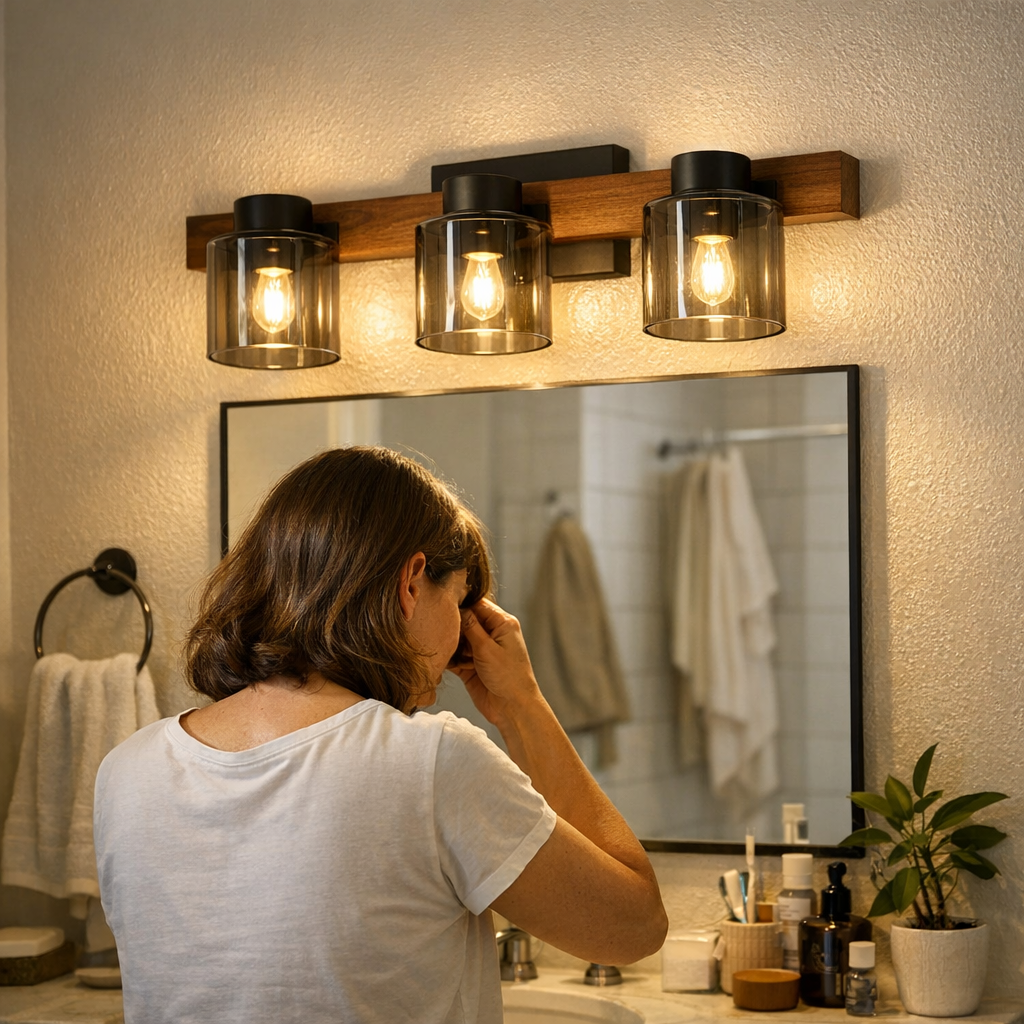
Most indoor lighting issues aren’t about brightness—they’re about what accumulates after the lights have been on for a while. In real bathrooms, hallways, utility corners, or stairwells, a fixture that seemed perfect at install starts to reveal its edge: the mirror fogs before anyone showers, air in passageways grows dense after just a few crossings, or the bathroom vanity feels sticky before you even finish your routine. These aren’t quirks—they’re signals that the bulb’s heat output is quietly working against you, quietly layering discomfort into spaces designed for movement and clarity. Replace “well-lit” with “mildly oppressive” and the difference in daily function is anything but subtle. In rooms meant for repeated, purposeful use, bulb-generated heat is often what makes the difference between a fixture that blends in and a setup you quietly try to avoid.
Why Bulb Heat Is an Invisible Friction Point
Bulb heat doesn’t announce itself during installation. A new flush mount, semi-flush, or wall sconce often looks right and covers the space—until routines press in. It’s easy to glance at wattage, color temperature, or fixture style and assume the job is done. But in confined spots—small bathrooms with sealed doors, laundry nooks boxed in, low-ceilinged hallways—every hour of bulb time leaves its mark. Incandescent and halogen bulbs trade some of their inviting warmth for a slow-release heat load. In rooms with nowhere for warm air to go, that’s the crack in the armor: surfaces capture and radiate heat, condensation forms earlier, and what started as a clear, lit space now drags at every pause or passage.
Everyday Friction: How Overheated Fixtures Disrupt Flow
The Corridor That Becomes a Gauntlet
Picture a hallway just wide enough to pass through, fixed with flush ceiling lights or close wall sconces. For the first few passes, the lighting seems to work: floor is lit, shadows are pushed out. But by mid-afternoon or evening, each walkthrough brings a weight—literal heat hanging in the corridor. You start speeding up to avoid the overhead warmth, or simply avoid the route altogether. The space has light, but loses its ease of movement. The wrong bulb turns a clear path into a spot you dodge.
Mirror Clarity Breaking Down Before the Steam
At the bathroom vanity, a flush mount lights the glass well—at least early on. But after a couple of grooming routines, you notice it: fog at the edge of the mirror, well before any steam. The air above the counter grows restrictive. It’s not mechanical failure, ventilation, or humidity from a shower; it’s bulb heat pooling over the glass, setting off the fog before the water even runs.
Laundry and Utility: The Chore Zone Turns Heavy
Inside a laundry room with low airflow and a semi-flush ceiling light, the effect feels cumulative. Each cycle with the light on builds up warmth until the walls themselves seem to clamp down. Folding feels stuffier, ventilation acts too slowly, and even short tasks start to tire you out. The brightness is there. The room is “usable.” But the experience becomes quietly strained—another case of heat, not just light, making chores harder.
How Low-Heat Bulbs Change the Routine’s Texture
LED and compact fluorescent bulbs cut the cycle of collected heat, making rooms feel usable no matter how often the switch flips.
LEDs in particular release only a sliver of the heat produced by old-style bulbs. This single choice keeps the ceiling, wall, and air around fixtures from sliding into stuffiness—so morning prep, laundry rounds, or stair crossings feel ordinary, not like battling a dense zone in your own house. It’s a change that often goes unnoticed in the moment but means, a week later, surfaces remain neutral and movement feels as easy at hour five as it did at minute one.
Spotting the Absence of Irritation After Switching
Swap a standard 60-watt incandescent for an LED over a stair landing and see what’s missing: that hotspot you once dodged on every busy evening. Now, crossing floors doesn’t require a quick escape. Illumination stays steady, but the creeping warmth that used to stake out the top stair is simply gone—visibility remains high without creating new obstacles.
Task Areas: When Heat No Longer Lingers
At the mirror or the laundry counter, eliminating bulb heat means less edge-fog, fewer mirror wipes, and no sense of invisible exhaustion at the end of use. Instead of light making the space slightly more difficult—to see, to pause, to use—you get routines that finish as cleanly as they start.
Quick Diagnosis: Is Heat Your Real Lighting Problem?
Do this: after your fixture’s been on for a while, carefully touch near (not directly on) the mount. If you feel warmth radiating, or if stuffiness builds up in tight spaces faster than expected, the bulb is likely overloading the room with heat. Common signals:
- Mirror edges fog or streak before the bathroom steams up
- Hallway or stairwell air starts to press in after a few crossings
- Rooms need long, awkward cooling after you shut the light off
These issues surface fastest in low-ceiling, poorly vented, or high-use spaces—especially where repeated routines keep the light on longer or require frequent stops and starts.
Small Swaps That Remove the Drag
- Install LED or compact fluorescent bulbs in enclosed fixtures— they dramatically cut excess heat without sacrificing visibility or control.
- Confirm fixture compatibility, especially with damp-rated or sealed flush mounts—an easy oversight that can cause other headaches.
- Combine efficient bulbs with better airflow whenever possible—a cracked door, quick vent fan, or shorter “on” cycles all reinforce the cooling effect.
The smartest fix is the quiet one—where your bathroom, hallway, or laundry zone feels completely unremarkable after hours of use. No residual weight, no early fog, just a space that never interferes with the routine.
Lighting That Keeps Pace With Repeated Routines
Good indoor lighting never calls attention to itself; it lets you move, pause, shave, fold, and cross through as if the fixture simply wasn’t there. Poor lighting—especially from high-heat bulbs—forces a choice: put up with subtle extra effort or start resenting every pause for fogging, glare, or thickened air. The real test is repeated use: the stair turn that’s no longer a barrier, the bathroom mirror that stays clear, the laundry counter that doesn’t sap focus at the end of the day. Bulb choice shapes every one of those moments.
Choose bulbs for actual repeated rhythms: minimize heat, check your fixture match, and watch how the room feels as routines stack up. The best lighting upgrade is the one that removes invisible obstacles—keeping your space not just “lit,” but genuinely hassle-free to use every time.