
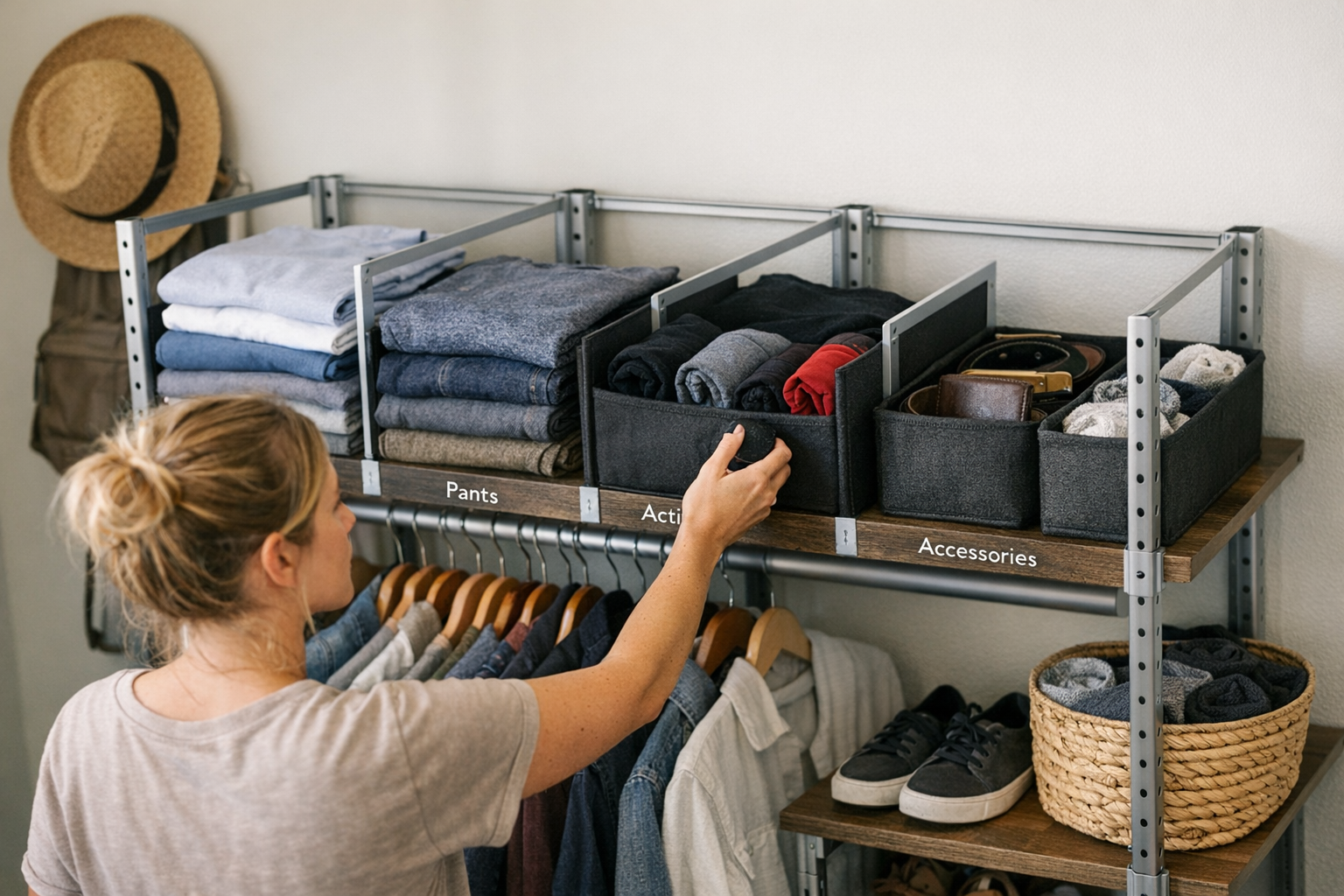
The real test of your closet isn’t in a photo—it’s staring you down on a bleary Monday morning. That’s when the setup either saves your routine or eats up precious minutes. You slide open the door: is today another rush of digging through sock heaps and unraveling lopsided shirt stacks, or do you reach straight for what you need? Every morning answers that—and reveals if your “organization” is really working.
When “Organized” Isn’t Enough—Closets That Stall Your Routine
Neat rows and visible stacks look satisfying, but by midweek, reality sets in. Shirts creep into pants territory. Socks vanish to the back, or surface doubled up with T-shirts. Accessories sink between piles, quietly shifting out of reach. What starts as a tidy tableau quickly turns into a puzzle—especially when you need to get dressed fast.
Organization breaks down the instant you’re in a hurry. If grabbing a single item means rummaging, lifting half a stack, or untangling yesterday’s choices, your system isn’t saving you time. It’s just hiding the struggle until you’re pressed.
The Cost of Blended Storage: Micro-Delays and Daily Clutter
Most closets don’t erupt in chaos overnight. Clutter creeps in subtly, with small inefficiencies multiplying each day:
- Grabbing for that tee tucked behind jeans—toppling the front stack, then spending a minute reshuffling it all.
- Digging through a pile of gym shorts to rescue a lost pair of socks from the shadows at the back.
- Staring at a shelf mid-routine, trying to decode if those folded stacks are for work or weekends—because category lines have disappeared.
Each of these looks harmless, but across a week, they add up. The “organized” shelf keeps stealing moments—and mental bandwidth—that you never intended to lose.
Where Open Shelving Fails: Boundaries Make the Difference
Open shelves promise flexibility but quietly encourage chaos. With no clear borders, every reach or return lets stacks bleed together. It’s effortless at first, but maintenance grows exhausting—one category seeps into the next until you’re left with an indistinct pile-up where retrieval is a gamble every time.
Segmented storage changes the equation. Simple dividers, bins, or dedicated shallow drawers cut the drift. Each category claims a defined space, so shirts actually stay in their lane, socks don’t vanish under sweaters, and accessories don’t free-float into oblivion. You start reaching with confidence—no unstacking, no guesswork, no mental rerouting. The system resets itself every evening when you put things back, not just on big cleaning days.
The Real Impact of Boundaries: Routine vs. Reset
Perfectly folded stacks rarely survive contact with real life. One hurried morning is all it takes for clothes to sprawl across old category lines. Add in roommates, partners, or kids—each with different ideas of “putting things back”—and your system deteriorates even faster.
Physical boundaries—however simple—shrink these gaps. The hesitation vanishes. Each grouping stays visible. Even after a hasty grab, you know exactly where the next shirt or belt belongs. The system is more forgiving, making resets a near-automatic part of your nightly routine rather than another chore you avoid.
Real-World Reset: Four Zones, One Shelf, No Second-Guessing
This isn’t a closet makeover. It’s a targeted swap. Take a broad shelf and split it into four functional zones: shirts, pants, athletic gear, accessories. Slide in dividers or line up a handful of bins—suddenly, every item is either in place or obviously out of it. Mornings become one-move decisions. At night, even if you toss things back a bit scattered, broad borders wrangle them into order without extra effort or a weekend overhaul.
Some days will be messier than others. That’s the point—segmenting doesn’t demand perfection, just gives you guardrails that reset every time you put something away. You don’t need a labelmaker or a new closet—just an honest look at where your system lets clutter sneak in.
Warning Signs: How Crowding and Confusion Take Over
Most people spot trouble only when it’s already annoying them. Signs your closet’s boundaries have blurred:
- Socks wedged under jeans or shirts, vanishing for days.
- Shirt piles slumping or spreading sideways after a few quick pulls.
- Baskets that were meant to “organize” have merged—now everything’s mixed in one low-visibility bin.
- You find yourself scanning every shelf for a missing belt, then rifling through three categories for a single item.
If any of these sound uncomfortably familiar, a couple of well-placed dividers or bins can put boundaries back in play—often without needing to blow up the whole closet and start over.
Build Zones That Actually Survive Daily Use
- Think broad, not fiddly. Use wide segments—shirts, pants, accessories—so you can quickly toss and retrieve. Micro-compartments are high-maintenance and invite friction.
- Keep prime real estate for daily essentials. Eye-level space should go to what you reach for most. Overflow and seasonal pieces can live up top or down low, where access matters less.
- Stop before you over-divide. Too many boxes and boundaries become another organizing chore. Make it obvious, not labor-intensive, even for someone sharing the closet.
- Leave room to breathe. Don’t max out every inch. A bit of empty space makes stacks less likely to tip and helps small items stay reachable instead of getting squashed or hidden.
It’s not about buying more. It’s about designing storage that handles real life—rushing, resetting, and all the messiness between.
What “Works” Looks Like: Effortless, Not Flawless
The goal isn’t a show-home closet; it’s one that stays clear even on brutal mornings. You shouldn’t be thinking about “organization” at all. You should be pulling out your shirt and socks, barely noticing the mechanics because each thing lands in its own spot—routine, repeatable, and resilient when you’re running five minutes late.
Check yourself: Are you hesitating before grabbing? Are the stacks becoming shapeless blobs by Wednesday? Do you dread putting laundry away because it messes up what you just “organized”? If so, try adding one blunt boundary—a divider, a container, a wide bin. Let the improvement show in your speed and calm, not just in the visual tidiness you snap for social media.