
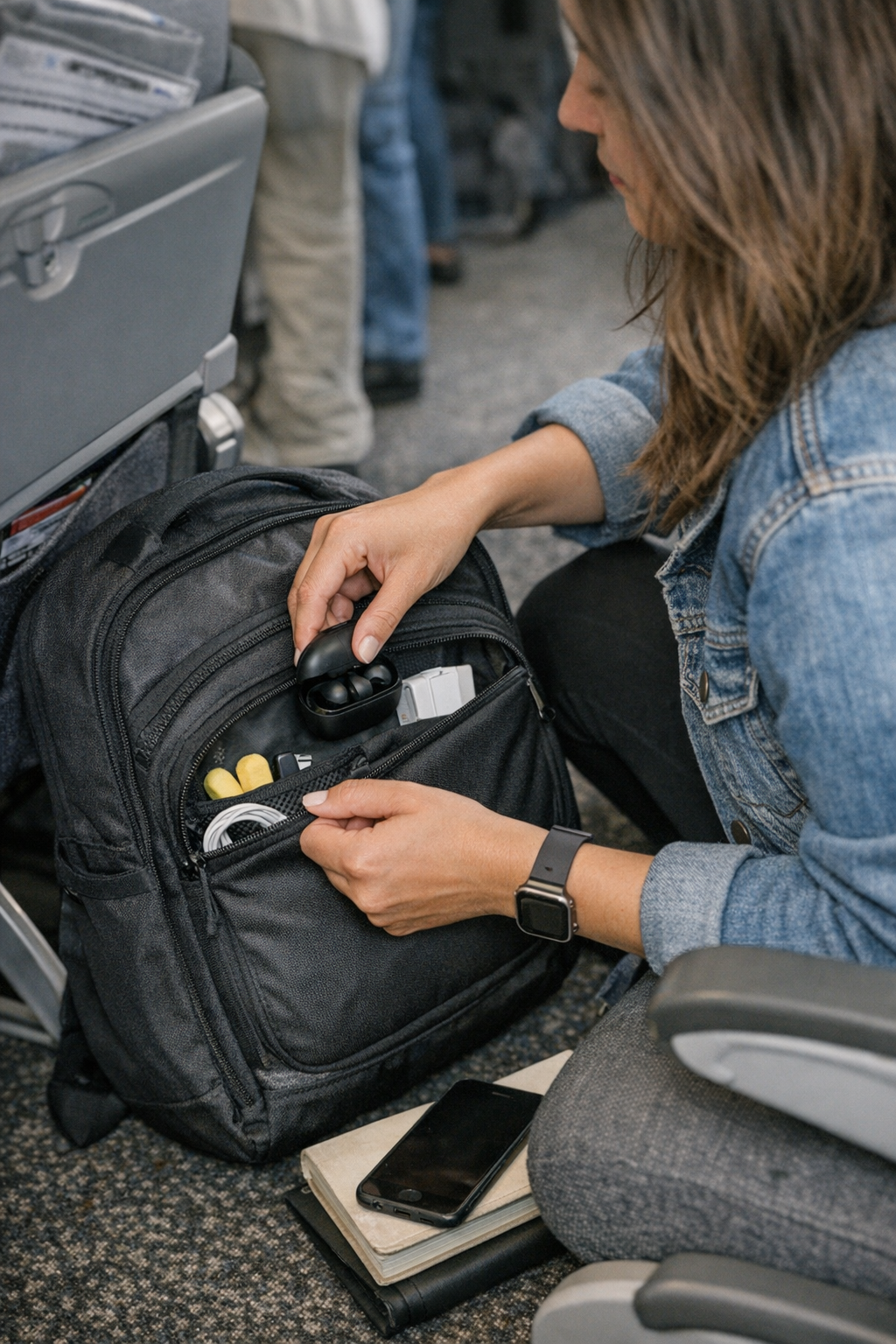
The moment you step into the security line, the cracks in your bag’s setup show themselves fast: what looked organized at home turns chaotic when your essentials are trapped behind zippers, buried by pouches, or lost in an outer pocket so crowded it might as well be locked. You’re squeezed in a boarding line, juggling a passport and phone, trying to look calm while you secretly wrestle your bag’s “system.” Every reach for comfort—a charger, a mask, earplugs—turns into a public display of pocket searching, pouch shuffling, and escalating zipper drama. Suddenly, what should be a two-second grab drags into a scramble. The whole point of traveling light slips away, replaced by the frustration of a well-packed bag that doesn’t move with you.
Why ‘Organized’ Isn’t Always ‘Usable’
There’s a critical difference between a bag that looks sorted on your bed and one that actually keeps up with airport reality. What starts as a neat assembly—cables tucked, pouches labeled, pockets zipped—breaks down by the third document check or late-night gate switch. Unzipping one pouch for a charger ends up spilling out half your gear; grabbing your documents means emptying layers you thought were separate. The core issue is not mess, but slow, stacked access—each “solution” introducing tiny repeated stall points whenever you need to move fast.
The Repeat-Offender Moments You’ll Recognize
- Security tray crunch: you’re holding your phone, digging for your passport, and realize the document pouch is pinned under two other organizers—good luck not stalling the line.
- In-seat frustration: elbows tight, your hand wedges for earbuds in a shallow pocket, but the second item you grab snags everything else, drawing attention with each movement.
- Boarding limbo: zipper after zipper, each attempt at “quiet” retrieval just creates more sound, more pause, and ends with a rushed, messier repack as the crowd compresses behind you.
- Tray-transfer breakdown: retrieving a single tech item means undoing the careful order you built—your logic evaporates as travel chaos exposes flaws in the system.
The Real Cost: Disrupted Flow, Lost Focus, and Shared Space Friction
Every drawn-out retrieval or noisy shuffle multiplies when you’re under real pressure. The inconvenience that goes unnoticed at home becomes impossible to ignore in an airport line or cramped cabin aisle. Suddenly you’re rehearsing a sequence—open, unzip, dig, re-stack—while everyone waits and watches. Calm, private order is traded for public, visible delay. Announcements urge you forward, cabin space constricts, and every second spent digging just amplifies the tension. The bag hasn’t failed on neatness; it’s failed the test of movement and access when the stakes are higher.
How Packing Choices Ripple Into Repeated Disruption
Where you stash your high-need items shapes your entire flow. Stack organizers for visual order, and you bury necessity. Split everything into too many pouches, and you lose track: was the passport in tech, or did it end up with headphones? Each fix solves a past annoyance, but creates new work when the environment changes—in motion, at the gate, or under a time crunch.
One common result: your bag looks ready, but routine access becomes a friction point. Passport under a pen case, earplugs wedged with a power bank—suddenly every quick reach interrupts the sequence. The strongest signal you need change isn’t a messy bag; it’s the instinctive dread at every checkpoint, tray transfer, or seat shuffle, when your flow hits another snag.
Compact Isn’t Always Conducive
Hyper-minimalist or compact designs often create their own kind of block. That outer pocket that should be for fast grabs turns into a confused multi-use space—snacks, tech, receipts—too loose and disordered, or so tight that nothing comes out without drama. Slim setups solve excess, but not the slow dig or the awkward public unpack when one item is sealed off by another in motion. Many setups look minimal, but force you into slow, showy retrieval right when you need zero interruption.
The Shift: Isolate Essential Quiet-Use Items to the Exterior
The only reliable fix that stands up to repeat-use testing: assign a dedicated, accessible exterior pocket for your silence-first essentials—earplugs, sleep mask, passport, power cord, e-reader, or compact comfort item. Not the main compartment. Not an inner pouch. Just one repeat reach, one quiet unzip, nothing else disturbed.
This approach directly cuts friction in the most punishing real-world moments:
- Boarding scramble: headphones slip out in one motion, no need to unpack the main bag or draw every eye with a zipper symphony.
- Security rush: passport slides from the correct spot instantly, not after a fiddly bottom-of-bag dig that holds up everyone behind you.
- In-flight: sleep mask returns to its pocket without triggering a cascade of re-folding, tidying, and disrupting seatmates.
By giving essentials a visible, isolated home, the main compartment stays zipped and stable through repeated repacking. Used items go back in a fast, silent loop—not a scene. You keep order and forward motion, even when the airport pace turns brutal—or when the cabin lights go down and you’re moving by touch.
Going from ‘Looks Packed’ to ‘Moves Quietly’
This external-pocket shift isn’t a one-time hack—it’s an upgrade with compounding value over trips. The result is loud in its silence: fewer distractions as you duck into a row, no more slow, searching hands or mid-aisle repacking. Passengers barely notice your movements. Your bag stops making public noise every time you reach for something. The change isn’t about perfection or style—it’s about a system that holds up, keeps your trip flowing, and lowers both hassle and visibility where it matters most.
The Quiet Carry-On Routine, Trip After Trip
Even the neatest packing fails the test when you repeat the same reach, in the same crowded space, and hit the same blocking point. That “one last pocket” trick works until it becomes a friction spot in real pressure—security, tight aisles, frantic repacks, seat swaps. The dedicated exterior silence-pocket isn’t about looking like a minimalist or carrying it all; it’s about shutting down repeated open-close-reset cycles at the exact moments the old system drags. Security trays, seat changes, fast gate exits—each becomes faster, less visible, less disruptive.
Set up right, your bag moves with you instead of against you. Noise fades, the stress of repeated public unpacking vanishes, and your carry-on finally works as quietly as you need it—trip after trip.