
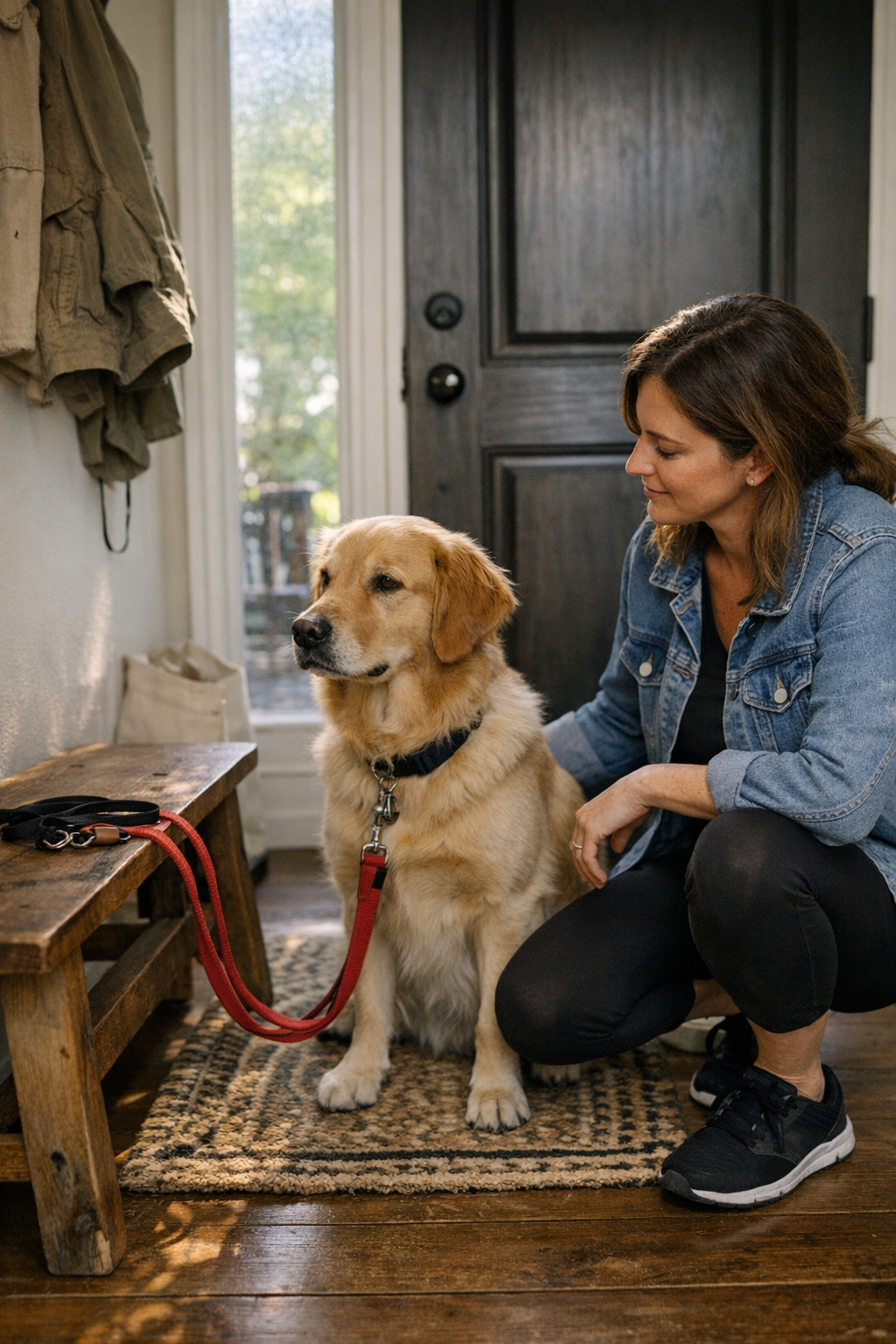
If there’s one spot where your daily dog routine keeps tripping you up, it’s the before-door scramble. You feel it in the pressure to get out: leash in one hand, shoe half on, hunting for a poop bag while your dog vibrates at your feet. The “walk” always starts at the threshold—but the first real problem starts there too. One rushed moment and you’re fighting a leash knot before you hit the sidewalk, dog already surging, your plans and mood disrupted in seconds. Over and over, it’s the same friction point—no matter how tidy the area looks or how many times you declare you’ll get out smoother next time. The DogPile world starts right here, where setup and flow collide every single day.
The Real Flow Problem: Skipping the Pause
Running late? Most owners try to power through, yanking open the door as soon as the leash is clipped. The logic: why slow down when your dog is practically bouncing through the wall? But that skipped pause is exactly where the chaos begins. Dog lunges, leash tension spikes, your arm’s twisted, and control is already gone—long before you see the street. That scramble isn’t a one-off mistake; it’s the usual pattern, replayed until the routine feels less like a dog walk and more like a starting pistol for daily hassle.
Most days, you try to ignore it. Entryway tangles blur into background noise, and maybe you only really notice when your dog nearly sweeps your legs or sidesteps out the gap before you’re ready. But walk after walk, you end up bracing for that initial burst—not enjoying it, not really resetting. The doorway isn’t just another spot in the house; it’s the daily edge where your system either holds or slips.
Small Oversights, Big Repeats: Why the Entryway Routine Matters
On paper, an entryway feels basic—grab leash, open door, go. But the difference between “fine” and “friction” is buried in the seconds before you step out. Every skipped pause multiplies annoyances:
- Leash looped under your dog as they corkscrew for position
- One hand scrambling for the handle; the other juggling bag, keys, or phone
- Dog gear—towel, boots, wipes—sprawled near the mat, exactly where you need to move
- Your dog picking up on your rushed movement and turning it into more chaos
The entryway can look organized, but still jam you up with the same old tangle. Order isn’t function—and the same weak spot keeps reappearing, no matter how neatly you restack hooks or bins.
The Built-Up Cost: Repeated Minor Friction
This isn’t about a wild morning. It’s about the way impatience and small blocks stack up and turn the whole process into something you brace against. All those micro-frictions build steam: your dog’s excitement gets mistaken for readiness, you rush to match it, and the first five minutes become a series of leash knots and off-balance moves. Day after day:
- You lose control and pace the moment you step out
- Your dog keeps zooming far longer than needed
- You’re left resetting your grip, leash, and attitude almost immediately
The setup sends the signal: launch now, don’t settle first. It shows up in the walk’s choppy start—one fixable thing spiraling into a routine mess.
Scenes from Real Life: Where the Routine Breaks Down
The Leash-Grab Gauntlet
Picture weekday morning: leash buried behind another harness, wiped tangled in a boot, towel slumped dangerously close to your line of movement. You reach for your gear—realize something else is blocking it—and by then your dog’s spinning circles, feeding the tension. Even on a neat-looking hook system, if the path isn’t clear, scramble returns the moment you move.
Re-Entry Woes: When Reset Comes Too Late
The mess doesn’t stop on the way back in. You try to wipe paws, but the towel’s somewhere under scattered shoes, or you’re shuffling past a bag pile to hunt down the wipes. By the time you finish, paw prints are already past the mat. Every missed setup is another cleanup job—avoidable, but repeated because access patterns don’t match what you actually need in the moment.
Surface Calm, Hidden Hassle
Sometimes, everything looks managed—shoes lined up, hooks clear, mat in place. But standing at the door, you hesitate: do you have to dodge toys, move a bag, or reach awkwardly to avoid knocking something loose? A tidy look doesn’t translate into a flow that works. You’re still doing little reshuffles just to get out the door, and every pause becomes forced instead of built-in.
Why a Pause Works (and What Counts)
The fix is blunt: stop yourself and your dog for a real pause at the door. Not to demand obedience—just to let tension bleed out for three to five seconds. Leash settles, you and your dog physically reset.
- Hang or set down the leash so it isn’t taut—let it truly rest
- Leave the door closed until everyone visibly slows, even if it’s just a half-breath’s worth
- No command or perfect “sit” needed. Just a mutual stop in the action—the dog’s front paws steady, body quiet, the energy dialed down
When you start with a pause, the immediate difference: the leash stays slack, you don’t get yanked out, your own shoulders drop. Pressure releases before you ever cross the line. The expectation for both sides resets—from “explode out” to “move as a pair.”
No Calls for Perfection—Just a Pause
This is not about controlling your dog. It’s about letting that one overlooked moment change the feel of the entire outing. When the pause is normal, the scramble start vanishes; tension drops, leash stress vanishes, and you’re no longer bracing yourself at step one.
From Threshold to Sidewalk: The Flow Difference
As the pause becomes habit, so do its payoffs. First steps out are quieter, the dog’s pace matches yours, the leash rarely knots, and you stop running the same rescue routine—untwisting, lunging, self-resetting—over and over. Instead, you cross the threshold in sync, starting with actual control and momentum that holds past the first block.
Repeating the pause anchors your whole walk. It doesn’t just solve the opening seconds; over days, it erases the chain of hassles that used to flood your early minutes outside. The physical habit stays small, but the functional difference only grows.
Small Setup Tweaks: Making the Pause More Reliable
If the pause never feels natural, your setup is probably blocking you without you seeing it. Notice where friction hides:
- Is the leash actually within arm’s reach? Or do you cross the entryway?
- Are wipes, bags, towels grab-able without interrupting your flow?
- Is there a clear place for both you and your dog to pause, or will you always step on something?
A neat entry can still be cramped. Try simplifying: put the leash on the closest hook, clear out one blocked corner, or swap storing items in piles for a single reachable hook or bin. Even small changes can free up the seconds you need for things to settle—making a calm start much more likely, every single day.
Resetting Friction Points: How Setup Affects Repeated Use
An entryway that works “fine” on slow weekends can collapse the moment weekday rush returns. If towels, bags, or boots aren’t placed for grab-and-go when your hands are full or your dog’s hyped, friction sneaks back:
- Stumbling over stray boots or spilled dog gear
- Juggling last-moment items while your dog surges at the leash
- Flow that looks organized, but interrupts real pace when put to actual repeated use
Keep reworking where everything sits, hangs, or lands. The right setup makes the pause almost automatic—less a chore, more a genuine improvement in daily rhythm. If a pause always takes unreasonable effort, your setup is costing you. Catch and fix it where the friction reveals itself, not just where things look best on a hook or shelf.
The Difference Between “Looking Managed” and “Feeling Easier to Live With”
You can arrange everything to appear neat and logical—leashes on hooks, shoes in line, gear binned out of sight. But the signal that matters is invisible: whether the flow stops tripping you up once you start moving for real. Look for the places you always have to adjust, detour