
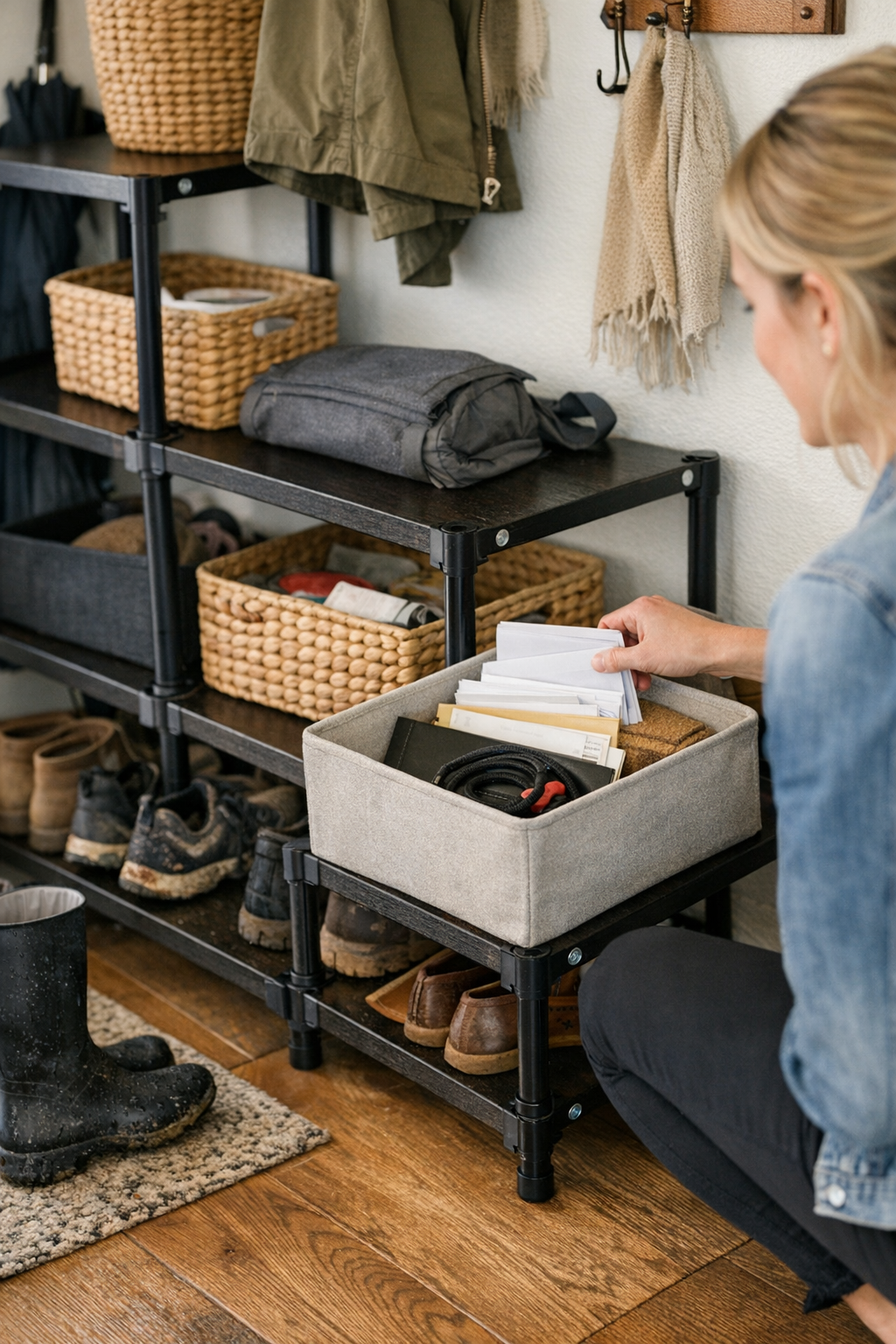
Most storage setups look perfect—right up until they meet your actual routine. Open the closet or step into the entryway on day one and everything feels ready: shelves lined up, baskets crisp, every bin promising that this time, things will stay in place. But fast-forward three days. One rainy morning, shoes pile up near the door. The mail ends up marooned on the bench. Grocery bags hitch a ride with jackets, and folded stacks begin to lean, already losing shape. The plan for “everything in its spot” gets outpaced by the churn of daily life—and the friction starts to show up everywhere you look.
When Order Starts to Slip: The First Signs of Storage Breakdown
That slippery slope from organized to “almost organized” often starts small. You promise you’ll file the mail soon, but the envelopes edge out from the counter anyway. Shoes multiply right where you want open floor. A gym bag lands in the ‘wrong’ cubby, and now jackets, backpacks, and random books start to blur the original categories. Even thoughtfully labeled bins become catch-alls. Each item not easy to slot finds the nearest flat surface—whether or not it fits the system.
Without fail, shelves fill up too quickly, folded stacks collapse, and corners become limbo for forgotten things. The room still looks decent for a while, but that reset you used to do in seconds now takes a full sweep and some second-guessing. You spend more time shuffling items than actually using them.
Where Most Systems Fall Short: The Need for a True Buffer Zone
Storage solutions tend to assume objects fit tidy categories—but real life rarely agrees. This is where a buffer bin makes a difference: it is a dedicated, visible landing zone for what’s “in between.” Unsorted mail, shoes drying off, a bag without a home for an afternoon—these don’t get mixed into permanent storage, but they aren’t left to wander. A buffer bin keeps these “mid-task” items from taking over surfaces or causing endless reshuffling.
Without this buffer, the divide between what belongs and what’s just visiting disappears. Baskets that start for hats become a pile of everything. Counters are suddenly half mail, half chargers. The difference isn’t just visual—resetting the space slows down, and the house feels like it’s always “in progress,” never clear.
Real Example: The Entryway Juggle
Imagine the usual rush—raincoat dripping, mail in one hand, a leash in the other. Hooks are tucked behind coats, shelves are full with shoes that haven’t dried yet, so you improvise. The umbrella sprawls to dry by the door, mail stacks up on the closest surface, and the leash gets tossed somewhere you’ll have to search for it later.
With a buffer bin right by the door, the routine shifts: it becomes second nature to drop those damp shoes and stray mail in one container, just for now. It’s contained, in sight, but not “put away” until you’re ready. Resetting takes a quick pass at day’s end—not a scavenger hunt.
How Buffer Bins Change Storage Performance
The right buffer bin turns repeat friction into a single, manageable stop. No more reaching around a pile of shoes to grab your bag or moving three stacks to find a jacket. The bin contains overflow, keeps categories clearer, and trims down the mental drag of “where does this go?”
Here’s what a buffer bin routinely prevents:
- Mail towers crowding surfaces you actually use
- Shoes creeping across the walkway to the stairs
- Chairs moonlighting as storage hooks
- Bins becoming a guessing game instead of a shortcut
- Shelves losing vertical space to “temporary” piles
On the days where everything runs late, the buffer bin is a safety net. It keeps stuff visible but out of the way, making resets faster and helping every category keep its shape. You stop reorganizing on the fly and spend less time fixing yesterday’s clutter before you can start today.
Choosing the Right Buffer Bin: Size, Shape, Placement
Too big, and the buffer bin will quietly become a black hole for odds and ends. Too small, and overflow just starts up again outside it. The sweet spot? About a foot wide—just enough room for a couple of pairs of shoes or a day’s mail and keys, but not so much that things get buried.
Open-topped bins pull their weight here. You see what’s inside at a glance, and access is instant—key for quick drop-offs when your hands are full. Try putting one on a low shelf near the closet door, or right under the hall bench. In my own routine, I dedicated a lower closet shelf: shoes, mail, water bottles—a day or two’s worth of “between” items, all in one spot. No more hunting lost gloves behind other bins or refolding piles toppled by a bag in the wrong place.
Keeping the Buffer Bin Useful—Not Just Another Junk Drawer
A buffer bin’s power is in its regular use, not its capacity. If it’s becoming a permanent hiding spot, it’s lost the plot. Try this approach:
- Use only for items that are truly “in transition”—the stuff you know you’ll touch again soon.
- Commit to emptying or sorting it every day—or every other day at most. It should never feel like its own category.
- If it’s getting tight, don’t upgrade the bin—treat that as your signal to reset, not to accommodate more overflow.
A smooth habit loop—drop, then resolve—makes tidying less of an ordeal and cuts down on unfinished “piles.” When everyone in the house makes the buffer bin a pause point, there’s less nagging and less friction around who’s responsible for the spreading mess.
Habit Builder: Pair It With an Existing Routine
Tie a quick buffer bin check-in to something you already do. Maybe it’s when you hang up your jacket, or the moment you swap work shoes for slippers. By linking it to a built-in trigger, the buffer becomes part of the rhythm: a rinse and reset instead of a looming chore.
The Practical Payoff: Resets That Actually Stick
No storage hack erases the chaos of real life, but a buffer bin makes order a repeatable outcome, not a one-off illusion. Instead of a constant battle to keep surfaces clear and shelves behaving, there’s a predictable spot for “not yet sorted” stuff. Overflow doesn’t leak onto every surface. Categories stay more separate. Resetting takes seconds, not an evening.
The result isn’t perfection—it’s steadier footing. Less hunting, less shuffling, and quicker recoveries from life’s everyday bumps. You might still have a wet shoe or stray envelope, but you won’t lose the plot before the end of the week.