
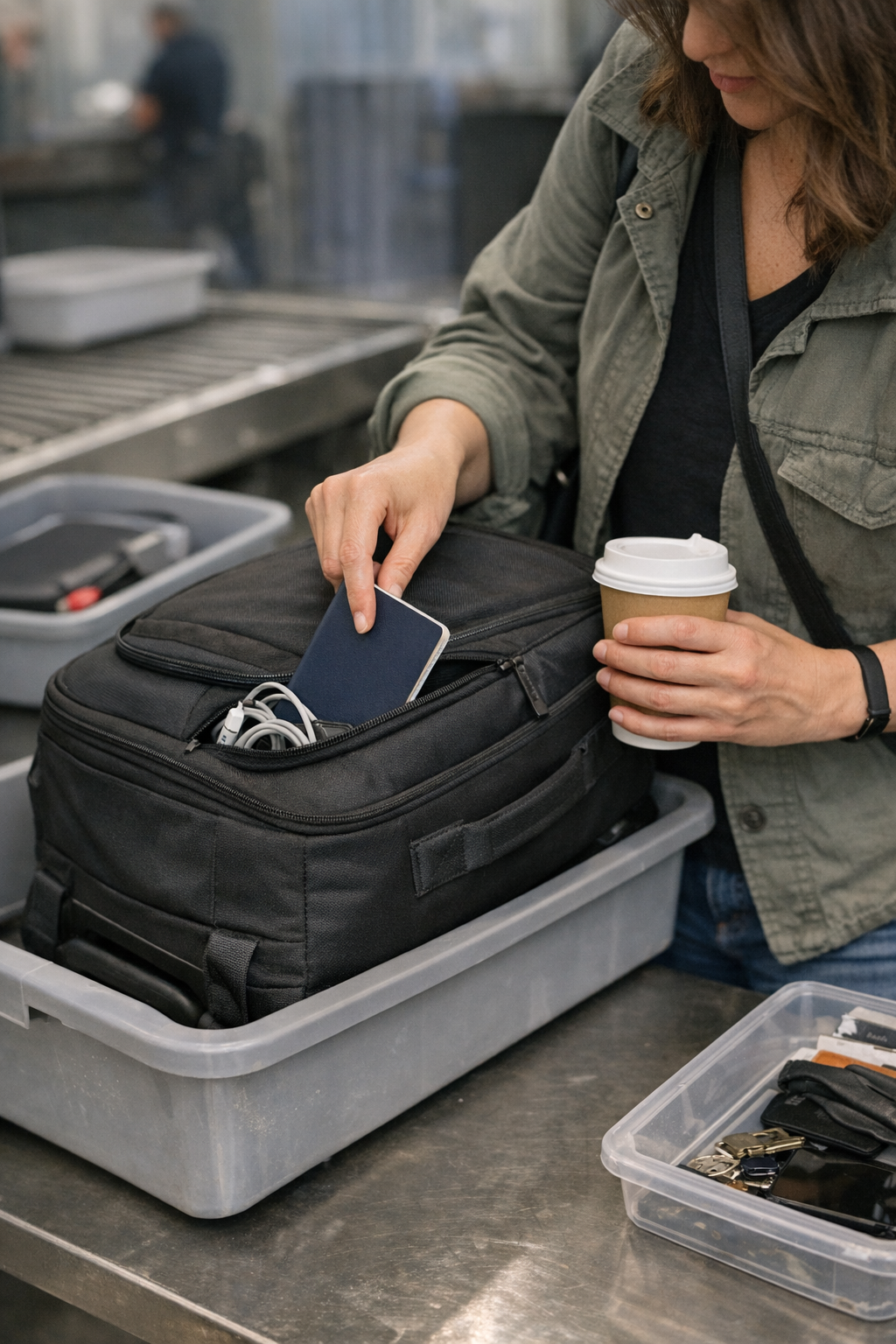
The real airport test isn’t how neat your bag looks at home—it’s how fast you can pull a passport when the line behind you starts shifting. You close your carry-on in your living room, everything perfectly sectioned into pouches and zipped away, but that control dissolves the first time a gate agent asks for your ID and you’re bent, awkward, peeling back layers you packed just an hour ago. Travel friction isn’t the mess you see; it’s the seconds lost fumbling with order that only holds up when you’re standing still. That’s the core challenge: the tidy structure that made you feel ready at home becomes a liability as soon as you need fast, single-motion access—exactly when every other traveler on your route is crowding closer, watching you unpack and repack what you thought was “organized.” CarryOnSupply lives at that intersection: where something looks under control, but the real difference is how smoothly it works when you actually have to move, retrieve, and reset, again and again, in real airport time.
Order Isn’t Access: When Tidy Packing Becomes a Trap
The zipped pouches, wrapped cables, and stacked organizers promise order—but every layer adds a step between you and what you actually need in motion. That “everything has its place” system breaks down with your second retrieval: you open the main compartment, unzip a small pouch, and still have to fish past other organizers to get your charger. Meanwhile, you’re blocking half the security tray, and what looked streamlined this morning now feels like a slow-motion rerun of the same struggle, repack after repack.
The friction isn’t random: Travel isn’t about losing items, it’s about repeated friction points stacking up—dragging over zippers, pulling pouches, making each retrieval feel slower and more public the more you repeat it. Grab your boarding pass at security, ID at the gate, headphones at the next layover—every motion exposes how “packed right” gives way to “packed away.”
Multiplying Slowdowns: Stacked Calm Turns into Sequential Delay
If your setup depends on everything staying in its precise spot, small problems multiply. Three-layer pouch logic means every urgent document check forces a main-compartment unzip and pit-stop repack, no matter how short the line. When pressure builds—like at a fast-moving security line or busy terminal checkpoint—the difference between visual calm and access fatigue isn’t theory. You only need to dig for a buried cable or a wayward passport once for the tension to spike: you’re either holding up the queue or sacrificing order for speed, every time you reach in and don’t immediately come out with what you need.
Security Trays: Where Setup Weakness Shows Fast
Think of the tray transfer: your laptop is up top, but your ID just got nudged below another pouch. Suddenly, “main compartment tidy” means your essentials are deeply nested, and every extra retrieval adds up—items shift, organizers bunch, and your bag’s control system works against you instead of with you. Everyone behind you can feel it: you repack hastily or, worse, shove everything in and lose the structure altogether for the rest of the trip segment.
Main Compartment vs. Outer Pocket: The Practical Shift
The biggest upgrade is often the simplest one: a wide, interruption-free outer zip pocket at arm’s reach. Shifting the critical items—passport, ID, charging cable, small tech—from main compartment to an edge position means you’re no longer undoing layers just to survive an ordinary checkpoint. From above, it might look more “in use” than “on display”—but that’s honest: three retrievals in thirty minutes shows you which design is slowing you down and which is letting you keep pace, especially when the line moves or a sudden call for documents drops in mid-queue.
What matters isn’t how “clean” your packing looks after the first leg; it’s how quickly you can move without breaking your system. A dedicated outer pocket makes routine retrieval—boarding pass, ID, headphones—a two-second motion, not a production. Those small time savings stack up, especially when you’re boarding, transferring, or sidestepping in a crowded terminal with only one free hand. On a second or third trip, you don’t just remember the convenience—you rely on it, and you stop dreading every required check.
Hidden Friction Reveals Itself Over Every Segment
Every airport checkpoint is another chance for perfectly arranged packing to become a nuisance. Each retrieval—passport, charger, headphones—is a repeat test. A pouch system with too many nested layers promises security but delivers inefficiency. The illusion of order fades as soon as your bag has to move repeatedly, or when you’re forced to expose and rearrange three sections just for a single document. The longer the trip, the more this friction becomes obvious; every time you have to pull or re-layer, you’re burning time, focus, and patience. What looked “secure” on the rug becomes pure drag when you’re called to show a boarding pass with one hand while the other holds your coffee or flight snack.
Boarding, Seat Entry, and Micro-Delays That Stack Up
See the usual failure point: You’re in the boarding line, bag on your shoulder, cup in hand, and the gate agent calls for boarding passes right now. Your main compartment is zipped, your order intact—until you have to slide the whole bag off, unzip, sift past two organizers, and pull what you need from inside. You either hold up the line for an awkward second or do a sloppy grab-and-stash, immediately disrupting the organization you spent time building. Meanwhile, the traveler beside you, with passport and pass in a slip pocket, just steps forward—no pause, no reshuffling. Revisiting this problem on short, crowded flights is where the gap between “visually organized” and “actually usable in motion” widens with every segment and every micro-delay.
Making Carry-On Structure Match Real-World Movement
Moving must-grab items—documents, phone, headphones—from deep layers into a clean, always-accessible outer pocket isn’t just a cosmetic change; it fundamentally shifts how often your bag structure fails or holds up. A wide, side-panel zip; a shallow tech zone; a direct-slip passport pocket: these design choices mean you can retrieve what matters most in seconds, even after multiple uses. The main compartment stays almost untouched, your system doesn’t collapse after five retrievals, and on your fourth gate of the day you’re not rebuilding from scratch.
Main-portion order survives, while outer pocket activity absorbs the friction of repeated access. After five flights or thirty retrievals, the setup that trades a bit of “packing symmetry” for ongoing function consistently comes out ahead—not just in time saved, but in the energy you don’t spend managing your carry-on’s order between segments, lines, and unexpected delays.
Will Your Setup Survive Real Travel? The Fifth-Trip Test
Packing “for looks” and packing for repetition will produce completely different outcomes by trip number five. True, it’s satisfying to stack pouches and wrap every cord, but those setups struggle the most when quick access is forced under pressure. Over time, even one slow document retrieval or poorly placed slip pocket can make you question the whole system. The best test isn’t the first journey, but the one where you’ve run your bag through thirty segmented uses, ten repacks, and several moments where order needed to be rebuilt—not just preserved. The structure you trust is the one that stays low-friction, usable, and intuitive move after move, even as conditions change and patience thins. If your carry-on makes those retrievals disappear into routine, not friction, then it’s doing the real work—not just looking organized on your bedroom floor, but performing in every travel moment that counts.
Find practical carry-on solutions at CarryOnSupply.