
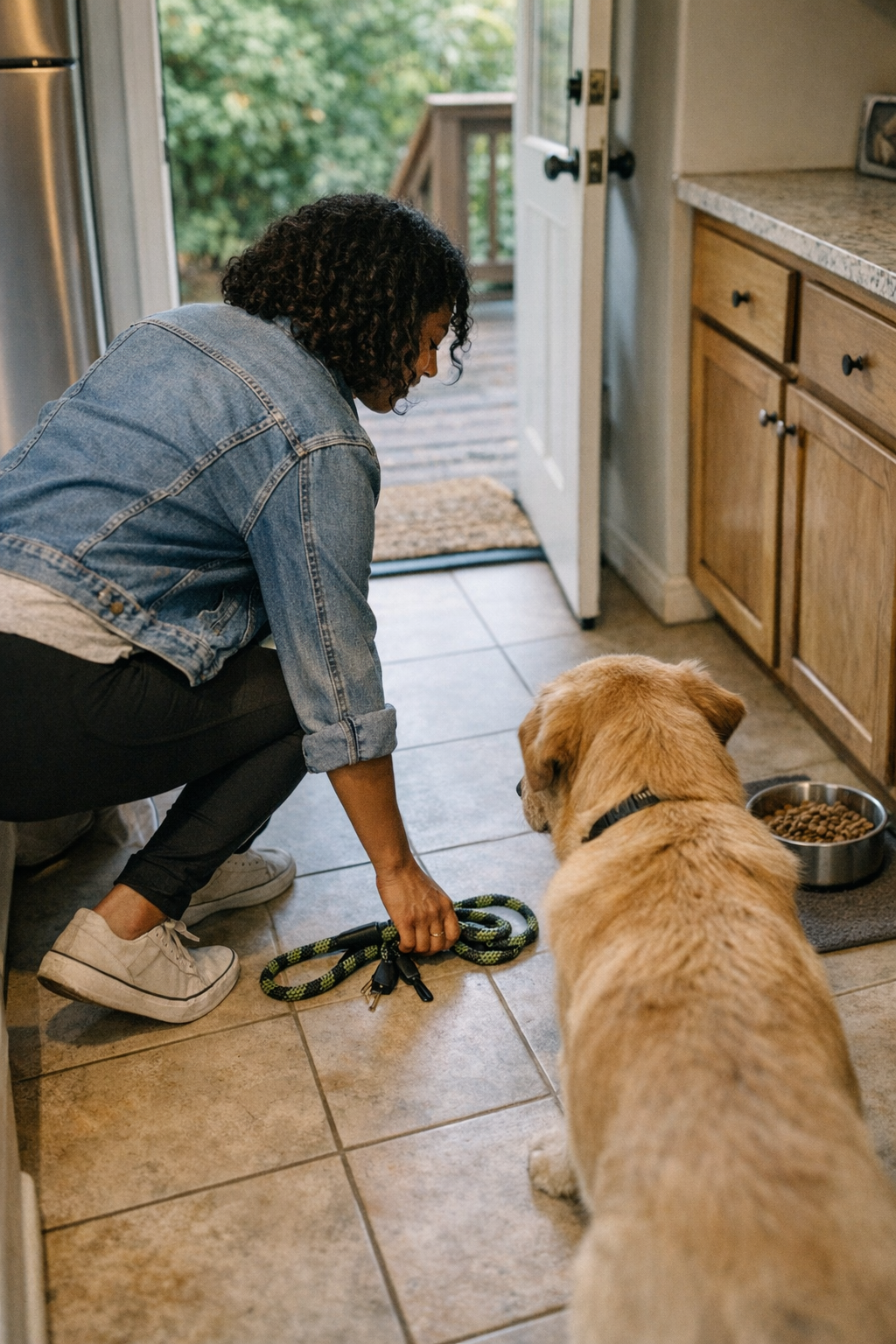
The slow trudge home after a walk rarely signals true calm—more often, it’s where routines quietly fall apart. If your dog lingers at the curb, drifts sideways at the front steps, or waits just outside the door every night, you’re not seeing peaceful wind-down. You’re running into the same invisible snag: a handoff gap that nudges every part of the evening off track. That hesitation at the threshold—dog hovering, leash in one hand, clean paws still questionable—marks the start of a sequence that gets messier and less reliable with each return. What feels like a minor pause is actually the crack where the evening flow starts leaking time, comfort, and sanity, again and again.
The Overlooked Drag After Daily Walks
Most people misread their dog’s slow-down at the end of a walk. Sure, it looks like winding down. But if you step back and notice the patterns—dog doubling back for another sniff, loitering on the porch, or circling while you’re balancing leash, bags, and keys—the story changes. These aren’t neutral pauses; they add up to a slow dismantling of the routine you thought you had.
What gets glossed over is how these sticky transitions bleed into everything that follows. Is the slow homecoming feeding into twenty minutes of kitchen pacing, a bowl left untouched, or everyone silently reshuffling while mud tracks past the doormat? The “wind-down” isn’t an extra treat—it’s a sign your setup is asking for too many decisions at once and letting friction regroup at the very place it should ease off.
When a Calm Dog Isn’t Actually Comfortable
That look of lethargy or hovering at your front door is less about rest and more about uncertainty. Without a clear signal, your dog isn’t shifting from outdoor readiness to indoor routine; instead, they’re stuck in a holding pattern—inside, but not switched over. You drop the leash somewhere random, boots half-off, a bag blocking the way, and suddenly the dog is circling or peeking into the kitchen, bowl untouched, mess inevitable. One weak link at the handoff, and every step after feels just slightly late or off-balance.
How Small Home-Entry Delays Add Up
These daily stutters rarely explode into chaos, but the cost is consistent: routines never fully “land.” Spot the cues in your own evenings:
- Feeding drifts later each night because the dog paces or hovers, ignoring the bowl.
- Settling stalls—the dog circles, scrapes, or stands at the door, not quite done with the walk, not quite at rest.
- Cleanup is always a step behind—towel or wipes are stashed somewhere unreachable, and the muddy paws have already moved on.
- The rhythm feels heavier; it takes longer to regroup, and you keep asking, “Why is this never smooth?”
Over time, even in well-organized homes, the bottleneck creeps back: days where you thought you solved clutter, but the same sticky moment at the threshold pulls things off course, night after night.
Spotting the Real Cost: It’s Not Just Lost Time
This isn’t just about five lost minutes. The cost is a nagging misalignment—dogs restless, routines missing their snap, energy leftover where you needed it gone, and cleanup never quite integrated. Instead of feeding, settling, and resetting as a single flow, you end up with overlapping interruptions—nothing catastrophic, just a background static that never leaves.
What Routine Sticking Really Looks Like
The breakdown always shows in the walk-in: leash dropped halfway to the kitchen, towel left in the laundry when you need it most, toys encroaching until you nearly trip, wipes out of reach but the floor’s already smeared. It’s not that things look chaotic—they look tidy until the repeated use exposes where function still slips.
- Leash out of place: Instead of a habit, it’s wherever you last dropped it—now it’s blocking today’s cooking zone or tangled by a shoe.
- Cleanup delayed: Towels or wipes are always one room off, forcing you to follow the dirt trail instead of cutting it at the door.
- Toy spill: Dog drops chews or toys right where you need to step in, turning every return into an obstacle course.
- Threshold traffic jam: Leash, boots, paws, bags—everyone bottlenecked, no quick, clean step to “we’re inside now.”
- Tidy setups reveal weakness in use: Hooks look perfect until real use bends them out of order, or baskets stop making sense when you need fast access.
Tidy isn’t the same as workable. If the routine asks for too much reaching or reshuffling, it silently soaks up time and comfort, never quite settling into something you can count on.
Setting a Clear Walk-to-Home Handoff Point
So what changes things? A single, deliberate handoff zone—anchored by routine, not just decor. Instead of letting the leash wander, pick one spot: maybe the first tile inside the door, maybe a hook only the leash ever uses. Unclip, store, cue the dog to move forward—with supplies for cleanup and bowl all within one reach. That repeatable handoff signals, “Now we’re inside, next step starts,” and breaks the old pattern of everything blurring together.
The crucial difference: dog knows what to do, owner isn’t juggling improvised steps, and supplies are exactly where hands will reach during the real return.
The Difference Over a Week of Real Use
Test this for a week and the improvement is visible—not in how the area looks, but in what you stop tripping over:
- Dog moves with certainty—straight to the bowl, mat, or rest spot—no more circling the door waiting for the next unclear cue.
- Feeding happens on schedule, not orbiting around late resets.
- Entry stays clear—leash, shoes, towels, all land in their spots, not tossed wherever you paused last.
- Cleanup is built-in—paw wipes and towels are at your side before the dirt gets embedded.
- The whole routine regroups: you reset, they settle, the transition actually means something now.
The old irritations—the clutter that kept returning, the repeated backtracking for essentials—start to vanish, not because the space looks new, but because the flow actually matches how you and your dog move.
Maintaining the Edge: Preventing Routine Slippage
No fix holds if it ignores your real patterns. Every “new” setup eventually slides if the leash lands somewhere out of reach or the towel goes back to the old laundry pile. Friction returns—not as visible mess, but as small, relentless interruptions that shadow the routine.
Why Tidy Isn’t Always the Same as Functional
True function is tested in repetition, not arrangement. If you’re still sidestepping for the leash or doubling back for wipes, even a remodeled space hasn’t fixed the fundamental drag. Routine-tools should land, get grabbed, and reset in the same motion every time, without double-thinking or detours.
The best setups reflect:
- Leash drop is a habit—always within reach, mid-motion, no searching.
- Cleanup built into entry—nothing waits until mess has spread.
- The last outdoor step leads directly into the first indoor cue—dog moves in, hits routine, feeding happens next.
- Rest or crate spots aren’t delayed by threshold clutter—entry means ready-to-settle, not more crowding.
The win isn’t visual order—it’s the loss of repeated hang-ups that sneak into every walk, meal, or return after a long day.
Everyday Scenario: A Routine That Works—and One That Doesn’t
Visualize two nights back to back:
When the Transition Stays Fuzzy
You’re home from the walk, leash tangled in one hand, treat pouch in the other. The dog loiters at the threshold, then circles, waiting for you to remember where the towel went. You juggle boots, drop the leash somewhere between the door and the kitchen, and when you go for the wipes, they’re nowhere within reach—mud is already tracked across the entry. The bowl sits out, but the dog paces a loop from door to kitchen and back. Cleanup is reactionary, not part of the flow. Feeding stalls, settling drags, and every step feels like one step removed from working right—even though everything “looks” organized.
When the Hand-Off Is Clear
Same evening, but now the leash always