
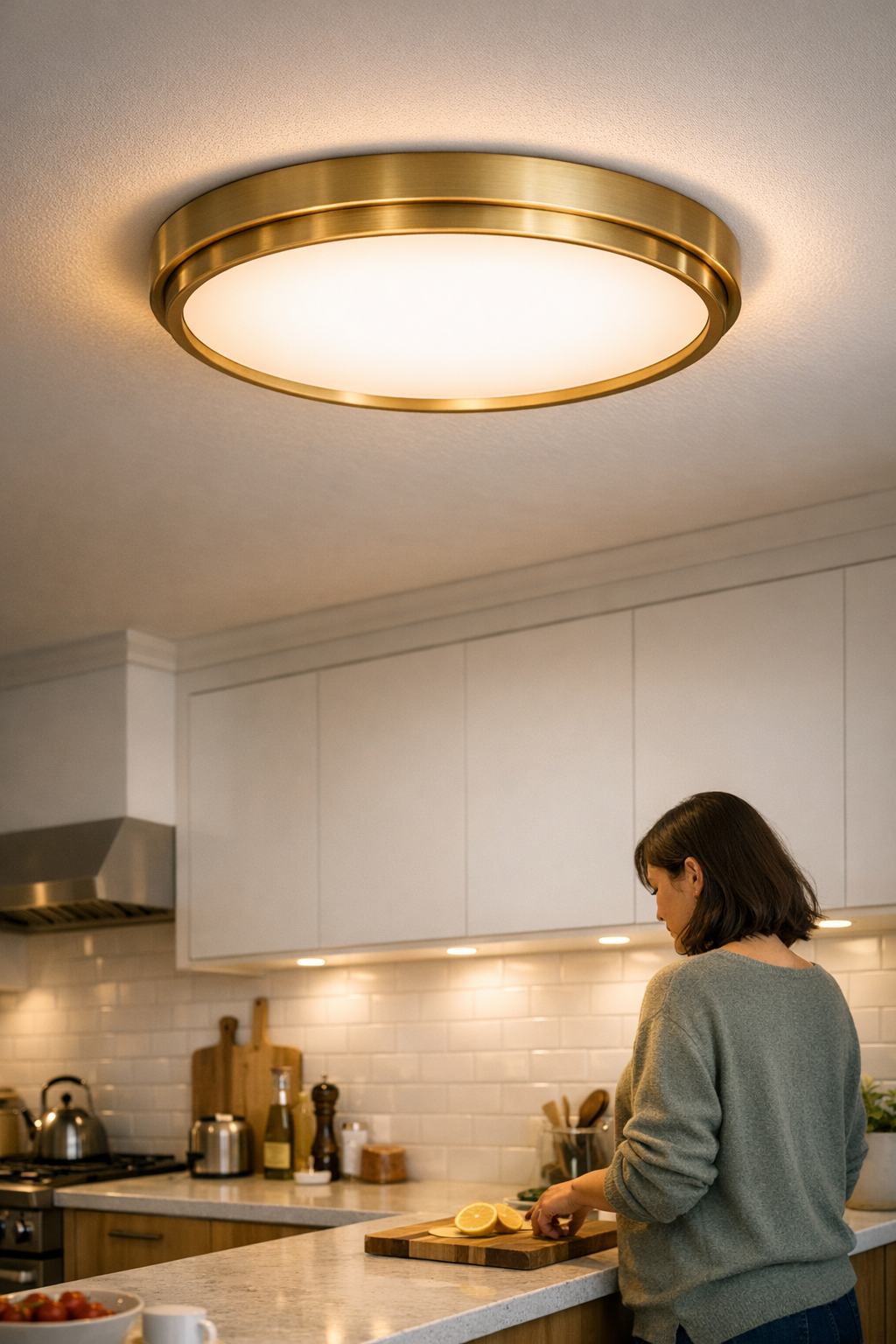
Kitchens that pass the “organizing” test still slip into daily friction when the ceiling lighting falls short. The wrong fixture position leaves you tilting your head to spot a spill, reaching for a light switch just to see the back counter, or finding cables and mounts more obvious than the food you’re prepping. You’re not dealing with a one-time annoyance—it’s the silent drag of poor coverage, glare bursts, and blind spots that resurface every time you slice, rinse, or wipe. Even with an uncluttered plan, these lighting weak points interrupt basics: clean lines don’t prevent overlooked mess, and the promise of ‘minimal’ vanishes under exposed hardware and mismatched glow.
Why Clean Looks Don’t Always Mean Comfortable Use
A row of ceiling spotlights, pendants, or flush-mounts may look organized overhead, but each brings its own shadow logic. When fixture placement isn’t actively mapped to prep, sink, and cook zones, shadow overlap and glare lines slice up the space. The brightest patch often lands a few inches from where you actually work, while cables meant to be discreet catch attention every time a bracket edge flashes in the wrong light. Suddenly, your clean kitchen starts highlighting cable runs instead of meal surfaces.
This friction reveals itself slowly. You miss smudges along the sink edge until you shift position and realize half the counter is shaded. A streak of crumbs appears only when you crouch or turn off the overhead. These are not just minor inconveniences—they keep routines jagged: touch up a spill here, pause to squint there, never quite scrubbing with confidence because the light misses where hands go most.
The Day-to-Day Impact of Patchwork Lighting
A setup that’s almost right becomes quietly exhausting. Gradually, you notice yourself dragging a cutting board back and forth, trying to catch usable light, or breaking the flow to angle a tray so the stove edge is visible. Every fix ripples a problem elsewhere: cluster fixtures to hide clutter, and you inherit rival pools of shadow. Mount a glossy linear and glare stings just as you lean forward. The cable bundle you cleaned up now spotlights a dust trail the fixture never fully covers.
The pattern exposes itself in the small hours or after cleanup, never when the room is staged: by dawn, rinsing a mug in dusk-shadow, or midnight, trying to wipe a stubborn smear under a lit patch that somehow leaves the wall edge murky. The ceiling’s finish helps nothing if every daily task pulls you into poor angles or partial darkness.
Panel and Linear Lighting: More Promise, But Not Always a Fix
Swapping scattered pendants for a seamless LED panel or linear strip seems like progress—neat surfaces, invisible cables, the illusion of even light. Visually, the room goes from cluttered to streamlined in an hour. But after a week, problems creep back in: if the panel rests too centrally or the strip floats away from wall edges, shadows reform in the only places you regularly stand. Illumination dots right above your head but leaves the crucial slice of backsplash dim or veiled in reflected glare from a shiny counter.
Even minimal mounting hardware shows its limits in repeated use. Cables intended to hug the ceiling sag near brackets, picking up crumbs and dust with every busy cooking cycle. Wall-proximal linears that promised edge clarity instead miss by an inch if the support wasn’t properly placed, restoring the very blind spots you aimed to erase.
The Setup That Looks Better, But Still Feels Off
- Pull the toaster to the wall edge, and now one hand works in deep shadow while the other faces sharp glare.
- Slide kitchen gear to the neatest line, and find the edge remains aloft in partial darkness no matter how you rearrange.
- Tidy cable bunched along a bracket stands out as soon as a crumb coats the line or a smudge hits where cleaning becomes tricky.
Routine still means circling annoyances—wiping twice, shifting plates just to see clearly, or pausing every few minutes when another over-bright patch chases you from the prep space you actually use.
Real Improvement: Matching Light to Daily Movement
The real gain arrives not from the fixture’s aesthetics, but the precision of its placement. Nudge a linear strip six inches nearer the wall—guaranteeing it tracks the run of your chopping, rinsing, or plating zone—and friction drops. Suddenly, splatters stand out early, elbows avoid glare, and you use the full prep edge regardless of the hour or angle.
Anchoring brackets tightly in the least visible spots, routing cables flush to corners, tilting panels so all action areas get direct spray—these tactical tweaks outperform raw wattage upgrades. Frustrations you learned to work around—persistent crumbs, shadowed corners, awkward cable crossings—shrink not because the light is brighter or newer, but because the coverage now anticipates your real path.
Tip: Test Lighting Before Final Mounting
If you’re installing a new panel or linear, temporarily tape it in position and run through your actual kitchen routine after dark. Notice where the light falters—dim streaks, glare bursts, stray dust catching on a cable. A minor shift matters: the right placement cancels months of small hassle, while an off-center mount invites a steady drip of daily irritation.
Spotting Persistent Lighting Gaps
The weakness often shows in how you clean. If you catch yourself scrubbing areas rarely touched, or hunting dust by daylight because last night’s light hid debris, your setup still misses your motion patterns. Lights that ignore the realities of movement and cleaning habits guarantee overlooked mess, a cycle of annoyance, and a surface that never stays “done.”
The Cable and Support Factor
Even slimline fixtures can throw everyday use off if cable runs, brackets, or supports interrupt the eye line or snag stray dust. In a kitchen, exposed wires anchor crumbs, and every bracket you move around highlights where the setup wasn’t quite resolved. The “invisible” install quickly feels loud once you notice cleaning has become more complicated—not less.
Beyond Looks: Does the Kitchen Actually Work Easier?
Don’t call the upgrade finished as soon as the room looks unbroken overhead. Wait for routines: is wiping the counter easier? Are you moving objects less just to see them? Have cables honestly vanished, or did they just relocate into view?
The real test is repeated use. If light lands exactly where you work, with cables managed out of both sight and disruption, the setup fades (in a good way) into background support. If you’re still pausing—pausing to see, pausing to wipe, pausing to dodge—those “upgrades” are just style on the ceiling, not substance on the surface. In a room used dozens of times a week, these differences accumulate. Invisible problems, left unchecked, pile up as fast as visible mess.
For all your practical indoor lighting and support solutions, visit LightSupport.