
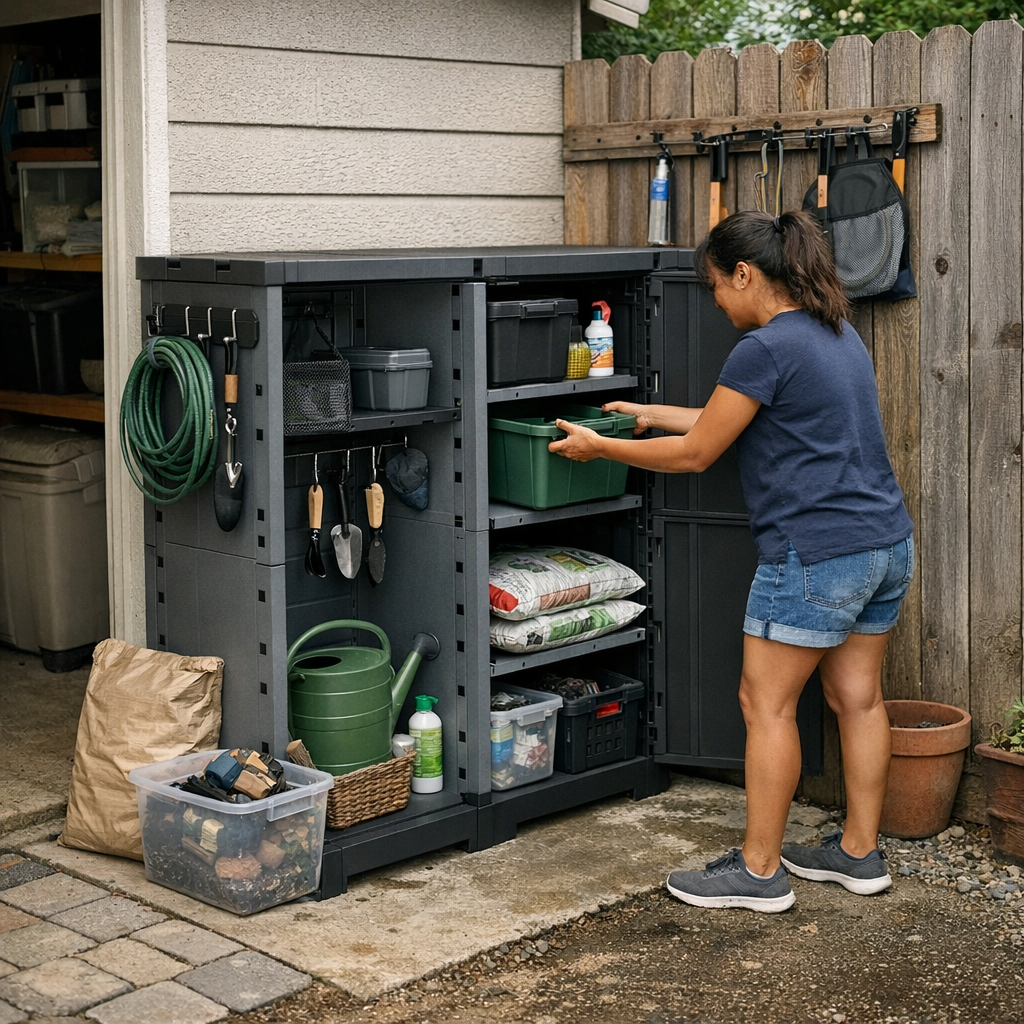
In a small backyard or side-yard strip, setup flaws announce themselves fast—sometimes before the week is out. A promising wall rack, a bin tucked against the fence, a modular shed that supposedly frees up the patio: in photos, it all looks organized. In real use, one awkward lid or a single blocked path is enough to send the whole setup sideways. The real divide between wall-mount and floor-bulk storage isn’t about preference; it’s about which kind of reset-burden or bottleneck you’re going to fight every time you step outside to put something away.
Why Setup Choice Hits Harder in Tight Spaces
Wall systems and modular bins give you hope at the start. The plan is always simple: tools on the hooks, bins under shelves, overflow tucked into that “multi-use” shed in the corner. But after a few runs of real chores—hauling soil, swapping sports gear, juggling pool floats—you end up wading through old patterns: blocked paths, stacked-up piles, and a “just for now” spot that quietly expands until you can’t ignore it.
Wall Storage: Works Until It Trips You Up
Wall racks draw you in for a clear reason: they promise open walkways and vertical order. In a narrow side yard or up against the garage, you hang what you use most, reclaim the ground, and figure you won’t have to shuffle anything on a weekly basis.
But then reality pushes in. Predictable routines shift fast, even with wall storage. A snow shovel suddenly has to swap with a soccer net. You add another long-handled rake or wedge in a kid’s scooter for the season, and before you know it, the clean line of hooks is tangled. It starts small: one batch of garden gloves dumped at the end, or an extension cord snaking below the baskets. Soon, heavy tools knock smaller ones onto the ground. Every “quick fix” skips a reset, and the pile underneath begins its slow, annoying sprawl—all from what was supposed to be a tidy, grab-and-go solution.
Floor Storage: Bulk Meets Blockage
Floor units—deck boxes, all-weather cubes, anything with a lid or a sliding door—seem like the fix for overflow. They do swallow bulk, but pay attention to the cost: the first time you try opening a heavy lid one-handed, or have to shift a box just to clear the gate, the space itself feels tighter.
Containers line up neatly in the beginning, flush against the fence or the garage wall. But daily use pushes them out, and slowly, each one inches into the walkway. One bin blocks the hose spigot, another grabs the prime mower spot; removing anything becomes a two-step shuffle—nudge this, drag that, stop to untangle the mess left from yesterday’s workaround. Instead of freeing up the area, the storage units start stealing it back, one slow, habitual detour at a time.
Modularity and the “Mobile-for-a-Minute” Effect
The pitch for modular or mobile sheds is always adaptability. In theory, you shift bins or roll the entire unit aside when your routines flip: sports gear in, pool stuff out, or suddenly room for guests. It promises to turn every corner into temporary prime space. The catch? “Mobile” becomes “fixed” the minute something else gets parked in the way or the pieces grow too heavy to bother. Those wheels rarely move once a patio table pins the shed in place. Soon, stray balls are stuck behind a bin; a bag wedges itself between cube and fence, and a corner meant for flexible use devolves into a zone you avoid. The harder it is to slide things, the less you bother resetting—until mobility is just another word for clutter with handles.
The Overflow Trap: How Small Spaces Collect Trouble
Every outdoor setup creates its own weak spot, and in compact areas, these fill up fast. You’ll spot the overflow: gloves and packets sliding to one end of a wall rack, old hose nozzles lost to the back half of a deck box, bikes dumped into the fence gap after a rushed drop-off. If a single corner or shelf becomes the “put it here for now” zone, the mess multiplies—what looked organized last weekend now demands you pull half the setup apart just to get to the thing you need.
Return Flow: The Test You Can’t Skip
The real stress-test isn’t putting things away once—it’s putting them back again and again. Try hanging a trowel after digging beds: if it means wrestling last week’s leaf blower out of the way, you drop it “just this once.” Diving into a deck box for the bike pump? You move a heap of unrelated gear, promise yourself a future cleanup, then forget. Hooks get crowded, lids stay unloaded, “later” mounds grow. When each return takes extra steps, it’s only a matter of time before the whole system unravels.
Map Storage to Your Actual Chore Flow
Forget matching racks to the longest span of wall or parking your biggest bin wherever it fits. Watch how you actually move after each outdoor job. Do you come from the gate or circle the fence? Is the nearest wall where you walk after mowing? Sometimes two hooks near the gate beat a full-size bin in the far corner. Shaving off a few unnecessary steps makes resets automatic instead of a backlog waiting to happen.
Looks Organized, Works Frustrating
In any catalog, the system snaps into place: everything shines, nothing is blocked. Three weeks later, deck boxes crowd the mower path. Wall racks drop gear onto the walkway. The “just move it” shed sits cemented by garden chairs. Overflow piles lurk in dead corners until reset day turns into an afternoon project. The difference between “ordered” and “truly usable” is what happens under the slow, escalating pressure of routine: only the setups that survive rapid shifts and crowded returns avoid becoming a chore themselves.
What Survives Daily Pressure: Tweaks That Actually Matter
No setup’s perfect, and small spaces rarely reward big solutions. The best layouts in real-use backyards are the ones that:
- Make returns simple—one thing back, nothing else blocked
- Stay easy to reset—not needing a cleanup hour after every busy week
- Adapt fast when the routine shifts—versatility only counts if you can use it without wrestling the whole system
The goal isn’t showroom perfection. It’s a yard, alleyway, or patio strip where resetting after real use doesn’t sap your patience, movement feels natural, and corners stay open enough to stop “just for now” spots from snowballing.
Try These Real-World Checkups
- Reset check: After a week, can you get things back where they belong in two minutes, or is it another Saturday chore? If not, downsize, swap locations, or lose the least-used module.
- Overflow pattern watch: Notice if the same hook, bin, or rack collects the clutter every week—shift the problem, not just the items.
A storage setup isn’t proven by how well it fits at the start, but by how it absorbs daily friction without crumbling into chaos. If your yard stays usable, resets stay quick, and you aren’t dancing around your own storage, you’re already ahead of the catalog ideal.