
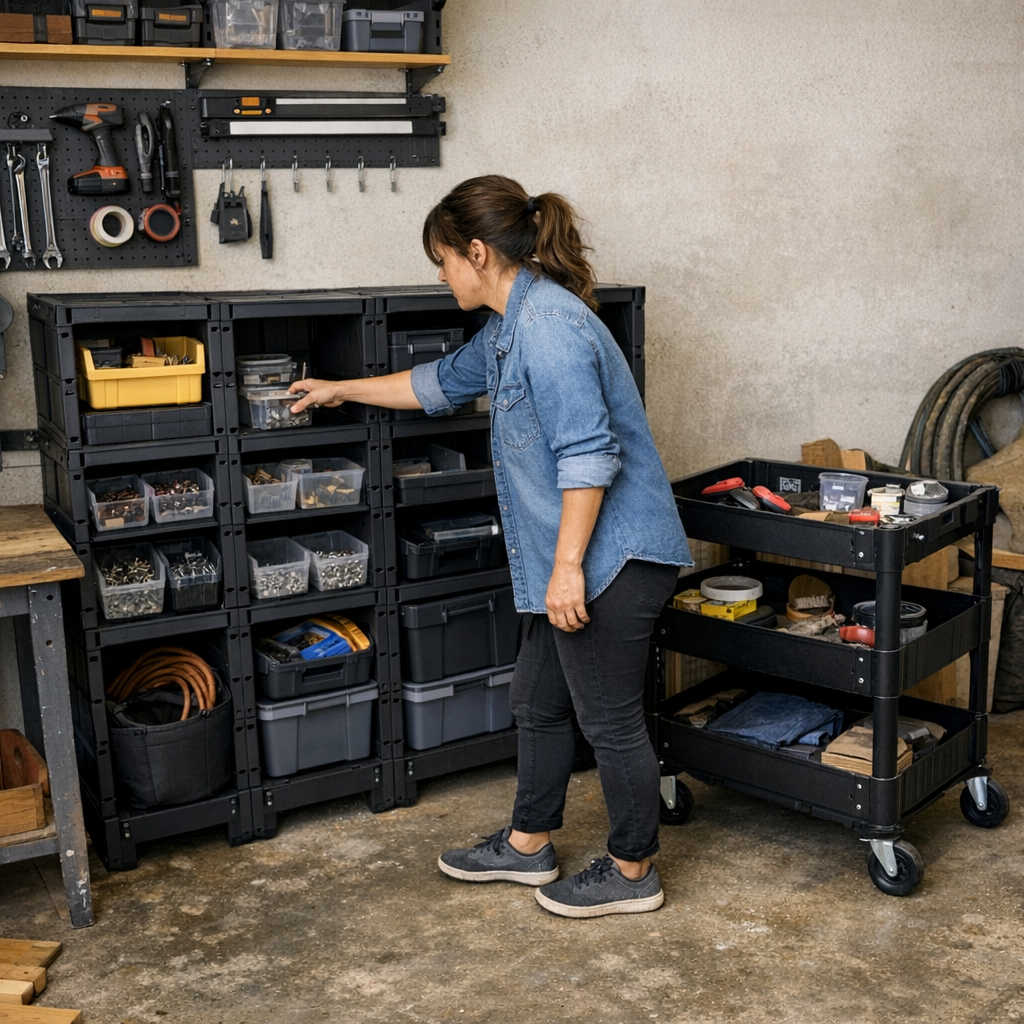
The illusion of order doesn’t survive the first busy weekend. Step into a freshly organized garage, workshop, or tool corner—everything lined up: modular cubes hugging the wall, a floor chest and wall racks squared away, a mobile cart waiting by the bench. It looks “done.” But as soon as the real work starts—when you’re drilling, fixing, shuffling through half-finished projects—this tidy arrangement is suddenly on trial. Tools land wherever your reach stops. Hardware clusters in corners. The perfect plan, five minutes ago, is derailed by the pressure of actual use.
Where Neat Setups Unravel: The Slow Creep of Daily Mess
The first day after organizing is never the problem. The system breaks down quietly—one hurried session at a time. You drop a screwdriver “just for now” on the rolling cart. Unsorted screws build up on the nearest shelf, that “dead” nook in the back absorbs overflow, and clearing work surfaces becomes a pre-project ritual, not a rarity.
This slow creep is subtle but relentless. Week after week, resets take a few more shuffles. Benches get cluttered with tools waiting to find their way home. Corners that should be open become catch-alls. What started as support for your projects ends up adding friction—until finding anything or even moving through the space gets slower and less predictable.
When Storage Roles Blur, Routine Clarity Disappears
Real efficiency comes from clear boundaries—but it’s these boundaries that fade first. Storage zones without a strict job end up tangled: carts, supposed to ferry active tools, become wheeled piles after just a couple projects. Floor chests wind up blocked by the boxes and odds-and-ends you told yourself you’d “sort later.” Even wall hooks and bins lose their purpose, hosting whatever no one had time to put away “properly.”
Within a month of use, everything overlaps. A project stalls while you search for a measuring tape that never found its way off the cart. The cart can’t roll because clamps and sandpaper are stacked on top. Drawers fill with unrelated leftovers. Resetting order isn’t one step, it’s a multi-stage rescue attempt, and the supposed convenience of your layout begins to feel like a chore.
Real-World Friction: Where Use Outsmarts “Looking Organized”
On paper, modular bins and wall racks promise a place for everything. In practice, habitual shortcuts and real project speed expose every weakness:
- The corner module morphs into a holding pen for “miscellaneous” clutter—because it’s unlabeled, everything ends up there.
- The cart’s flat surface disappears under small tools, tape rolls, and scraps nobody wants to stash just yet.
- Wall storage that should make things grab-and-go instead gets crammed; every quick reach nudges something else out of place, or forces an awkward shuffle.
The setup still photographs well—until you notice how it’s actually used. Week by week, these micro-irritations stack up.
Defining Roles: The Thin Line Between “Looks Right” and “Works Right”
Clarity beats capacity every single time. After running through half a dozen setup cycles—reorg, work, reshuffle, frustration—I learned that having “a spot” for everything is useless unless it’s obvious and quick to use every single time. My own space, packed with cubes and a cart, looked organized but quickly revealed the same slide. Hardware never quite made it off the cart. Cords collected on the bench. Eventually, resets stretched out because there was never an automatic return flow—just wishful thinking and more piles.
The failure wasn’t in how much storage I had, but in how slippery the boundaries were. The cart began as an “active tools” zone but quietly absorbed every stray thing; the cubes became background. Without sharp roles, even a well-planned setup is always at risk of collapse.
Resetting Flow—The Small Rule That Changed My Shop
I stripped the chaos back to one discipline: the cart is for current project tools only. Everything else gets returned to its labeled cube, no exceptions. I relabeled the cubes with giant, unmissable categories (“Hand tools—return every use,” “Hardware—no overflow”). I cleared a single, open path for the cart—no bins blocking its wheels, nothing to step over. It wasn’t Instagram-beautiful, but one week in, resets got simple. The cart was always clear by day’s end; anything still out triggered an automatic return. No more shoving aside stacks to roll the cart, no more confusion about what lived where.
Suddenly, the difference was real: open space stayed open, nothing collected in “temporary” spots, and surfaces stayed useable instead of permanently cluttered. It didn’t just save time—it made working smoother, because there was less thinking and less chasing after missed tools or random debris.
Spot the Warning Signs: Is Your Setup Dragging You Down?
If you’re seeing these red flags, your storage isn’t delivering real support:
- Every project starts with clearing off what’s left from the last round
- Your “return zones” stay half empty, while benches and carts pile up with tools and parts
- Resetting order means sorting three or four unrelated categories—every single time
- Blocked paths, shuffled furniture, or “don’t go there” corners slow you down
- Labels fade into the background or get ignored completely after a few days
None of this is a random nuisance—it’s the direct cost of storage roles blurring and paths losing definition.
Labels Alone Can’t Rescue a Weak Setup
A label only works if the system behind it makes sense in motion. If a bin is the easiest place to dump overflow, a sticker won’t stop it from turning into a catch-all. True clarity happens before the label: the zone itself must be unmistakable and hard to misuse, even when you’re moving fast or distracted by the next step.
Pursuing “maximum flexibility” is the classic trap—rows of interchangeable cubes or shelves that promise to fit anything but actually end up hosting everything at once. When boundaries are this vague, resets require double or triple the effort, and no amount of relabeling fixes the core problem. Every time the flow stalls, you’re forced to reshuffle and rethink rather than just work.
Automatic Return: The Real Benchmark for a Working Layout
The gold standard for any setup isn’t that it looks organized—it’s how little you have to intervene after repeated use. If, by the fourth or fifth project cycle, resets are down to one simple sweep and the cart, floor, and benches stay mostly clear, that’s true support. Setup friction drops, movement paths stay open, and “finding space” never requires a detour or quick fix.
Bottom line: A clear, logical storage layout won’t banish every bit of friction, but it will keep the space working for you, not against you. Most setups fail in the small, boring battles—overflow in corners, blocked movement, resets that drag. Winning isn’t flashy, but it’s unmistakable: your workshop feels usable after the tenth round, not just after a photo-friendly re-org. That’s how arrangement turns into actual, repeatable advantage.