
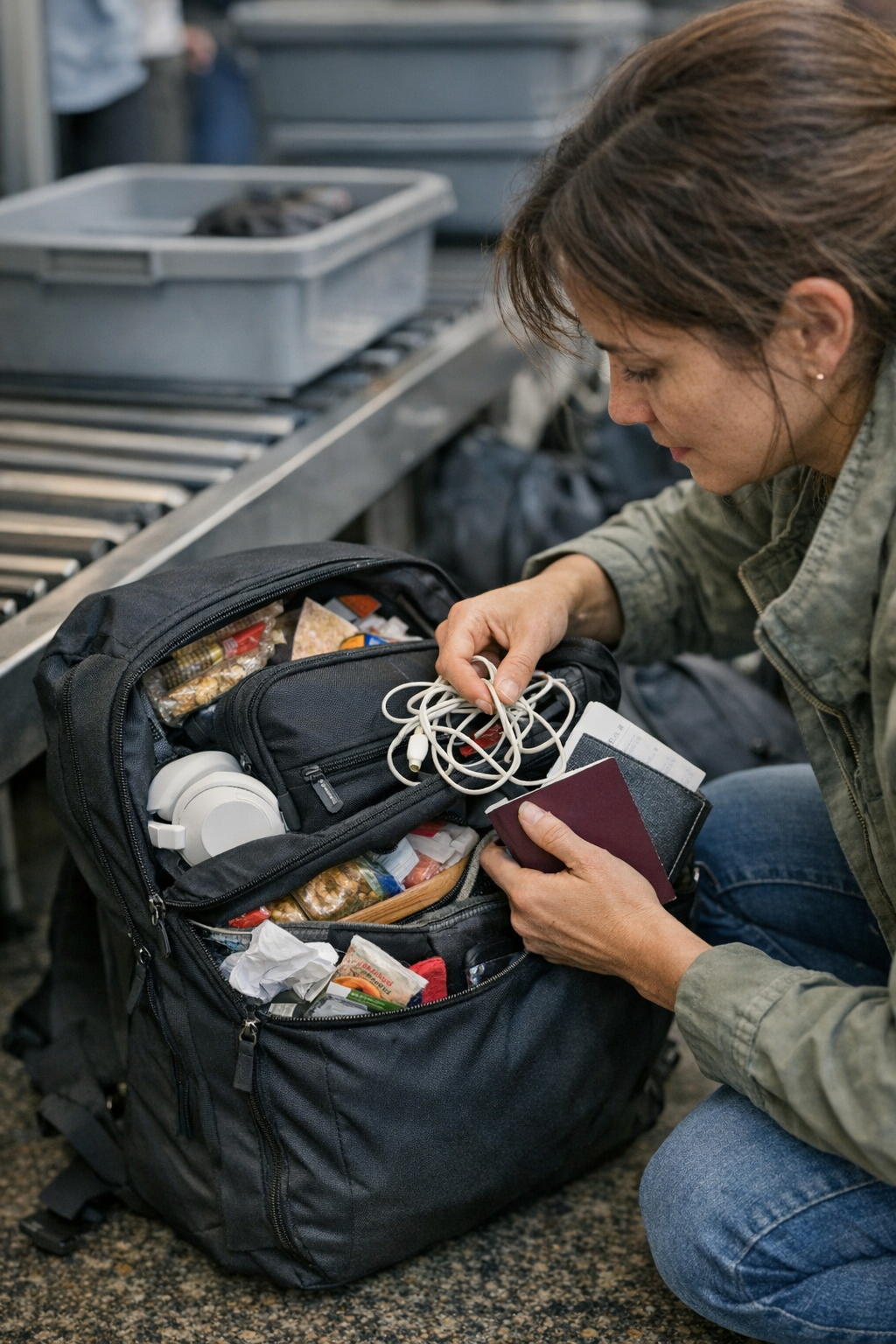
A carry-on bag that looks meticulously organized at home often fails when it hits real airport flow. The moment you hit security trays, boarding queues, or document checkpoints, those tidy pouch grids and stacked cubes become a test—can you actually get your hands on what you need, fast? That “ready” feeling in your living room dissolves the first time you reach for a passport and hit a wall of overlapping pouches, or unzip for a charger only to spill half a snack bag. Travel doesn’t reward good packing form; it exposes the difference between setup that only looks orderly and a carry-on that slides through repeated reach, retrieval, and repack without friction. When every airport movement is a countdown—tray moving, line pressing, plane filling—finding the right item without stalling matters more than arranging it perfectly.
The Unseen Friction of a ‘Visually Ready’ Bag
Visual order is a setup you see, not a system that moves with you. At home, color-coded organizers, stackable tech sleeves, and slim wallets seem travel-proof—until a sudden document check or revised gate number shoves your planned sequence out of order. Instead of a quick handoff, you’re rooting for a boarding pass but landing on a power bank, or peeling up snack sleeves stuck over your passport. Every checkpoint, boarding call, or seat entry repeats this friction—tiny roadblocks that add up. What you thought was efficient at the start morphs into a menu of delays: more stops, more digging, more public repacking, with each loop making order harder to maintain.
When ‘Organized’ Backfires Mid-Trip
Failure signals show up immediately—not after hours, but on the first round of airport movement. At TSA, your liquid pouch is trapped underneath headphones and a tangled charger. In the boarding line, impatience builds as you hold things up, shuffling notebooks to reach your ID. By the second or third access cycle, the bag that impressed you at home becomes a cluttered guessing game, where retrieving a simple document means fidgeting through layers, blocking the flow behind you, and messing up your system further with each rushed repack. The pattern is clear: when every retrieval creates more disorder, the setup loses its promise of control.
How Compartment Overlap Turns Into a Bottleneck
Packed-in multitasking pockets easily create roadblocks in action. Nest a document sleeve under a tech pouch and you’ll pay for it the first time your ID is called and everything slides out at once. Share an “essentials” pocket between snacks, cables, and receipts, and you’ve set up the next spill during a fast check. The real-world effect isn’t theoretical—it’s a loop of micro-stalls:
- Wrong pouch, wrong moment: You open two or three before hitting the one you need—contents exposed, order lost.
- Transit shift: Cables and chargers shift, blocking zipper paths and jamming up quick access points.
- Out-of-sequence return: After two live cycles, your “organized” layout breaks down—key items drift out of position while less-used pouches migrate to the top.
The result is not just hassle—it’s repeated slowdowns at every choke point, from lining up for security to dropping your bag under the seat, with each interruption building on the last.
Scenes from Real Airport Movement
Security Tray Transfer: Where Setup Weakness Shows Up
At security, the test is brutal and public. If your liquids kit is buried under backup pouches or tangled in tech cords, you’re forced to unpack in the moving tray, fumbling with layers as the bins stack up and travelers behind you get impatient. Every extra reach or rearrange exposes a weak packing link—what worked for a flight checklist can unravel in seconds under airport pressure.
Gate Change Scramble: Access Can’t Be Optional
Repacked after document checks, bag zipped—new gate announced. Standing up, you face a time squeeze and realize that the accessible pocket for your boarding pass is blocked by a cosmetic bag or tech pouch that slipped out of line. The clean packing logic that made sense in your living room now clogs the works the moment the travel routine becomes urgent.
Seat Entry and Overhead Bin: The Quick-Access Mirage
As you squeeze into a tight seat, your bag snags on the aisle. The so-called “quick access” pouch can’t unzip without spreading half its contents on your lap or the floor. If a cable crosses the entry point, you end up forcing the zipper, bending your charger, or closing up with loose items. Neatness returns after repacking, but the underlying layout keeps fighting against fluid movement, and every return to the compartment demands another fumble.
Why the Same Traps Keep Returning
Organizers help—until each access forces a reshuffle. Stack cubes or use dividers, and you’ll still find yourself shifting gear just to reach one commonly used item. What starts as control ends up as chore: a repeated cycle of pause, shuffle, and rebuild. With each brief stop—security, snack break, inflight battery hunt—your organization resets visually but gets messier to use, pointing out that the system wasn’t built for actual access. Frustration surfaces not during packing at home, but at the third, fourth, or fifth reach when you stop caring about neatness and start wishing the right item would just land in your hand.
Travel exposes what a static setup can’t handle: repeated, uneven access under real-time pressure, loose order that crumbles with real use, and a layout that slows down every checkpoint instead of clearing the way.
Resetting Your Setup for Repeated Reach
Every Item Needs Its Place—For a Reason
The only layouts that hold up in the field are ones built on purpose, not appearance. Travelers who separate tech gear, documents, and essentials into truly dedicated, consistently placed sections find their setup holds under pressure. One outer pocket assigned for documents will do more to speed your airport time than any catchall space that claims to handle everything. Set a predictable spot for each core cycle—no improvising, no last-minute cram. This stops the overlap and makes each return fast and reliable, not just neat at rest.
Split your setup with use in mind: one defined location each for documents, tech, and small on-the-move extras. Build a packing habit around these repeated access points—a quick boarding pass pull, a security tray liquid check, a charger grab that never blocks your passport. Every time you return something mid-movement, it lands back in the same place—no second guessing, no reshuffle.
Packing for Real-World Flow, Not Just Good Looks
The setups that survive aren’t just compact—they’re the ones you can reset blind after a rushed check. This means straight zipper access for boarding passes, tech cables routed far from crucial documents, and the discipline to quarantine essentials instead of mixing “convenient” with “urgent.” A carry-on that works is one you can enter and exit over and over during a normal trip without a cascade of mess, pause, or lost time. The difference is not only visual—it’s the freedom to move through trays, gates, and aisles without your bag tripping you up.
When Setup Improvement Makes the Real Difference
Airport movement isn’t about getting it right once. It’s about reliability under repeat, often unpredictable, pressure. A good setup won’t solve every inconvenience, but it limits the points where you get stalled—removing backup at security bins, fumbles at boarding, or aisle crowding during repacking. Each smoother retrieval isn’t just a time saver—it’s the difference between steady progress and a trip punctuated by needless slowdowns and tension points. In practice, the only carry-on that works is the one you reach into—over and over—without it ever reminding you where it went wrong.
If you’re ready to reset your routine for real movement—not just visual order—find carry-on solutions built for access, not just appearance, at CarryOnSupply.