
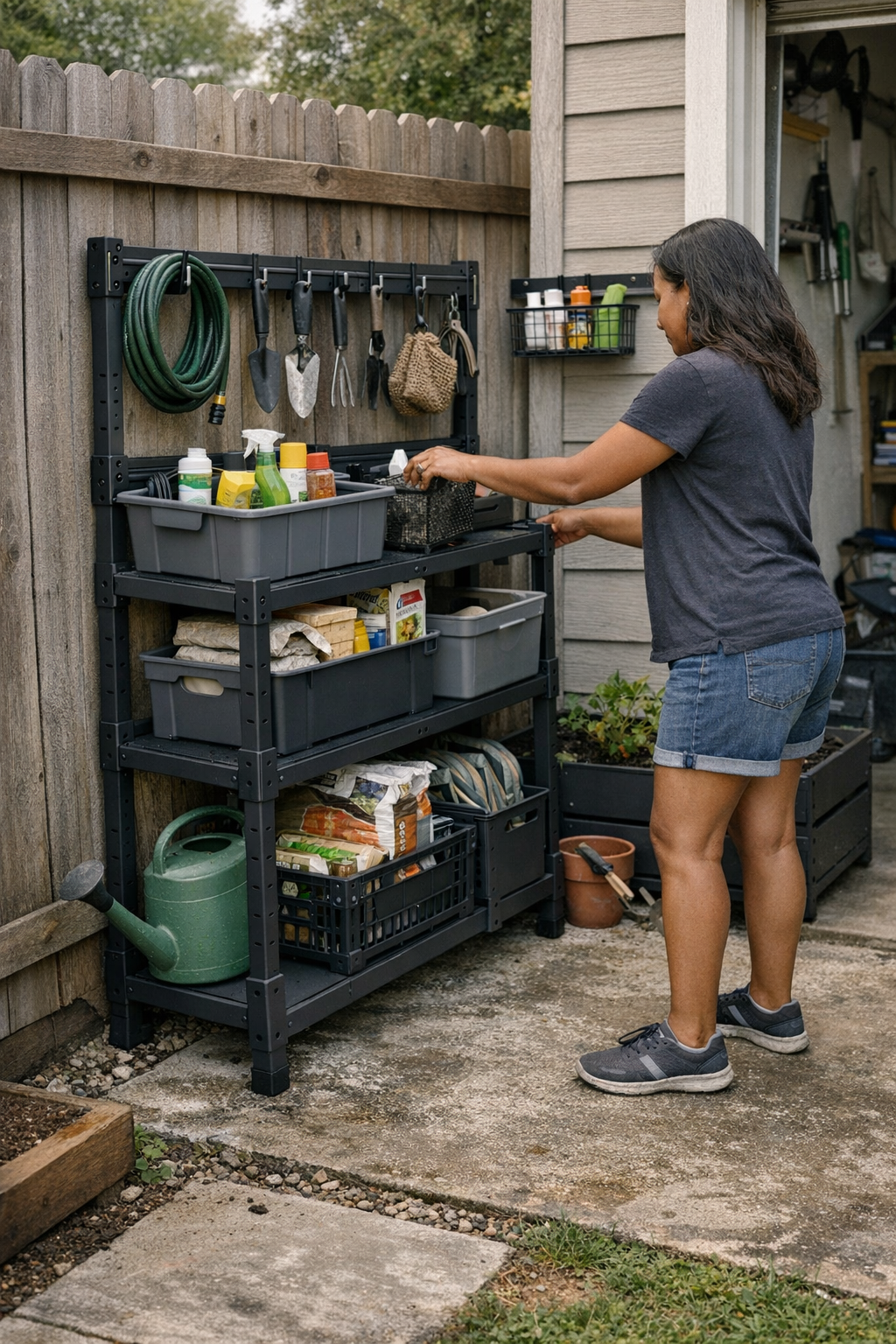
Outdoor storage headaches rarely explode—they creep in, one inch at a time, until the simple act of crossing your side yard or garage threshold feels like threading an obstacle course. Yesterday’s neat setup turns into today’s shuffle past leaning rakes, a bag of potting soil dropped “for now,” or a bin so stuffed it’s faster to just leave gear outside. It doesn’t start with chaos; it starts with one item that can’t quite go back, a floor corner lost to overflow, a path you no longer walk straight through. You keep sidestepping because the system that looked right last month now quietly resists every return, every reset. The cost isn’t just mess—it’s momentum lost, routines disrupted, and real space stolen from your week.
When “Organized” Isn’t Usable: Where Outdoor Setups Break Down
Most outdoor storage looks fine right after a cleanup—hooks lined up, bins stacked, everything in place. But real use isn’t a single Saturday. The question isn’t whether the garage or fence line looks tidy today—it’s whether you can get the mower out on Wednesday without moving three things first, or walk the side yard after a storm without steering around soggy bags and loose gloves.
Ground-level bins attract stray gear like magnets. Trowels, soccer balls, garden shoes—anything left “just for a minute” lands in the same bin, quickly mixing tools with toys until finding one means digging and reshuffling. The garage edge designed as a quick drop-off spot morphs into a permanent holding pattern. Getting to what you need means shifting something else—an endless chain that makes every trip slower, every reset heavier. The space still looks organized, but you’re working around it, not with it.
Real Trouble Spots: Overflow Zones and Blocked Paths
Take the classic side-yard strip. Meant for stashing tools or the mower, it starts clear. But on a hectic weekend, the storage bench gets piled with a tangled hose and rake across its lid—now nothing inside is accessible. The wall above, maybe with a fresh pegboard, keeps smaller hand tools tidy—until a basketball shows up and crowding begins again. Wall systems that seemed organized double as catch-alls. Overflow isn’t loud; it’s quiet, gradual—the lane narrows, the “return” gets skipped, and floor space shrinks until shuffling sideways is routine.
How Movement Gets Interrupted—And Why It Adds Up
In real outdoor corners, the penalty for poor storage isn’t always visual; it’s the way movement bogs down. Floor bins and shelf units drift into walkways. Bikes get wedged behind bins, hoses spill over into footpaths. Every out-of-line shelf or rogue bag costs another lost second—multiplied by every family member, every week. At first, you only notice when the mower’s stuck. But by Friday, there’s always something in the way, and clearing a path requires a five-minute shuffle that saps momentum before you’ve even started.
You’ll feel the difference after a single week: On Sunday, you set out chairs for a barbecue, carving a lane through garden gear. By midweek, something’s dropped “out of the way” against the fence. Suddenly the zone is half its original width. The routine isn’t stopped by a mountain of clutter—it’s slowed by the routine friction of reshuffling, sidestepping, rerouting. The space becomes mentally taxing, not just physically crowded.
Reset Fatigue: When Systems Don’t Absorb Real Life
This is reset fatigue—when every return or cleanup is slowed by the system, not by laziness. If nothing has a clear slot—if hooks double up, rails overflow, bins swallow stray gear—overflow never leaves. It just trades places, lingering in new forms. Even the best-looking closed cabinet can betray you: stash too much, and it becomes a barrier, not a helper. The floor in front collects the latest drop-off, so you shuffle gear just to reach what you put away “neatly” two weeks ago. It’s a shell game—and eventually, the shell cracks, and mess fights back.
What Really Changes the Routine? Modular Wall Rails in Action
The only setups that truly break the spiral are the ones that adapt to the repeated flow—not just the initial organization. In one garage-edge spot, adding a modular wall rail at the single busiest choke point changed everything. Rather than cramming overflow onto the floor or into endless bins, the most-used rakes, hoses, and bags went up into fixed slots, reclaiming a foot and a half of pathway in a single move. Now, pausing with gear no longer meant creating a new trip hazard. The rhythm changed: return up, not out. Anything left in the walkway at week’s end wasn’t just visual clutter—it was a direct signal that the setup needed a tweak, not a blind spot to be ignored.
With real slots, routines tighten. Each tool’s slot is visible, fixed, and not up for overlap. Wall segments get reconfigured as needed, but doors and walkways stay clear. Instead of rearranging to recover floor space, you adapt wall rails or swap a hook. Small yards and narrow strips—where one out-of-place shelf can choke access—become passable, even during high-traffic weeks.
Are Mobile Carts the Answer—or Just Another Source of Drift?
Mobile carts sound flexible, and sometimes they are. Haul gardening tools out for a full afternoon, sure. Wheel party gear right where you need it. But if a cart always ends up stationed by the only exit or right in front of the shed, “mobility” just means relocating the bottleneck. The real question: when the weekend rush is over, does the cart roll out of your path, or is it another piece to route around? Flexibility only counts if it actually reduces routine irritation, not just changes where it appears.
Effortless Isn’t the Same as Tidy—What Holds Up After Real Use
Organization that survives busy weeks isn’t about perfection—it’s about systems that absorb mistakes before they pile up. The best outdoor setups keep walkways unblocked, use wall slots that match repeated patterns, and avoid overlapping categories. If resets drag over ten minutes, or overflow comes back before the week is done, the setup needs revision—not more discipline. Storage isn’t a battle; it’s a buffer you trust to handle reality, not just appearances.
Practical Checks: Does Your Setup Really Work?
- Is your main path as open on Friday as it was on Sunday? If not, something’s feeding everyday drift.
- Do items have dedicated return slots, or are you shifting things just to clear a route after “normal” use?
If you’re constantly moving gear or confronting the same pile every weekend, it’s the system holding you back—not your habits. The structure should do the heavy lifting, not you.
Three Tweaks That Deliver—Without Adding More Stuff
- Walk your routes regularly: Test your path after a normal week. Any tight squeeze or backup is a real-world signal—not a minor inconvenience.
- Limit the reset: A decent system resets in ten minutes or less, even after storms or parties. If not, there’s friction at the wall or in the flow that needs fixing.
- Enforce slot-only assignments: If everything can’t fit on fixed wall slots or rails, reconsider what belongs in prime zones. Stop stacking categories on single hooks or rail strips.
Let Your Storage Catch the Clutter Before It Hits Your Day
Outdoor areas—the garage edge, narrow side lane, fence corners—will always test your system. Perfection isn’t the goal. But a setup that defends walkways, makes return-to-slot frictionless, and absorbs the churn of real weeks turns annoying resets into a non-event. Instead of fighting the same battles, you reclaim time and space—making the yard work for you, not against you.