
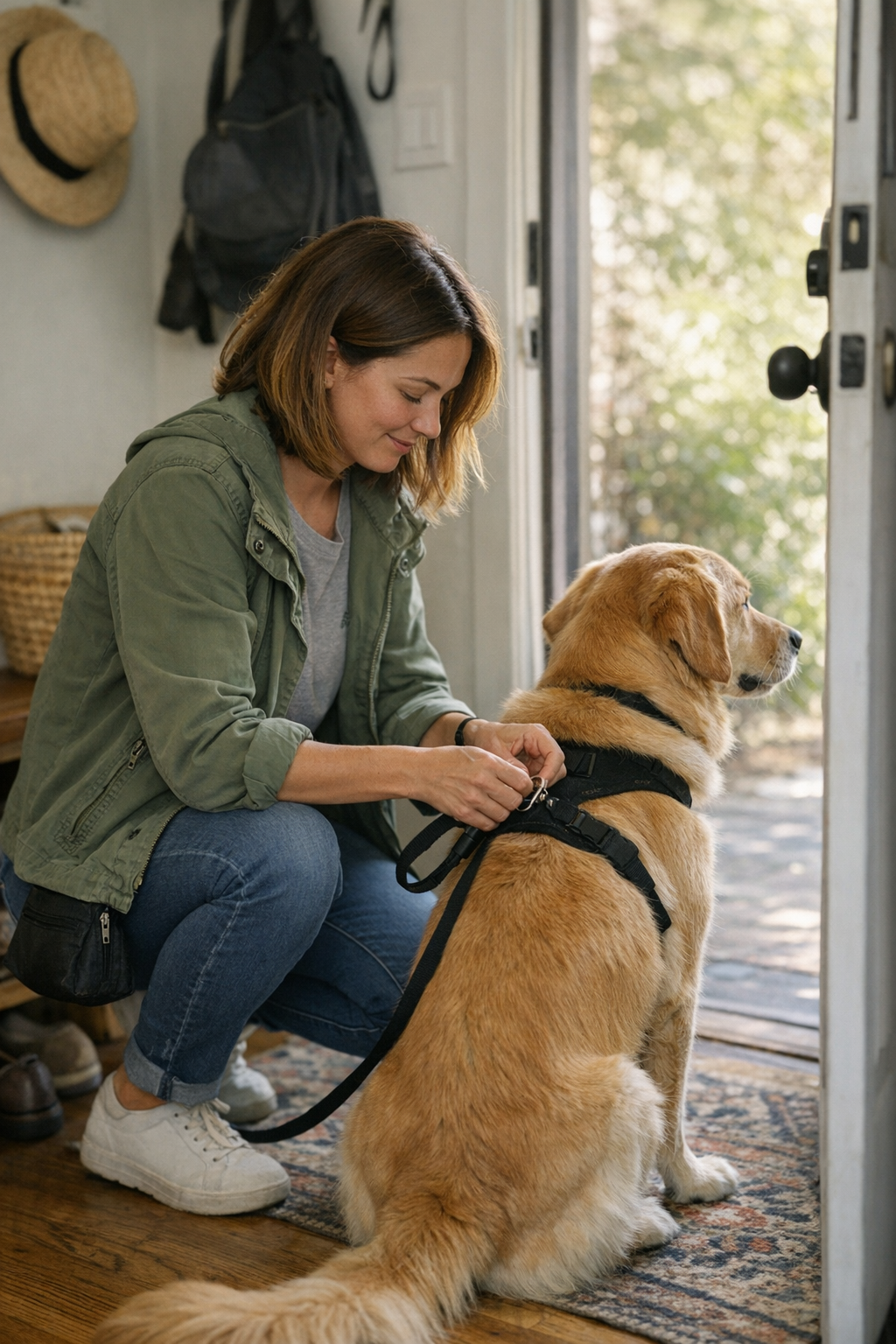
Everyday dog walks should be simple: grab the leash, head for the door, step out together. But if your dog leans away or freezes the moment you reach for the leash clip, that’s not just a training quirk—it’s your setup quietly failing at the exact point you need it most. The same metal snap that signals “walk time” keeps interrupting the calm, turning a tidy entryway and well-placed hooks into a repeated momentum-break. Over time, that tiny interruption grows: a clean front hall still comes with delays, a ready hanger still leaves you fumbling, and what looks efficient on paper just builds more friction in practice. This is the gap DogPile is built to close: not with more gear, but with setups that actually hold up under real daily routines.
The Leash Clip Pause: How One Weak Point Upends Routine Flow
Picture the most ordinary walk: you step into the hallway, your dog waits near the door—you reach for the leash. At the moment you snap on the clip, your dog’s weight shifts back or they hesitate. It’s not dramatic, but it’s not random. That little withdrawal is a signal, quietly repeating across all your outings: the first beat goes tense, energy drops, your routine breaks before the walk even starts.
This isn’t about distraction or willfulness. That metal snap cuts through the house’s quiet and your dog responds in the one space where excitement and anticipation are already wound tight. You’re left coaxing, pausing, and sometimes rushing the leash step to get momentum back. The cost isn’t a failed outing—but it’s a hinch every single day, right where calm and exit should connect.
The Hidden Pattern—And Why It Won’t Go Away on Its Own
Once you notice it, you can’t unsee it. The more often that pause recurs, the more you begin to anticipate it—expecting a tiny dance at the doorway, a brief friction that wasn’t always there. With every repeat, the hallway loses its “launch pad” feel and instead becomes a bottleneck. Now, instead of heading out, both sides are stuck: you delay for your dog, your dog delays for the leash, and the routine grinds down just when it should feel automatic.
Setup Isn’t the Same as Flow: Where Friction Hides in Daily Layouts
Most people respond to early-walk tension by cleaning up: racks for leashes, baskets for toys, hooks for bags, everything within easy reach. But if sliding open the leash still means sidestepping a shoe, reaching past a crate, or unstacking a mess, it’s not organization—it’s just a quieter way to get tangled. Even a clean, well-arranged corner still lets invisible friction build up: leashes catch, clips stick, a toy falls, or you just end up crowding the same small space with your dog on edge.
The mistake isn’t failing to tidy up. It’s confusing visible order with real walking flow. Those few seconds where the leash moment stalls? They’re where order unravels—every day, in the exact same spot.
When Looks Deceive—And Why Real Use Still Feels Off
This is where setups trick owners. You install more hooks, move wipes closer, set out towels. The entry looks “done”—but when your hand reaches for the leash, shoes crowd the grab, old towels pile in, or wipes wedge out of reach. The cycle repeats: your setup looks right, but each walk still starts with bumping past the same obstacles or coaxing a nervous dog toward the noisy trigger point. The visible problem is gone, but the experience hasn’t improved.
Routine Friction in Action: How Small Hurdles Stack Up
- Leash stored too close to shoes—every grab shifts the pile, stalling that critical first reach.
- Multiple leashes tangle on the same hook—the clock ticks as you untwist one while your dog fidgets or backs away.
- You go for the leash and discover the clip is closed or stuck, so now you’re prying it open, adding tension where calm is needed most.
- The loud leash snap happens right beside your dog’s ears, in the most echoey part of the hallway—breaking calm before you even get through the door.
Even in a corner that looks organized, the repetition of these small failures builds up. Dog and owner both develop new reflexes: you expect resistance, your dog expects hesitation, and neither side really trusts the setup. It’s not about chaos—it’s about routines that look smooth but move clumsily in practice.
The Real Trigger: Where Sound, Movement, and Setup Collide
For dogs that pick up on small cues, a metal leash snap isn’t just background noise; it’s the moment that marks “now everything changes.” If your dog pulls away or braces every time, that’s not solved by a prettier hook or extra command. What actually shifts routine is changing the sequence and space of the moment itself—specifically, by moving the action out of the doorway “hot zone,” prepping gear before you’re pressed for time, and smoothing every last motion before you take that joint first step.
- Clip the leash away from the threshold. Take the tension out by doing it before the high-energy spot—in the living room, near a bench, wherever the air is calmer and paws are steadier.
- Keep the leash clip open in advance. Store it ready-to-go, not closed, in a caddy or tray a few feet from the rush so you aren’t fiddling at go-time.
- Make every movement quiet and prepped. Fewer abrupt noises, less fumbling, and a routine your dog can actually relax into, not brace against.
Everyday Example: How Shifting the Leash Step Flattens Friction
For one household, just moving the leash-clip step out of the entry and into the living room—before shoes went on—dropped the pattern of freezing and hesitation entirely. No metal “crack” bouncing off hallway walls, no nervous sidestepping. Instead, both parts of the routine—owner prep and dog anticipation—could run side by side. The routine wasn’t magic, but it became automatic, and the difference was visible after just a few days: walks started rather than staggered out the door.
Why Friction Sticks Around Even When Setups Appear ‘Fixed’
If you’ve ever reorganized leashes, baskets, or storage, you know the look of “done.” But if the leash step still breaks rhythm—if you have to shift mats, clear toys, circle crates, or lunge past crowded corners—the real problem hasn’t moved. Underneath every tidy arrangement, routines can still jam at pressure points: gear that’s in reach but not ready, spaces that look sorted but stall out the moment you need to move fast.
Catching the Real Weak Link
True friction makes itself known at the same second in every walk: your hand to the leash, dog to the door, clip to collar. If your dog hesitates or the route slows right here, that’s your structural flaw—one repeated action that every new shelf or hook can’t hide. The sign isn’t clutter or chaos; it’s repeated, timed interruption, no matter how orderly the scene.
Resetting Dog-Life Routines for Real Flow
The best everyday fixes aren’t always more gear—they’re about cutting out the single repeated snag that keeps the whole routine feeling stuck. When a leash hangs prepped, towels and wipes are stored where you actually grab them mid-transition, and the final metal snap happens away from the hotspot, the routine flows. There’s less bracing, fewer second-tries, and a real chance for owner and dog to sync up before the chaos of the outside world barges in.
Finding the right setup isn’t instant. Sometimes the answer is a low bench, a wall caddy one step back from the door, or a gear spot that doesn’t crowd human movement. The true shift isn’t visible order, but a routine that moves as smoothly in the hundredth repeat as it did on the first clean-out day.
When Walking Starts Working for You—Not Against You
No daily routine stays perfect—and some days, you’ll still battle a tangled leash or dropped treat bag. But when the same friction points no longer chew up your first steps, the pattern finally breaks: the walk starts quieter, with less correction and more flow, and both you and your dog move together instead of tripping over the same old interruption.
Real dog-life comfort isn’t built on how your setup looks—it’s decided by what routine still gets in your way after a month of repeated use. The setups you keep are the ones that stop snags before they start—and that distinctions shows up, step after step, in the doorways and corners where routine friction sneaks back in.