
Organizing an entryway works—for about a week. A row of shoes lines up by the wall, mail stacks neatly on the bench, rain gear squeezes into a bin. But as soon as daily life returns—rushing out in the morning, scrambling for a missing glove, juggling kids or groceries—the illusion cracks. The “clean” zone can’t keep up with repeated use: shoes start to drift, bags multiply, and hunting for a scarf in bad weather means dragging out three bins to find last year’s buried gear. The difference between a setup that just looks tidy and one that actually survives the week appears fast—especially when storage helps hide the mess rather than keep it under control.
When Visual Order Slips: How Overflow Hides in Plain Sight
Entryway order erodes quicker than you expect. Fresh bins and empty shelves look promising. But with each week—one extra bag, another pair of boots, one forgotten donation—what’s stored quietly overflows its boundaries. Shared areas see coats and bags stacking atop each other; one guest visit, and the shoe row now blocks the path. Grab a raincoat in a rush, and you might end up with a pile dumped on the floor, searching for what’s lost somewhere “in the system.” Without visible tracking, duplicate items sneak in, and the time to reset increases every day. Over time, dropped bags creep into the walking zone, slowing down exits and making return home less smooth, while the line between order and backlog blurs with each new week.
Typical Scene: Where Small Delays Turn Cumulative
Rain starts on a weekday. Someone needs boots—one pair appears, but it’s the kid’s old size. The “right” boots? Buried under coats and two other pairs. What should be a grab-and-go becomes a shuffle: bench lids half-open, bags sliding off as someone squeezes past. Instead of speeding up, the entry route slows with each extra step—dodging piles, fishing through bins, resetting dropped items. What began as “just a bit tight” turns into repeated irritation: missed gloves, bottlenecked pass-throughs, and silent promises to clean up “next weekend.”
The Problem with Looking Tidy Versus Staying Usable
Wall-mounted shelves, slim storage benches, and closed cabinets deliver quick visual relief—at first. But when storage focuses on hiding clutter, not managing use, friction returns. Bins fill with stray hats and gloves nobody sorts; the shoe rack gets double-parked with outgrown sizes. Each “temporary” bag sits on the bench until the path narrows. The system looks calm when reset, but doesn’t survive Monday morning’s grab, Wednesday’s pileup, or a guest visit. Storage that’s too closed off traps overflow in place, making resets bigger but less frequent, and disguising the gradual loss of actual access.
Temporary Placements Become Semi-Permanent Obstacles
A dropped backpack instantly makes room for another—mail, keys, or a rain jacket—“just for the day.” By Friday, the bench is a holding zone; by the following week, a layer of out-of-season gear joins the pile. Temporary turns semi-permanent, blocking both seating and storage. In tighter spaces or homes with overlapping schedules, this slow sprawl means more time unblocking pathways and less time actually moving through the entryway. Every extra layer adds friction, and the official drop zone slides toward becoming an untracked backlog for everything with no clear spot elsewhere.
Why Duplicate Purchases Follow Untracked Storage
A missing inventory means repeated uncertainty. No one remembers if spare gloves are still around or vanished last winter; umbrellas could be lost, lent out, or just stuck under someone’s coat from two holidays ago. The uncertainty leads straight to duplicate buying: another pair “just in case,” more hats for next season, a backup bag for when the main one can’t be found. Every unaccounted-for item crowds the available space, making every retrieval slower and each return more fraught. Before long, the pile-up causes you to buy what you already have—wasting both money and valuable entryway real estate.
The Value of a Visible Inventory: Beyond Surface Tidy
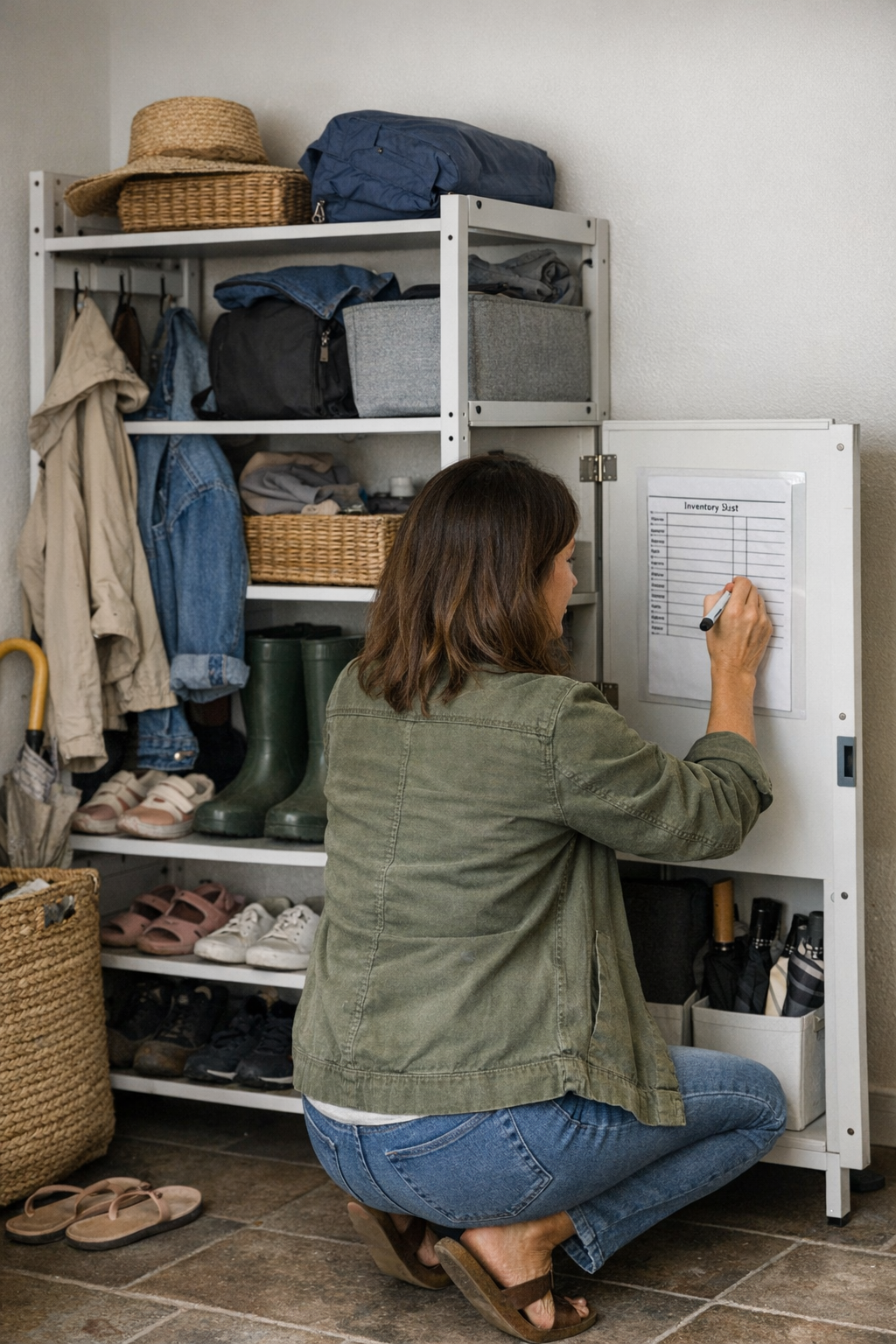
Inventory isn’t a decoration—it’s the daily difference between visible order and gradual entropy. Pin a list to the back of a cabinet, hang it next to hooks, or mount it within arm’s reach of the bench. When each bag or shoe comes and goes, jot an update. No item moves in or out without a glance at the tally. You see crowding as it happens—if the glove count is off, or the shoe row overflows, you fix it then, not after weeks of drift. This practiced friction—brief but frequent—catches clutter before it settles in, shrinking the reset burden and making crowding visible while it’s still easy to fix.
The First Month: Real Contrast Between Passive and Active Zones
After a few weeks, the split is clear. The entryway without tracking feels calm until a drawer reveals three mismatched mittens and two outgrown sneakers buried under newer pairs. The setup with a live, visible list looks blunt, but there are no mysteries: every extra umbrella, every lost glove, sparks a small reset before things get out of hand. Instead of gradual backlogs and Saturday marathon cleanups, you get five-second checks and fast corrections. Activity pushes problems into daylight, not deep storage.
Real-World Routine: Using the List in Both Directions
The inventory only works if it’s in your face—right where shoes are pulled off or bags dropped. The best spot is wherever hands go first: inside a busy cabinet, next to a sitting bench, or even mounted to the side of a utility shelf inside the door. Visibility beats appearance if it stops buildup at the source. Each coming or going doubles as a tiny reset moment—if the zone is crowded, something leaves; if space opens up, nothing gets hidden. This replaces the wait for a big, infrequent reset with steady, two-way flow.
Tip: Laminate for Lifespan
Slipping a laminated or dry-erase sheet onto your chosen spot keeps updating frictionless. A cheap marker hangs on a hook—one quick note for every item added or subtracted. The habit replaces wishful “mental accounting” with something everyone sees and uses, making misplaced and duplicate items rare even for busy families or shared entryways. Over time, this detail saves both money (no more duplicate buying) and movement (no more daily shuffle to find what’s missing).
Avoiding the Return to Backlog Staging
When seasons swap—cold to warm or dry to muddy—visible inventory is what stops the drop zone from swallowing up both summer hats and winter boots. Instead of deep-bin rummaging or panic shopping, everything is kept current to what the threshold actually sees. Less stagnation means quicker resets, open floor, and an entryway that stays a launch point, not a bottleneck. Overflow gets caught before it spreads, and fewer misplaced items mean every pass-through stays easier for real-life use.
When to Reset, Where to Place the List
The habit to aim for: check the list both coming and going. This catches overflow creeping back, keeps bins from going ignored, and trims back crowding before it explodes. Place the list right at eye-hand level where people naturally pause—inside the main cabinet door, next to the wall hooks, or even taped beneath the bench lid. The goal isn’t a perfect-looking note, but a list that’s obvious enough to interrupt buildup as it happens, not after it’s too late.
When Storage Looks Clean but Interrupts the Routine
Entryway storage that reads “finished” or “organized” is only a win if it keeps pace with actual routines. The difference isn’t design or decor—it’s whether the system calls out what doesn’t belong and makes it easy to clear. When drop-off points pile up, shoe rows spread too wide, and paths tighten each week, the friction signals a system lagging real life. An active inventory habit turns resets quick, return flows smooth, and makes accidental repurchase less likely—removing pressure at the door, not just hiding it behind closed bins.
See more practical transition-space storage solutions at Betweenry.