
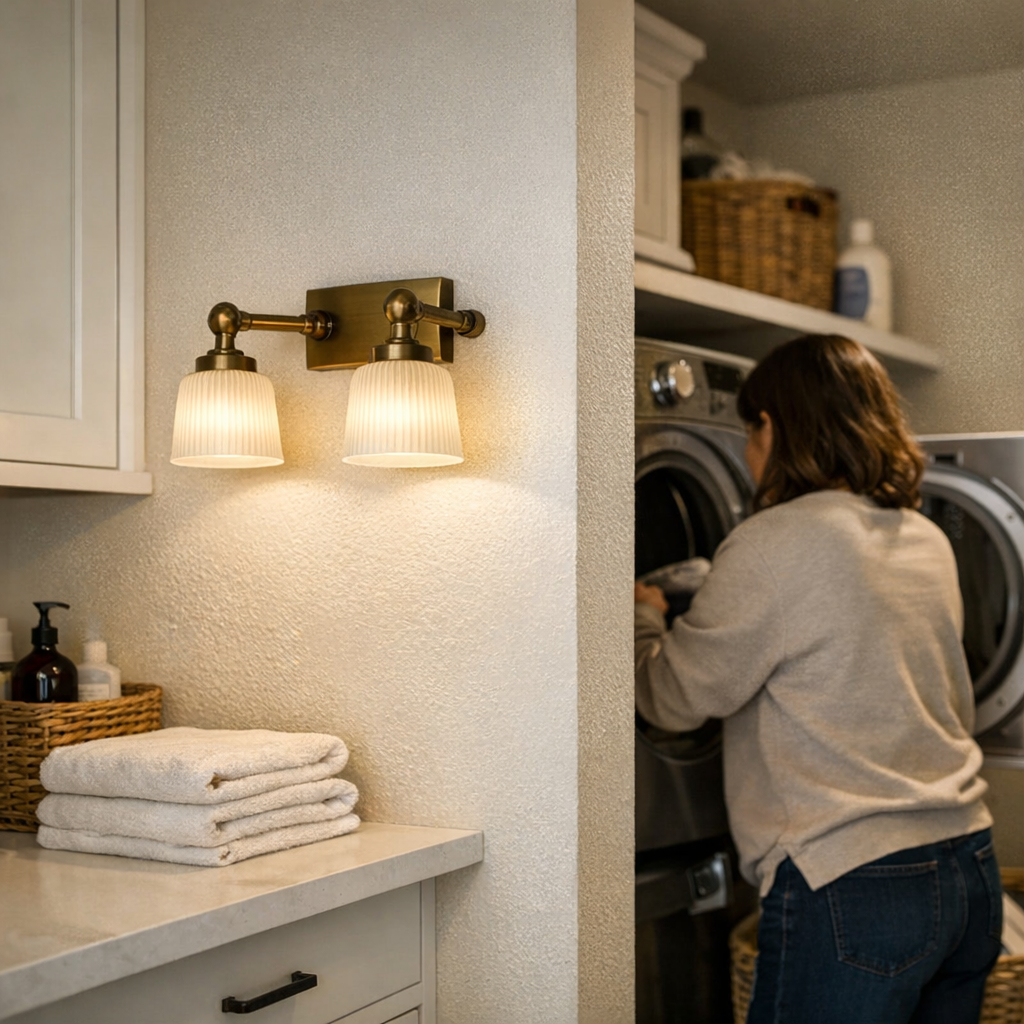
Bright doesn’t always mean right—especially in a hallway, laundry, or bathroom where you actually move, reach, and work. The fixture overhead can shine strong on install day, but after a week of real use, the weak points show up: a shadow slicing across the laundry counter just as you grab detergent, or an overhead glare that forces you to squint each morning at the mirror. This is the kind of lighting inconvenience that slips in slowly, shifting the room from “finished” to “frustrating” with every new routine.
The Overlooked Reality: Lighting Alignment vs. Just “Looking Bright”
A well-lit room on paper isn’t always usable in practice. It’s not just about the wattage, or the first impression under fresh paint—alignment and structural fit decide if light stays steady, or if a cabinet edge fades into shadow right when you need to see. A flush mount or hardwired wall light may seem to handle the load, but if the alignment slips and trims don’t seal cleanly, localized shadows and edge glare quietly sabotage key spots: the folding station, the hallway turn, the sink run.
“Lit up” means nothing if the light misses where you live and work. Any fixture looks flawless when first mounted, but within a month, base sag and lens drift can create dim pockets that no one warned you about—right where you search for socks or scan the mirror for a breakfast crumb. That gap between first-glance and lived-through is where real lighting problems start collecting.
Assembly Choices: Floor Pre-Assembly vs. Overhead Piece-by-Piece
Every proper install comes with a choice: fully assemble the fixture on the floor, aligning trims and sealing lenses before you climb, or risk building it overhead, one screw and shield at a time, while you balance on a ladder. The stakes are higher than just speed. Pre-assembly on a stable surface locks in structure, making sure your lighting holds its shape after weeks of use, steam, door slams, or vibrations—not just during the first walk-through.
When Overhead Assembly Starts Letting You Down
The typical approach is to wire and build directly overhead, prioritizing safety and connection over every other factor. But with a shaky base, dropped screws, or forced alignments, trims pull off true, lenses skew, and small errors multiply. At first, it just feels a bit off. In a few weeks, you notice:
- Shadow bands fall in odd directions as a semi-flush tilts with each door close.
- Mirror faces turn uneven—one side washed out in glare, the other falling into shadow from a pulled trim.
- The subtle but escalating rattle from a laundry ceiling light displaced by spin-cycle vibrations.
The Hidden Win of Floor Pre-Assembly
Spending the extra moments to align and seal every part on the floor pays off every day. The fixture arrives overhead with structure held firm—trims locked, lenses even, every angle checked. In squeezed quarters—a low-ceilinged bathroom, a narrow hallway, a laundry boxed next to a utility sink—this discipline shows: the beam lands where it should, not halfway down the wall or lost behind a cabinet run. Glare patches and creeping shadow are kept in check before they can interrupt your routine.
Lighting Scenes That Reveal the Difference
Hallways: When a Simple Trip Turns Annoying
Imagine the routine: a long hallway with one central flush-mount. As weeks pass, a fixture assembled overhead can slip—just half an inch, just enough that a shadow line now traces your regular path. You find yourself stepping left at night, adjusting a coat, pacing around the unpredictable shadow. The flaw is subtle but persistent, multiplying every time you walk through.
By contrast, a floor-aligned fixture stays where it’s meant to—beam straight, shadow minimized. Movement feels natural. Every corridor step lands in clear, even light. Lighting becomes invisible, which is exactly how you want it when half-awake or carrying laundry baskets at 6am.
Laundry Room: Rattles and Dark Corners No One Warns You About
Small rooms punish shortcuts. Overhead-assembled fixtures leave room for error—a trim just loose enough to vibrate, a lens angled to make the dryer’s edge dim. You shrug it off until the spin cycle, when the rattle gets louder and the far corner stays murky no matter how many times you wipe the lens. Those dark pockets aren’t “character.” They’re unforced errors, born of rushing what needed still hands and a flat surface.
Pre-assembly closes the gap: all screws tight, all shapes checked. The fixture holds its place. Covers stay silent, no matter how many cycles you run. Even after weeks of slam-shut cabinets and steamy utility loads, the beam remains even and the rattle never starts.
Bathroom: From Glare Patches to Even Mirror Light
Bathroom lighting doesn’t just fail in the dark—it fails with glare, shadow imbalance, or moisture drifting inside a loose-fitting lens. The real cringe isn’t bad style, it’s the moment you shave or do makeup and realize one cheek’s in spotlight glare while the other is lost to a dim patch. That unevenness traces back to how the fixture was mounted—misaligned on a ladder, rushed to finish before steam fogs the glass.
Pre-assembled vanities and sconces press flat and tight, holding their shape and keeping moisture sealed out. Mirror light is even, side to side—no guessing, no squinting, no realignment needed after the third shampoo bottle knocks the fixture. Every face wash and morning check is clearer, simpler, and less interruptive.
Why Pre-Assembly Pays Off Again and Again
Floor pre-assembly isn’t about saving time on day one—it’s about saving hassle every time you use the room. Error-proof trims block future shadow creep and stop covers from buzzing loose just as you step onto a damp floor or fill a laundry basket. You shouldn’t need a ladder for routine life. Lighting should stay quiet, even, and securely out of the way, month after month, not just barely holding on through week three.
- Long-term stability—spend more time using, less time re-tightening trims or adjusting coverage.
- True task clarity—no glare, no shadow at the counter or mirror where you need visibility most.
- Better resilience in wet rooms—tighter seals, less dust and steam intrusion, function preserved between cleanings.
A Real Tip for Busy Spaces
For any area that sees daily movement and occasional humidity—think laundry, bathrooms, busy stairwells—give yourself margin: pre-assemble every major part at floor level, in daylight if you can. Align the trims, set the lens, test the fit before you even pull out the stepstool. Ten minutes spent here spares you hours of future glare-fighting, trim-tightening, or battling with a fixture that never quite centers itself above the mess. That’s how you avoid the slow slide from “looks bright” to “feels off.”
The Difference Week to Week
The mark of good lighting isn’t how a room looks the next day; it’s how naturally your movement, routines, and sightlines hold up week after week. Floor pre-assembly makes it less likely you’ll ever catch a shadow swallowing the hallway’s end, squint against glare at the sink, or tiptoe around a laundry dark spot. Instead, the light stays quietly reliable—the signal of a fixture whose only job is to let you work, move, and see clearly whenever you return.